

Meta & Facebook Ads
3 min read

Somewhere in the Meta Ad Library right now there's an ad in your category that's been running for 6 weeks. Nobody keeps funding a loser for 6 weeks, so that ad is a free lesson in what your market actually clicks.
This is how the reference path of the Vibelets MCP turns that lesson into your own ad set inside Claude. Everything below comes from a real teardown we ran while writing this, and it takes about 4 minutes to repeat. Setup, if you're not connected yet, is 1 minute.
Key takeaways
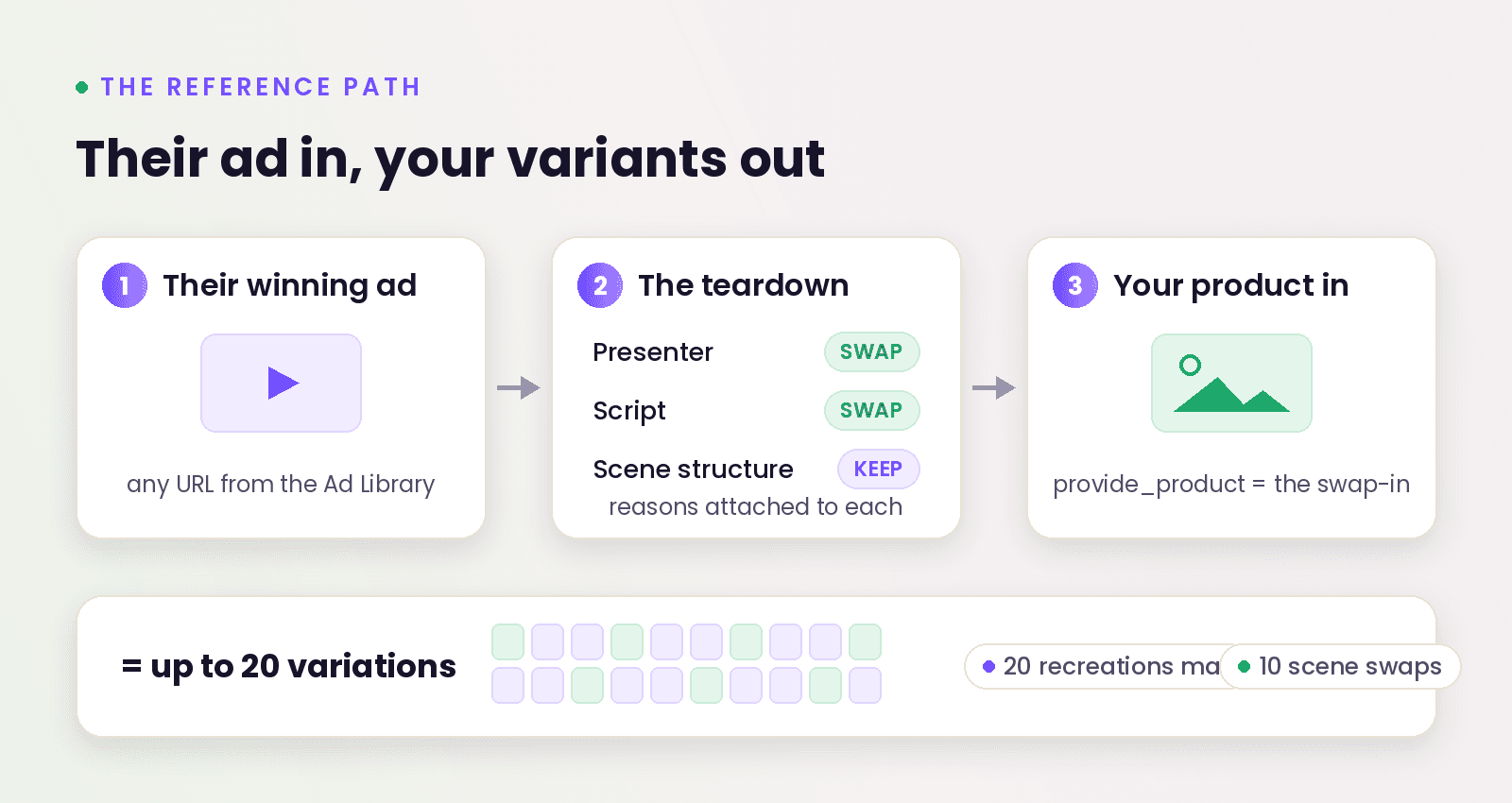
Hand Claude any ad URL and the Vibelets MCP returns a teardown: what the ad is doing, plus the change dimensions that are eligible to swap, each with a reason attached.
Whatever the teardown doesn't offer to change is what it keeps. The load-bearing structure survives, your product and presenter go in.
On the reference path, provide_product means swap my product in. Reference first, product second, or you get a fresh build instead of a recreation.
Recreations fan out to 20 variations, scene swaps to 10, and selecting several hooks produces 1 video per hook.
What the reference path does
It reverse-engineers a working ad so you can rebuild it around your product. You give Claude a URL, the connector runs an async analysis, and back comes creative intelligence plus a list of eligible changes with the reasoning attached to each one.
The mechanic: you declare which eligible dimensions you're changing. Everything you don't declare, and everything the teardown never offers, stays exactly as the reference had it.
A real teardown, line by line
We pointed it at a UGC style ad while writing this post. The analysis came back with the opening hook transcribed, and it's a classic of the genre:
"Alright, so I've been using this for three weeks straight and I need to talk about it."The transcribed opening hook from our reference teardown
It also read the craft: 9:16 selfie framing at arm's length, direct daylight, a single continuous take, ungraded footage, and delivery pacing measured at 223 words per minute. That last number is the kind of thing you'd never clock by eye, and it's exactly what makes a recreation feel like the original.
Then the change list: hook (a hook was detected), avatar (a presenter is on screen), product (a product is featured), and script (spoken narration was detected). The backyard setting and the single-take structure weren't offered, which means they're the keep.
The swap-in rule
1 rule decides whether you get a recreation or an accident: on a reference source, provide_product stores your product as the swap-in, not as a new brief. Hand over the reference first and your product second. Do it the other way around and you've quietly started a fresh build.
From there it's declaring changes, casting, and writing, with the avatar catalog ranked against the original presenter so a like-for-like face takes 1 tap. Recreations cap at 20 variations, scene swaps at 10, and several hooks means 1 video per hook.
Run your first teardown today
Connect the MCP in under a minute, then point it at the longest-running ad in your category.
2 prompts to paste
Competitor teardown to variants
Here's a competitor ad: [URL]. Analyze it, show me which change dimensions are eligible and why, then swap in my product: [PRODUCT URL]. Recommend what to change before you change anything.
Scale your own winner
This is my best performing ad: [URL]. Recreate it with 3 different presenters and 3 different hooks, keeping the scene structure identical. The hooks should test different angles, not 3 versions of the same one.
Conclusion
Competitor research used to end in a swipe file. Now it ends in production: the teardown tells you what's carrying the ad, you keep that, and your product rides a structure the market already voted for. Find 1 ad with staying power and run it through.
FAQ
In the Meta Ad Library. Filter by country and category, then look for ads that have stayed active for weeks. Sustained spend is the signal, since nobody funds a loser for a month.
Yes, and it's the highest-confidence version of this play. Feed it your proven ad, keep the scene structure, and swap presenters and hooks to refresh it before fatigue sets in.
Generation is the credited step. Analysis and planning are where you should linger: read the change list and the review_plan snapshot before you commit, because a 20 variant run is 20 generations.
Reference analysis is an async job. Claude polls in windows of roughly 2 minutes and re-checks until it reports ready; the teardown in this post landed on the 2nd poll. A pause is expected behaviour, not a failure.
Sources
Meta Ad Library, for sourcing reference creatives with sustained spend
Model Context Protocol specification, for how MCP servers and clients connect
Make ads that sell
your Products.
Generate on-brand product ads in minutes, no designer or brief required.
Trusted by 400+ growing brands