

Meta & Facebook Ads
12 min read

Analysis packs tell you which ad won. These 8 free Claude skills for Meta ad creatives make the next one: competitor teardowns in, shootable scripts and designer-ready briefs out, with a testing matrix that knows the learning-phase math.
The pack closes the loop with our 10-skill Meta ads pack. That pack's creative-fatigue-scanner diagnoses a dying winner and writes the iteration brief. This pack turns that brief into the actual scripts, storyboards, and static specs, named so the whole system can read the results.
A creator with a good script beats a studio with a bad one.
Key takeaways
Production beats ideas: every skill outputs at execution fidelity (a timed shootable script, a designer-ready spec, a staged test campaign), not a list of concepts to figure out later
Creative tests are judged on attention, never 3-day CPA: 3 hooks × 2 formats at 2,000+ impressions per cell, read on hook rate (30%+), hold rate (25%+), and link CTR (1.0%+); conversion verdicts stay with the Meta ads pack after the learning phase
Iteration locks what won: the KEEP list is a contract, all 5 variants change exactly 1 variable each, and a fatigue refresh never changes the angle, because audiences tire of the execution, not the argument
Compliance runs before launch, with rewrites: personal-attribute callouts, before/after implications, and unprovable claims get caught with the exact fix. A rejected ad costs a day; a restricted account costs the quarter
Honesty is structural: UGC scripts never fabricate customer experience, claims trace to real reviews, and teardowns extract patterns, never clones
Who does what: this pack vs the Meta ads pack
The 2 packs share a seam, and the boundary is deliberate so they never contradict each other.
The job | Meta ads pack (#1) | This pack |
|---|---|---|
Text-only ad copy (primary text, headlines) | hook-and-copy-writer | |
Video scripts, statics, carousels | ugc-script-writer, static-ad-brief, carousel-storyboard | |
Diagnosing a fading creative | creative-fatigue-scanner | |
Producing its replacements | winner-iteration-engine | |
Conversion verdicts (scale/hold/kill), after learning | scale-hold-kill-verdict | |
Attention verdicts (which hook wins), at kill-fast budgets | hook-testing-matrix |
Different metrics, different timescales, zero contradiction: the matrix picks which creatives earn a conversion-budget slot, and the Meta ads pack judges them there.
The prerequisite: mostly none
Paste-first by design
Stages 1, 2, and 4 run on what you paste (competitor ads, briefs, pages) plus Claude's web access. No connector required.
Optional live mode
hook-testing-matrix can stage the test campaign PAUSED through the official Meta Ads MCP connector from pack #1; paste mode outputs the same plan as a build sheet.
The naming convention
[product]-[angle]-[hook#]-[format]-[v#], e.g. serum-mechanism-h3-ugc-v1. It extends pack #1's campaign naming down to the creative level, which is what lets the fatigue scanner and winner finder read results by angle and hook automatically.
STAGE 1 OF 4
Deconstruct: patterns in, gaps out
01 · ad-library-teardownfree skill
Competitors' longest-running ads are paid-for market research
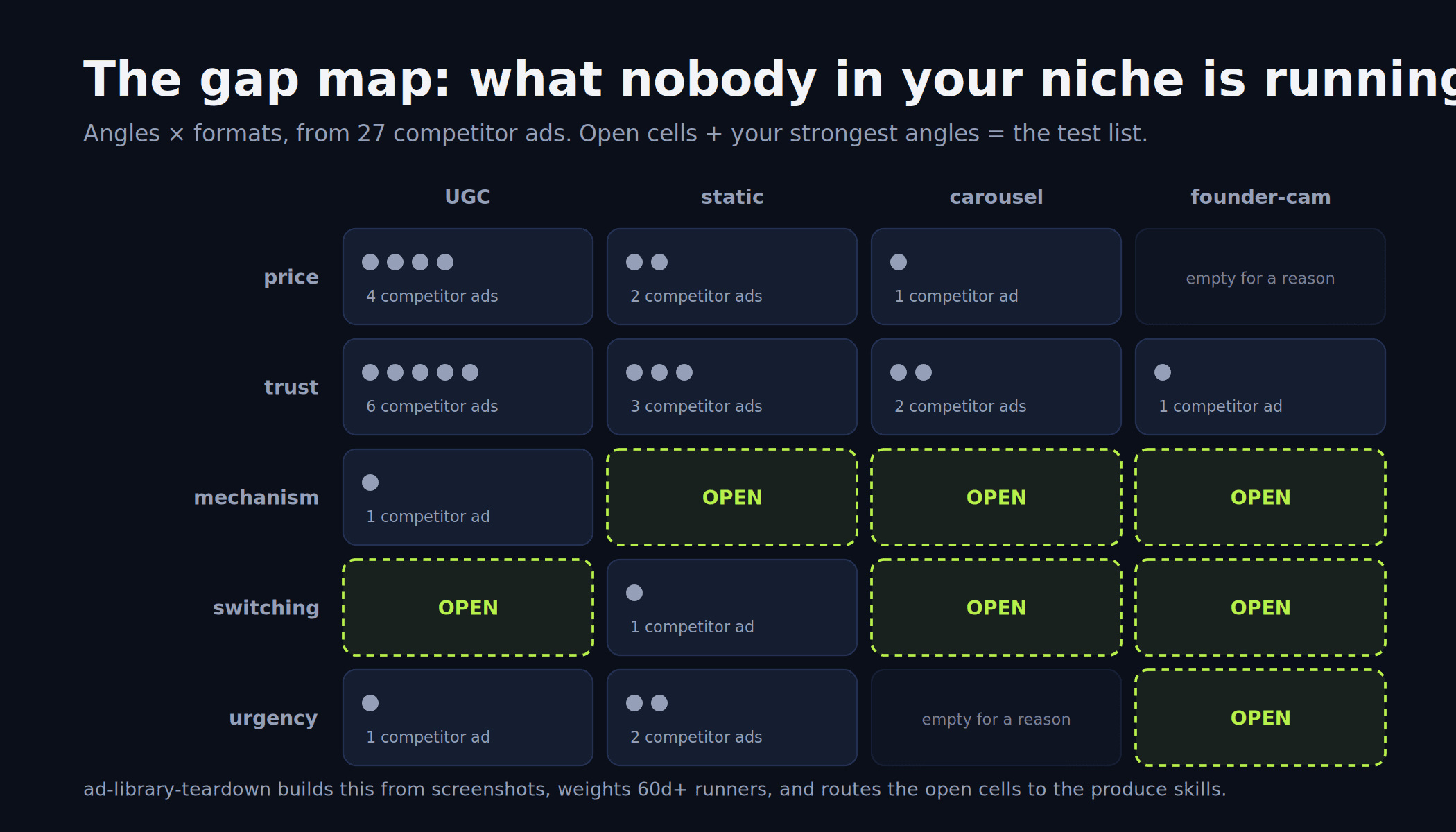
This skill takes 5+ ads per competitor from the public Meta Ad Library (searchable by brand, no login) and extracts per ad: the hook (verbatim, then classified), the angle (which objection it answers), the format, the offer, and the proof type. Ads running 60+ days are presumed working and weighted accordingly; below 5 ads, every observation carries a [thin sample] tag.
The actual deliverable is the gap map: an angles by formats grid marked with who occupies each cell and the longevity evidence. Empty cells crossed against your product's strongest angles become the test list, and the skill says when a cell is empty because it doesn't work, not just empty. Every pattern claim carries its count ("6 of 9 ads open on a data hook"), never vibes.
SAY THIS TO CLAUDE
> Here are 9 screenshots of [competitor]'s ads from the Ad Library, with start dates. Tear them down and map the gaps.Cadence: before a new campaign, then quarterly · Mode: paste-first, 5+ ads per competitor02 · landing-page-message-matchfree skill
Good CTR with bad CPA usually isn't an ad problem; it's a broken promise
The ad sells one thing and the page greets the click with another. This skill restates the ad's promise in 1 line, fetches the page, and scores 5 checks from 0 to 2: headline echo, offer consistency, proof carry-through, visual continuity, and audience continuity. 8+ out of 10 ships; 5 to 7 fixes the listed breaks first; under 5 means the pair is burning clicks regardless of ad metrics.
Every break comes with both fixes priced: the cheaper page-side fix and the ad-side alternative, because sometimes the ad over-promised and rewriting it is cheaper than rebuilding the page. It audits the mobile rendering by default, and it never recommends adding page claims the product can't support. The ad loses that argument.
SAY THIS TO CLAUDE
> CTR is 1.4% but CPA is awful. Here's the ad and the landing page: score the message match.Cadence: before any new angle; whenever CTR is healthy but CPA is bad · Mode: ad + page URL, fetched liveSTAGE 2 OF 4
Produce: scripts and briefs a stranger could execute
03 · ugc-script-writerfree skill
A script someone can shoot on a phone this afternoon
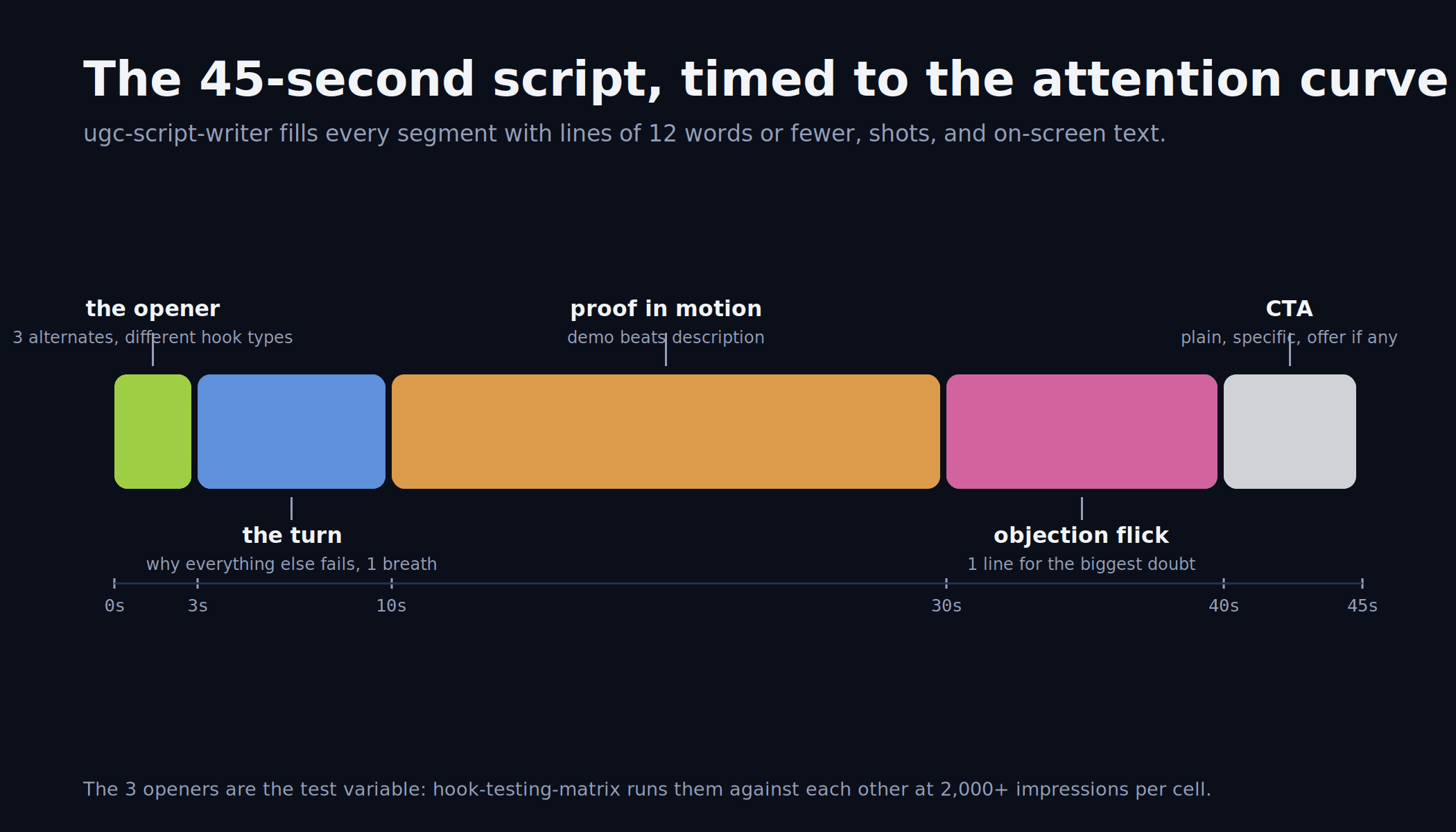
One angle in, a timed 30 to 45 second script out: spoken lines of 12 words or fewer, the shot list, on-screen text, and creator notes down to what not to say. The anatomy is fixed to the attention curve: a 3-second opener written as 3 alternates of different hook types (they're the test variable), the turn by second 10, proof in motion through second 30 (demo beats description), 1 objection flick, then a plain CTA.
The honesty rules are structural. Lines are creator-voiced opinion or sourced from real reviews, quoted back to you. The skill never scripts fabricated experience claims; it writes "here's why I switched" framings instead, flags disclosure norms for paid partnerships, and cuts unprovable lines rather than softening them.
SAY THIS TO CLAUDE
> Write a UGC script for angle #2 (the mechanism angle). Here are 4 real reviews to pull claims from.Cadence: per angle you shoot · Mode: pasted angle + reviews, no connector04 · static-ad-brieffree skill
A static has one job: stop the scroll and land one idea before the thumb moves
This skill writes the brief a designer (or an AI image tool) can execute without a single follow-up question: the one idea in a single sentence, the visual concept written so 2 different designers would produce recognizably the same ad, overlay copy (headline of 6 words or fewer doing the hook's job), a layout map with safe zones, and the proof element with its verbatim source.
Every angle gets 3 variants by mechanism: product-forward, outcome-forward, and proof-forward, where the review or number is the visual. Specs ship in the brief (1:1 and 4:5 minimum, thumbnail legibility test: read the headline at 150px wide or shrink it), and if the angle's proof is weak, the skill says the static should wait, because statics can't demo their way past missing evidence the way video can.
SAY THIS TO CLAUDE
> Brief me a static for the objection-flip angle. Brand palette attached.Cadence: per angle you design · Mode: pasted angle + brand notes05 · carousel-storyboardfree skill
Carousels earn the swipe or die on card 1
This skill storyboards the arc from 3 templates chosen by angle type: problem-mechanism-proof-offer for mechanism angles, the list for social-proof angles, or the catalog line-up for multi-product, ordered by product-winner-finder's contribution ranking when available and flagged when the card order contradicts it.
The card rules are strict: card 1 must work as a standalone static, cards 2+ open with a visual continuation cue that prompts the swipe, 1 idea and 12 or fewer overlay words per card, the last card carries the ask, and 7 cards means 2 carousels. The storyboard always states what a viewer who never swipes takes away from card 1 alone, because most never do.
SAY THIS TO CLAUDE
> Storyboard a carousel for the 5-reasons angle across our 3 bestsellers.Cadence: when the story needs a sequence · Mode: pasted angle + productsSTAGE 3 OF 4
Test: 1 variable per axis
06 · hook-testing-matrixfree skill
Testing 5 random ads teaches you nothing; 1 variable at a time teaches you what to make forever
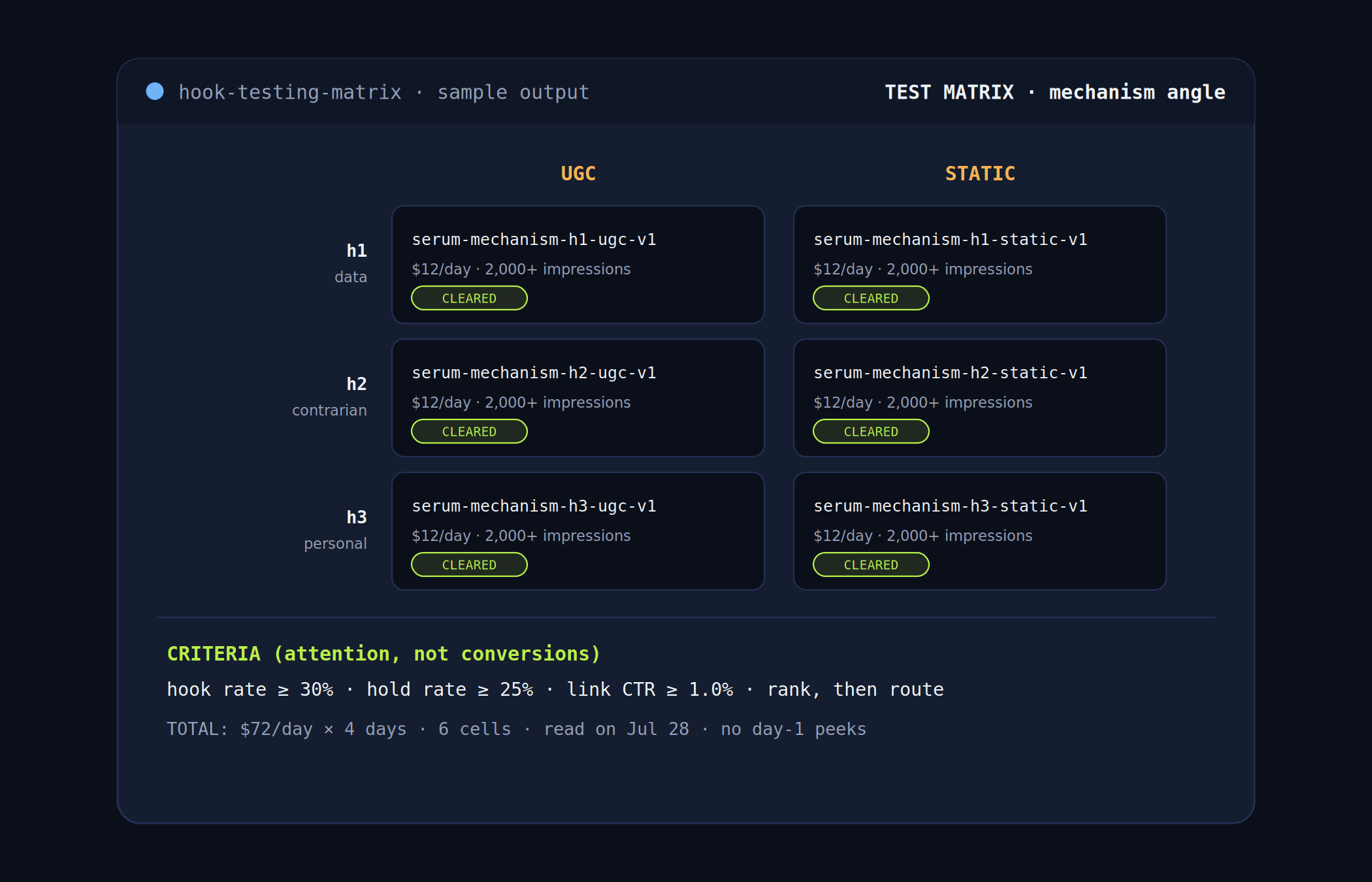
The default matrix is 3 hooks by 2 formats with the angle held constant: 6 cells, every cell answering a question. Cell budget buys at least 2,000 impressions before judging (roughly 2x your CPM, computed with your account's actual number), all cells launch simultaneously in 1 test campaign over 3 to 5 days, and no asset enters a cell without a CLEARED compliance verdict, because a rejected test ad wastes the whole cell's window.
The success criteria are attention metrics, and the skill says this twice: hook rate 30%+, hold rate 25%+, link CTR 1.0%+ where relative ranking beats the bar. A 3-day test cannot judge CPA, and this skill never claims it can. Winners route to campaign-architect; the winning pattern routes to the iteration engine. And no "quick peek" at day 1 ever kills a cell.
SAY THIS TO CLAUDE
> I have 3 hooks and 2 formats ready. Build the test matrix; test budget is $60/day.Cadence: per creative batch · Mode: live mode stages the test PAUSED; paste mode outputs a build sheetcell floor = 2,000+ impressions ≈ 2 × CPM
pass bars = hook ≥ 30% · hold ≥ 25% · CTR ≥ 1.0%
never judged here → CPA (that's pack #1, after learning exits)STAGE 4 OF 4
Iterate: lock what won, change 1 thing
07 · winner-iteration-enginefree skill
Most iteration fails by accident: the team changes the winning variable without knowing it
This skill autopsies the winner into angle, hook, format, opener visual, proof, offer, and CTA, marks each KEEP or VARIABLE from the evidence, and prints the KEEP list at the top as a contract. Then 5 variants, 1 variable each: new hook, new format, new opener visual, new proof element, new CTA framing. A variant that changes 2 things gets rejected and rewritten.
The outputs are production assets, not sketches: video variants ship as full UGC scripts, statics as full briefs. Two honesty gates: a winner with under 2,000 impressions is an unconfirmed win and routes to the matrix, not a refresh; and a fatigue refresh never changes the angle. Direct refreshes into a live ad set get the learning-reset warning first, priced via pack #1's edit-impact check and batched into 1 pass, never a drip.
SAY THIS TO CLAUDE
> This ad is fatiguing after 6 weeks. Here's the iteration brief from the fatigue scanner: build the 5 variants.Cadence: when a winner fatigues or a test crowns a pattern · Mode: paste the winner or the fatigue brief08 · creative-compliance-checkfree skill
A rejected ad costs a day; a restricted account costs the quarter
This skill walks every creative (and the landing page it points to, because Meta reviews the pair) through 7 checks: personal-attribute callouts ("your acne" becomes "stubborn acne"), before/after and implied-results patterns (an opener shot of the before state counts), unprovable claims (every superlative gets its source named or gets cut), restricted-category rules, brand and IP hygiene, spec and rendering, and the landing-page pair.
Every flag ships with the exact rewrite, because a compliance check that only says no gets ignored by Friday. The verdict is CLEARED, CLEARED AFTER FIXES, or HOLD. Two hard lines: this is pattern-level guidance from Meta's published policies, not legal advice; and it never suggests evasion tactics, because those convert a rejection risk into an account risk.
SAY THIS TO CLAUDE
> Check this UGC script and its landing page before I send it to the creator.Cadence: on every asset, before launch · Mode: paste the script or brief + the landing page
One naming convention, three packs
🏷️[product]-[angle]-[hook#]-[format]-[v#]
It extends pack #1's campaign naming down to the creative level. That's what lets creative-fatigue-scanner read which hook is dying and product-winner-finder read which angle prints, automatically, with no spreadsheet in between. Adopt it even if you adopt nothing else.
The guardrails every skill follows
UGC scripts are scripted content: never fabricated "real customer" testimonials, with claims and quotes from actual reviews or written as clearly creator-voiced opinion, and disclosure norms flagged for paid partnerships. Teardowns extract patterns and gaps, never instructions to reproduce a competitor's ad, brand assets, or trademarked lines. Every produced asset passes the compliance check before launch. And anything that touches the ad account is created PAUSED and executed only on your explicit approval.
Setup in 5 minutes
1
Gather raw material, no connector needed
Open the Meta Ad Library, screenshot 5+ ads per competitor with their start dates, and have your angle map or fatigue brief ready.
2
Install the skills
On claude.ai or desktop: Settings → Capabilities → Skills, upload the pack (grab it free from the pack folder; see Anthropic's skills repository for how uploads work). In Claude Code: copy the folders into ~/.claude/skills/.
3
Run the loop in order
Teardown first, produce second, test third, iterate forever. Each skill names the next one in its output.
Frequently asked questions
Do I need the Meta ads pack for this one to work?
No, the production skills run standalone on pasted material. The interlocks are optional but strong: the fatigue scanner's briefs feed the iteration engine, the matrix can stage tests through pack #1's connector, and conversion verdicts on the winners belong to pack #1 after the learning phase.
Do these skills make the actual images and videos?
No, they produce at brief fidelity: shootable scripts, designer-ready specs, and card-by-card storyboards precise enough that 2 different designers would make recognizably the same ad. A creator, designer, or AI image tool executes them. Vibelets, the product, generates the finished creatives end to end.
How do I get competitor ads into the teardown?
The Meta Ad Library is public and searchable by brand with no login. Screenshot the ads with their start dates and paste them in: 5+ per competitor for pattern claims, and ads running 60+ days get weighted as presumed working. Below 5 ads, everything carries a [thin sample] tag.
Why judge creative tests on hook rate instead of ROAS?
Because a 3 to 5 day test at kill-fast budgets cannot judge CPA, and pretending it can kills good creatives. Attention metrics decide which creatives earn a conversion-budget slot; the scale/hold/kill verdict then judges them on conversions after the learning phase exits.
Are UGC scripts allowed to sound like testimonials?
They're allowed to sound like a person, not to fabricate one. Lines are creator-voiced opinion or quotes pulled from real reviews (shown to you with their source), never invented experience claims, and the skill flags disclosure norms whenever the content is a paid partnership.
Will these ads pass Meta review?
The compliance check catches the common rejection patterns and ships the exact rewrite for each flag. It's pattern-level guidance from Meta's published policies, not legal advice, restricted categories may need professional review, and it never suggests evasion tactics, because those convert a rejection risk into an account risk.
Sources
Meta Ad Library (public competitor ad archive): https://www.facebook.com/ads/library/
Meta Business Help Center, About the Learning Phase: https://www.facebook.com/business/help/112167992830700
Anthropic, Agent Skills overview: https://platform.claude.com/docs/en/agents-and-tools/agent-skills/overview
Anthropic, public skills repository: https://github.com/anthropics/skills
Make ads that sell
your Products.
Generate on-brand product ads in minutes, no designer or brief required.
Trusted by 400+ growing brands