

Meta & Facebook Ads
12 min read

AI video finally makes UGC volume cheap. It also makes a new kind of failure cheap: a six-fingered hand holding your product, a label that melts mid-rotation, a creator who claims 3 months of use and has existed for 3 minutes. These 6 free Claude skills run the whole pipeline, script to shippable video, with the honesty and QC gates built in.
This pack starts exactly where the creative pack ends: that pack writes the shootable script; this one casts the AI creator, converts every beat into generation prompts, decides what must stay real footage, catches the artifacts before spend, and batches the variations for testing.
A viewer who spots the glitch stops trusting the claim. The QC gate exists because performance dies at the first six-fingered hand.
Key takeaways
The creator is generated; the claims are real: personas are cast as creators and disclosed as synthetic, never presented as verified customers, and every product claim still traces to real reviews, exactly like the human-UGC rules
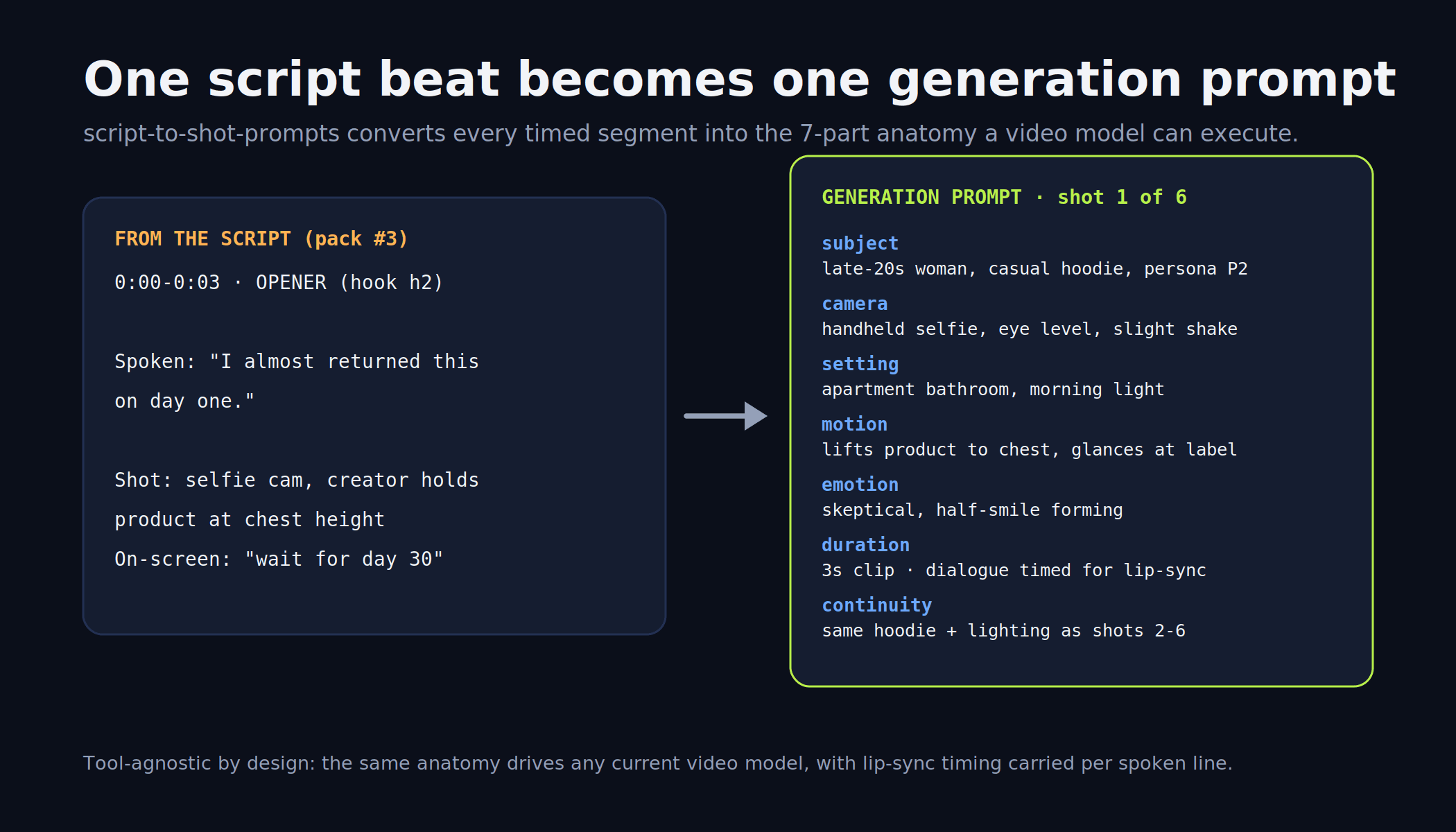
Scripts convert shot by shot, not vibe by vibe: each timed segment becomes a 7-part generation prompt (subject, camera, setting, motion, emotion, duration, continuity) with lip-sync timing carried per spoken line, tool-agnostic by design
Some shots must stay real: product texture, in-hand demos, and anything supporting a results claim get real footage in the hybrid plan, because a generated demo of a real product is a fabricated claim
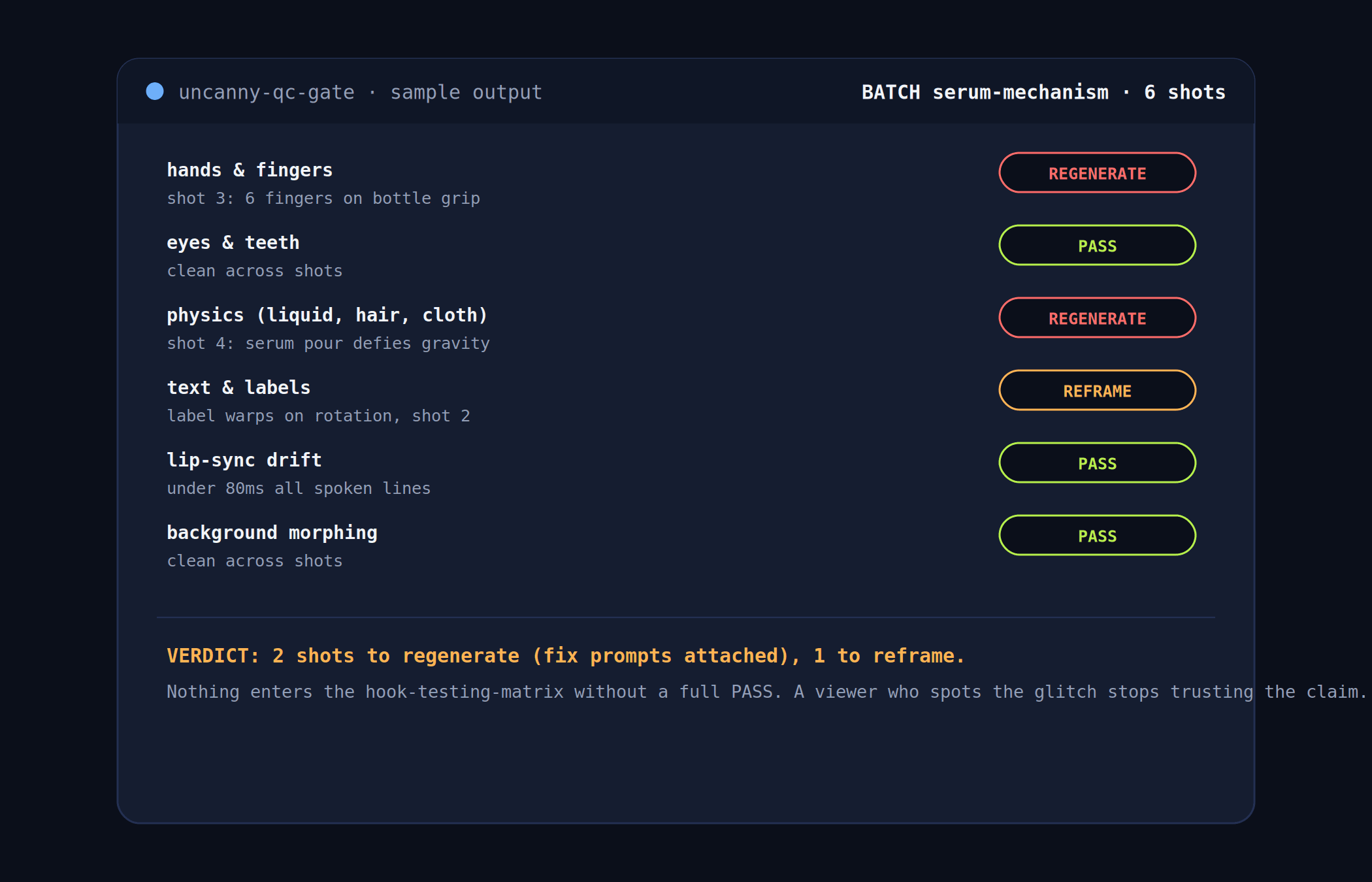
Nothing spends before the 6-point uncanny scan: hands, eyes and teeth, physics, text and labels, lip-sync drift, and background morphing each get PASS, REGENERATE with the fix prompt, or REFRAME
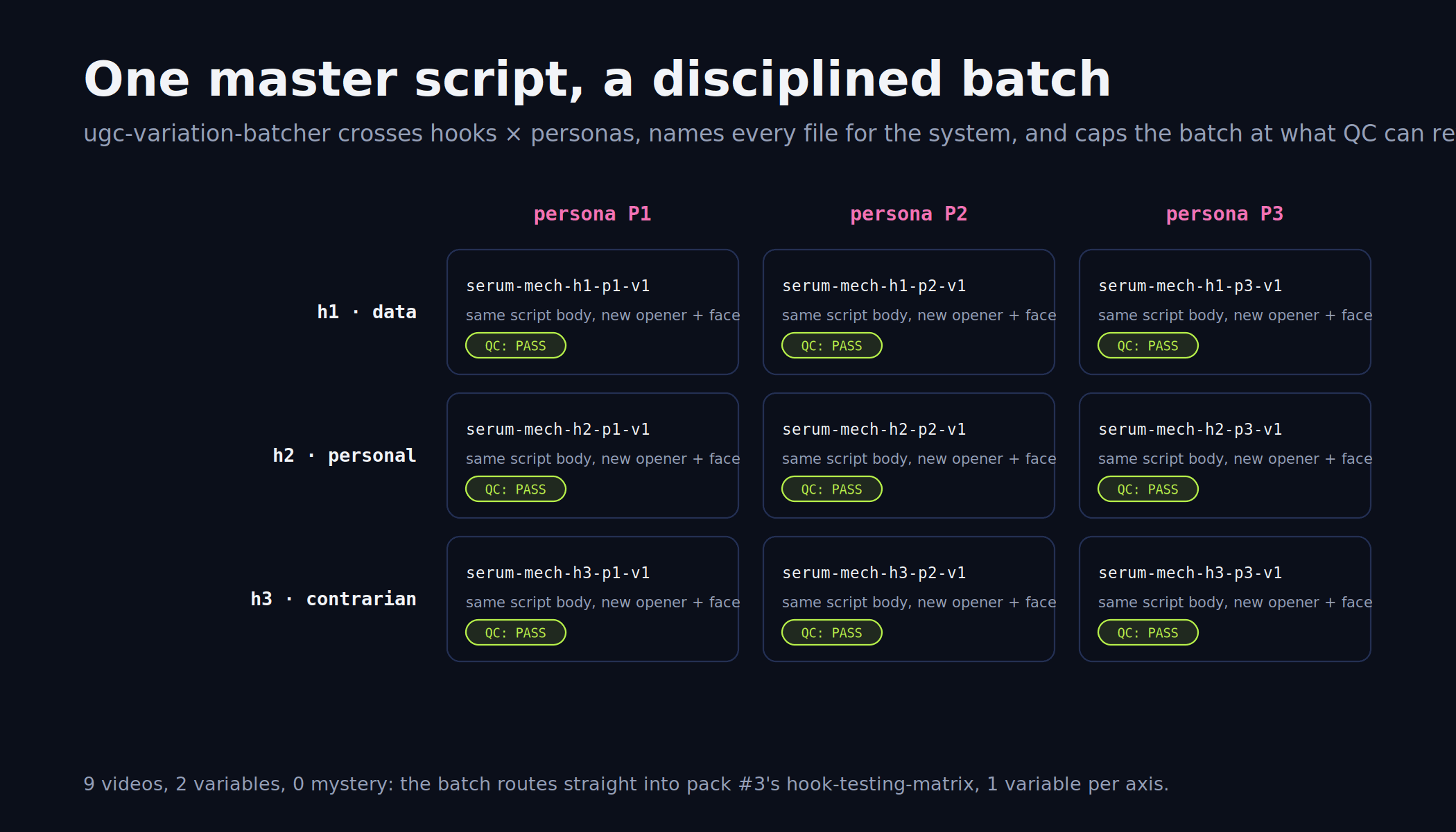
Volume stays disciplined: the batcher crosses hooks by personas from 1 master script, caps the batch at what QC can actually review, and routes everything into the hook-testing-matrix at 1 variable per axis
Human UGC vs AI UGC: what changes, what doesn't
The script anatomy, the honesty bar, and the testing discipline carry over untouched. What changes is the production economics and the failure modes.
Human UGC | AI UGC | |
|---|---|---|
The script | The 45-second anatomy from the creative pack | The same anatomy; nothing changes |
The creator | Booked, briefed, shipped product, 2-week turnaround | Cast once in a persona sheet, consistent forever |
The cost of a variation | A reshoot | A prompt edit |
The failure mode | Flaky creators, off-script reads | Six-fingered hands, melting labels, lip-sync drift |
The honesty bar | Disclosure for paid partnerships | Disclosure that the creator is synthetic; claims still trace to real reviews |
The gate before spend | Compliance check | Compliance check + the 6-point uncanny scan |
The prerequisite: a script and a video tool
A script, from anywhere
The natural input is ugc-script-writer's timed script, but any script with spoken lines and shot intent works pasted in. No script yet? Run the creative pack's loop first; this pack starts where the writing ends.
Tool-agnostic prompts
The 7-part prompt anatomy drives any current AI video model, including lip-sync tools: the skills write the prompts and the continuity notes, you press generate in whichever tool you use. Nothing here is locked to one vendor.
Optional live mode
Finished, QC-passed batches can stage into a PAUSED test campaign through the Meta Ads MCP connector from pack #1; paste mode outputs the same plan as a build sheet.
STAGE 1 OF 4
Cast: the persona is an asset, not an accident
01 · ai-persona-casterfree skill
Random faces make random ads; cast once, reuse forever
This skill builds 2 to 3 creator personas per target audience, each as a reusable persona sheet: age range, look and wardrobe, setting, energy, speech cadence, and the audience mirror logic (the persona resembles the buyer, or the person the buyer trusts). The sheet is the continuity contract: every future prompt references it, so the same face, hoodie, and bathroom light hold across a whole batch and across months of ads.
The honesty rules are structural. A persona is presented as a creator, never as a verified customer: no "I've used this for 3 months" from someone who has existed for 3 minutes. Claims in the persona's mouth come from real reviews (quoted to you with sources) or are framed as creator-voiced opinion, and the skill flags the platform's synthetic-content disclosure norms on every sheet.
SAY THIS TO CLAUDE
> Cast 3 AI creator personas for a skincare brand targeting women 25 to 40. Here's the audience breakdown.Cadence: per audience, then reuse · Mode: runs on pasted audience notes, no connectorSTAGE 2 OF 4
Convert: from script beats to generation prompts
02 · script-to-shot-promptsfree skill
A video model doesn't read scripts; it reads prompts
This skill walks the timed script segment by segment and emits 1 generation prompt per shot in a fixed 7-part anatomy: subject (bound to the persona sheet), camera (handheld selfie, eye level, the UGC grammar), setting, motion, emotion, duration (segments sized to what current models generate cleanly), and continuity notes tying each shot to its neighbors. Spoken lines carry their timing for lip-sync tools, and on-screen text is specified separately so it can be burned in post rather than generated.
The conversion respects the attention curve the script was built on: the 3-second opener gets the most prompt care (3 alternates, matching the script's 3 hook openers), demo beats get motion-first prompts, and any shot the model can't execute honestly gets flagged for the hybrid plan instead of forced.
SAY THIS TO CLAUDE
> Convert this UGC script into shot prompts for persona P2. Lip-sync tool in use, 8-second max clips.Cadence: per script you produce · Mode: paste the script + persona sheet03 · real-vs-generated-plannerfree skill
Some shots are honesty-critical, and those stay real
This skill splits the shot list into 3 buckets: GENERATE (talking-head segments, lifestyle b-roll, ambience), REAL FOOTAGE REQUIRED (macro product texture, in-hand demos, pours and applications, anything a buyer reads as evidence), and COMPOSITE (generated scene, real product plate). The rule that decides the middle bucket is simple: if the shot supports a claim, the shot is the claim, and a generated version of it is a fabricated result.
The output is the hybrid shot plan: which 2 to 4 real clips to capture on a phone in 20 minutes, framed to intercut cleanly with the generated segments (matched light direction, matched grade notes), plus the composite instructions where a real product plate drops into a generated scene. Before/after territory is refused outright, generated or filmed, because the compliance risk doesn't care how the pixels were made.
SAY THIS TO CLAUDE
> Split this shot list: what can I generate and what do I need to film? It's a serum with a visible-texture claim.Cadence: per script, before generation starts · Mode: paste the shot list + the claimsSTAGE 3 OF 4
Gate: the 6-point uncanny scan
04 · uncanny-qc-gatefree skill
Performance dies at the first six-fingered hand
Every generated clip passes the 6-point scan before it can spend: hands and fingers (the classic), eyes and teeth, physics (liquids, hair, cloth obeying gravity), text and labels (warping product packaging is both an artifact and a brand problem), lip-sync drift against the spoken line, and background morphing between frames. The first 3 seconds get double scrutiny, because that's where the viewer decides whether this is a person.
Verdicts are per shot: PASS, REGENERATE with the corrected prompt attached (the fix is usually a prompt fix: fewer fingers in frame, label out of rotation, shorter segment), or REFRAME when the shot should be recut or replaced with real footage instead of re-rolled. Nothing enters the test matrix without a full-batch PASS, and the skill keeps the artifact log so recurring failures teach the prompt library.
SAY THIS TO CLAUDE
> QC this batch of 6 generated clips before I build the test. Screenshots attached, spoken lines included.Cadence: every batch, before any spend · Mode: paste frames or clips + the script
This pack writes the prompts. Vibelets presses generate.
Vibelets runs the whole pipeline as a product: it reads your store, generates the finished AI UGC videos, and stages them to Meta for your approval.
STAGE 4 OF 4
Ship: native polish and disciplined volume
05 · platform-native-finisherfree skill
Generated or filmed, the feed has the same physics
This skill finishes each passed video for the placement: 9:16 with the safe zones respected (nothing critical in the UI-covered edges), burned captions in a consistent style because most of the feed watches muted, the first frame chosen deliberately (it's the thumbnail, and the thumbnail is the hook), sound and VO pacing checked against the segment timing, and the end card carrying the single CTA.
It also runs the tell-check: the small giveaways that read as AI even when no artifact fires: dead-eyed pauses between lines, unnaturally clean audio, missing micro-cuts. The fixes are editorial (a breath, a jump cut, room tone) and they're listed per clip, because native-feeling beats technically-perfect.
SAY THIS TO CLAUDE
> Finish these 4 passed clips for Reels and Stories. Captions in brand style, pick the first frames.Cadence: per passed batch · Mode: paste the clips + placements06 · ugc-variation-batcherfree skill
Volume is only useful if the test can read it
This skill turns 1 master script into a disciplined batch: hooks crossed with personas (openers change, body holds), every file named [product]-[angle]-[hook#]-[persona]-[v#] so the whole system can read results by variable, and the batch capped at what the QC gate can actually review, because 40 unreviewed videos is risk, not volume.
The batch routes straight into the creative pack's hook-testing-matrix at 1 variable per axis, and the readout comes back attributable: which hook won, which persona held attention, which combination earns the conversion-budget slot. Winners feed the iteration engine; the persona sheet and prompt library absorb what worked.
SAY THIS TO CLAUDE
> Batch this master script: 3 hooks by 3 personas. Cap it at what we can QC this week.Cadence: per creative cycle · Mode: paste the script + persona sheets
The guardrails every skill follows
Personas are creators, never fake customers: no fabricated experience claims, claims sourced from real reviews or framed as creator opinion, and synthetic-content disclosure flagged per platform norms on every output. Shots that support claims stay real footage; before/after territory is refused regardless of how it's produced. Every clip clears both the compliance check and the uncanny scan before spend. And anything touching the ad account stages PAUSED for your per-item approval.
Setup in 5 minutes
1
Bring a script and an audience
The creative pack's ugc-script-writer output is the natural input, but any script with spoken lines works. Have your audience notes ready for casting.
2
Install the skills
On claude.ai or desktop: Settings → Capabilities → Skills, upload the pack (grab it free from the pack folder; see Anthropic's skills repository for how uploads work). In Claude Code: copy the folders into ~/.claude/skills/.
3
Run the pipeline in order
Cast, convert, plan the real shots, generate in your tool, gate, finish, batch. Each skill names the next one in its output.
Rather skip the pipeline entirely? Vibelets generates the finished AI UGC end to end: it reads your store, creates the videos, and stages them to Meta for your approval.
Frequently asked questions
Which AI video tools does this work with?
All of the current ones: the 7-part prompt anatomy and continuity notes are tool-agnostic by design, with spoken-line timing carried for lip-sync tools. The skills write the prompts and the QC criteria; you press generate wherever you already work, and nothing in the pack is locked to a vendor.
Is AI-generated UGC even allowed on Meta?
Synthetic creators are workable when they're honest: personas are presented as creators, never as verified customers, synthetic-content disclosure follows platform norms, and every claim traces to a real review or is framed as opinion. The compliance check from the creative pack still runs on every asset, because policy risk doesn't care how the pixels were made.
Do I still need the creative pack?
For the full loop, yes: it writes the scripts this pack converts and runs the hook-testing-matrix this pack feeds. Standalone, this pack works on any pasted script, so you can start here if you already have writing you trust.
Won't the uncanny valley kill performance?
Unreviewed, yes: a viewer who spots a glitch stops trusting the claim in the same second. That's why the 6-point scan gates every clip before spend, the first 3 seconds get double scrutiny, and the finisher runs the tell-check for the softer giveaways. The gate is the difference between AI volume and AI risk.
Can it generate product demos and results?
No, and that's a feature: shots that support claims (texture, in-hand demos, applications, anything resembling results) are routed to real footage or honest composites by the planner, and before/after territory is refused outright. A generated demo of a real product is a fabricated claim wearing good lighting.
How many videos should one batch be?
As many as the QC gate can actually review, and no more: the batcher crosses hooks by personas from 1 master script, names every file for attribution, and caps the count deliberately. 9 reviewed videos beat 40 unreviewed ones, because the test matrix can only learn from variables it can trust.
Sources
Meta Ad Library (public competitor ad archive): https://www.facebook.com/ads/library/
Meta Business Help Center, About the Learning Phase: https://www.facebook.com/business/help/112167992830700
Anthropic, Agent Skills overview: https://platform.claude.com/docs/en/agents-and-tools/agent-skills/overview
Anthropic, public skills repository: https://github.com/anthropics/skills
Make ads that sell
your Products.
Generate on-brand product ads in minutes, no designer or brief required.
Trusted by 400+ growing brands