Most Google Ads accounts have penalised keywords they've never looked at. Not
because the advertiser doesn't care — but because Quality Score is buried in a
column most people don't check, and its impact is invisible until you do the
maths.
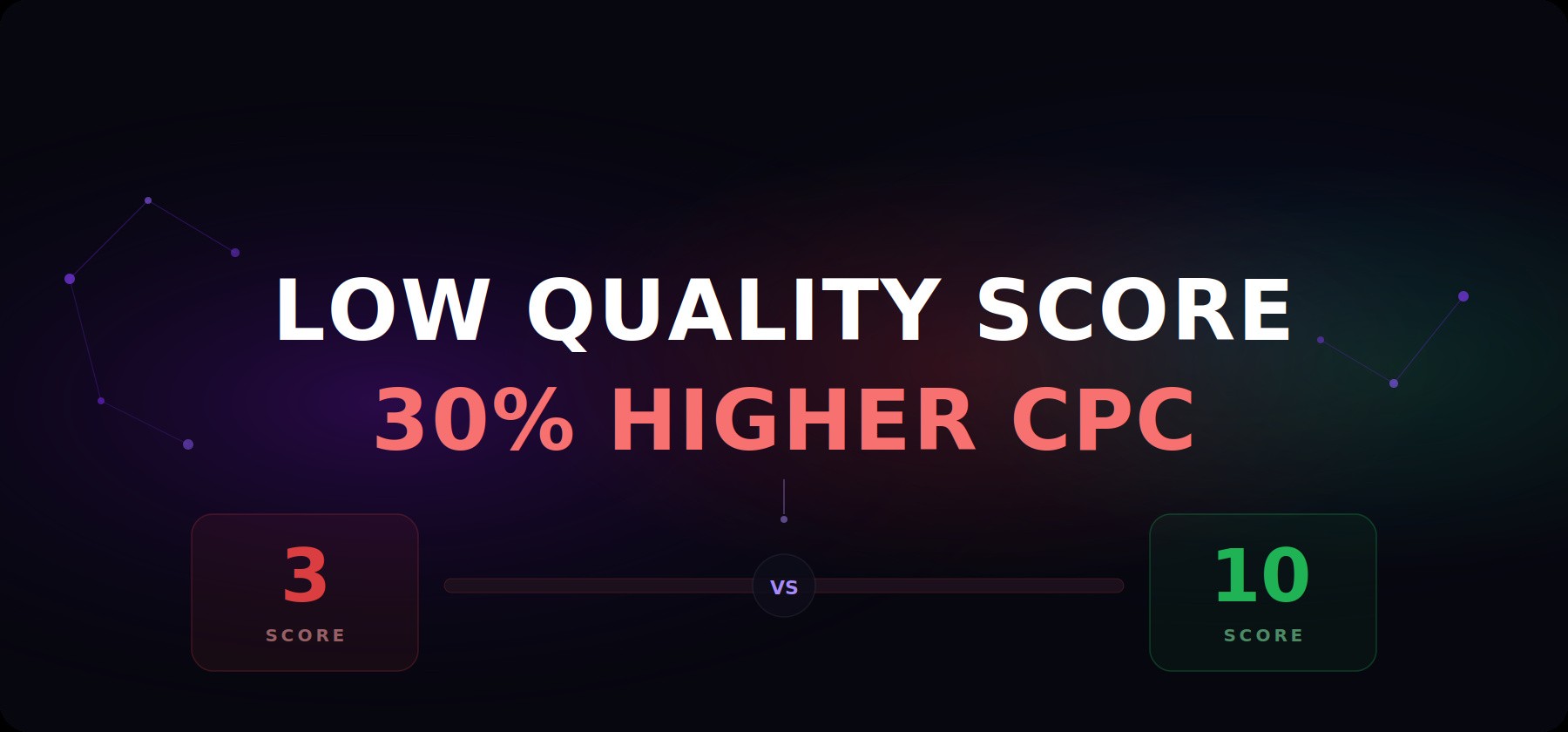
A keyword with a Quality Score of 3 costs you 30% more per click than a keyword
scoring 10 — targeting the exact same search. No bid change. No creative
difference. Just Google's rating of how well your keyword, ad copy, and landing
page fit together.
WHAT CLAUDE DOES IN 10 MINUTES
Paste your keyword, ad copy, and landing page URL into Claude and ask:
"Where is the intent mismatch between these three?" It reads the landing
page, maps the keyword intent, and tells you exactly which line is costing
you — and what to change
WHAT CLAUDE DOES IN 10 MINUTES
Paste your keyword, ad copy, and landing page URL into Claude and ask:
"Where is the intent mismatch between these three?" It reads the landing
page, maps the keyword intent, and tells you exactly which line is costing
you — and what to change
WHAT CLAUDE DOES IN 10 MINUTES
Paste your keyword, ad copy, and landing page URL into Claude and ask:
"Where is the intent mismatch between these three?" It reads the landing
page, maps the keyword intent, and tells you exactly which line is costing
you — and what to change
What the scores actually mean
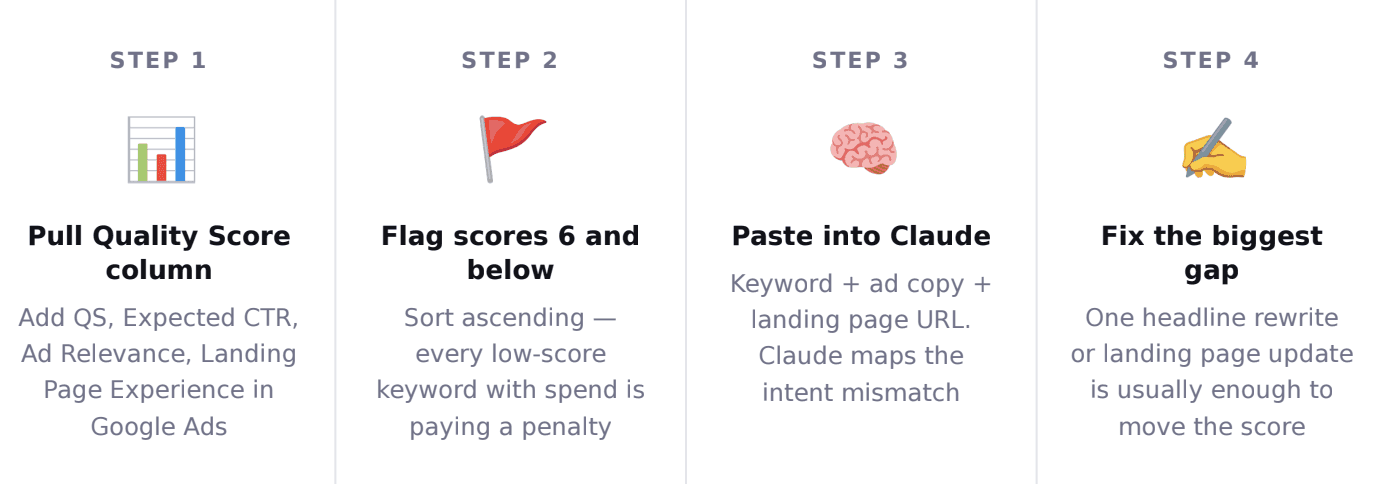
Google scores every keyword from 1 to 10. The score is a composite of three
signals: expected CTR, ad relevance, and landing page experience. Here's what
each band means in practice — and what it's doing to your account.

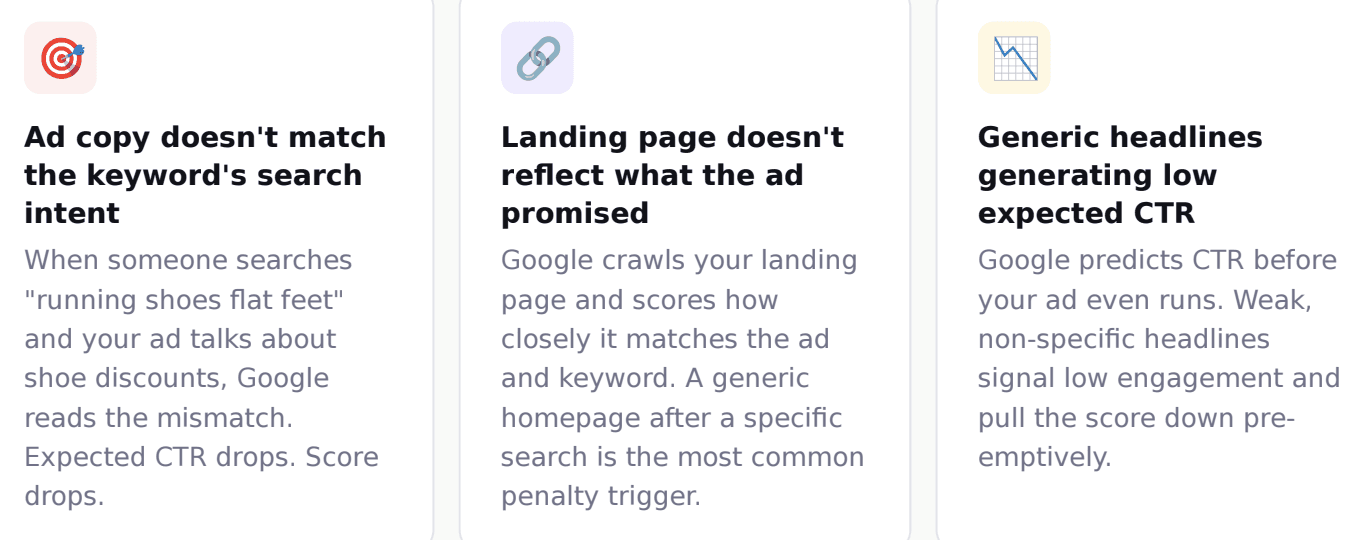
The 3 things that consistently drag Quality Score down
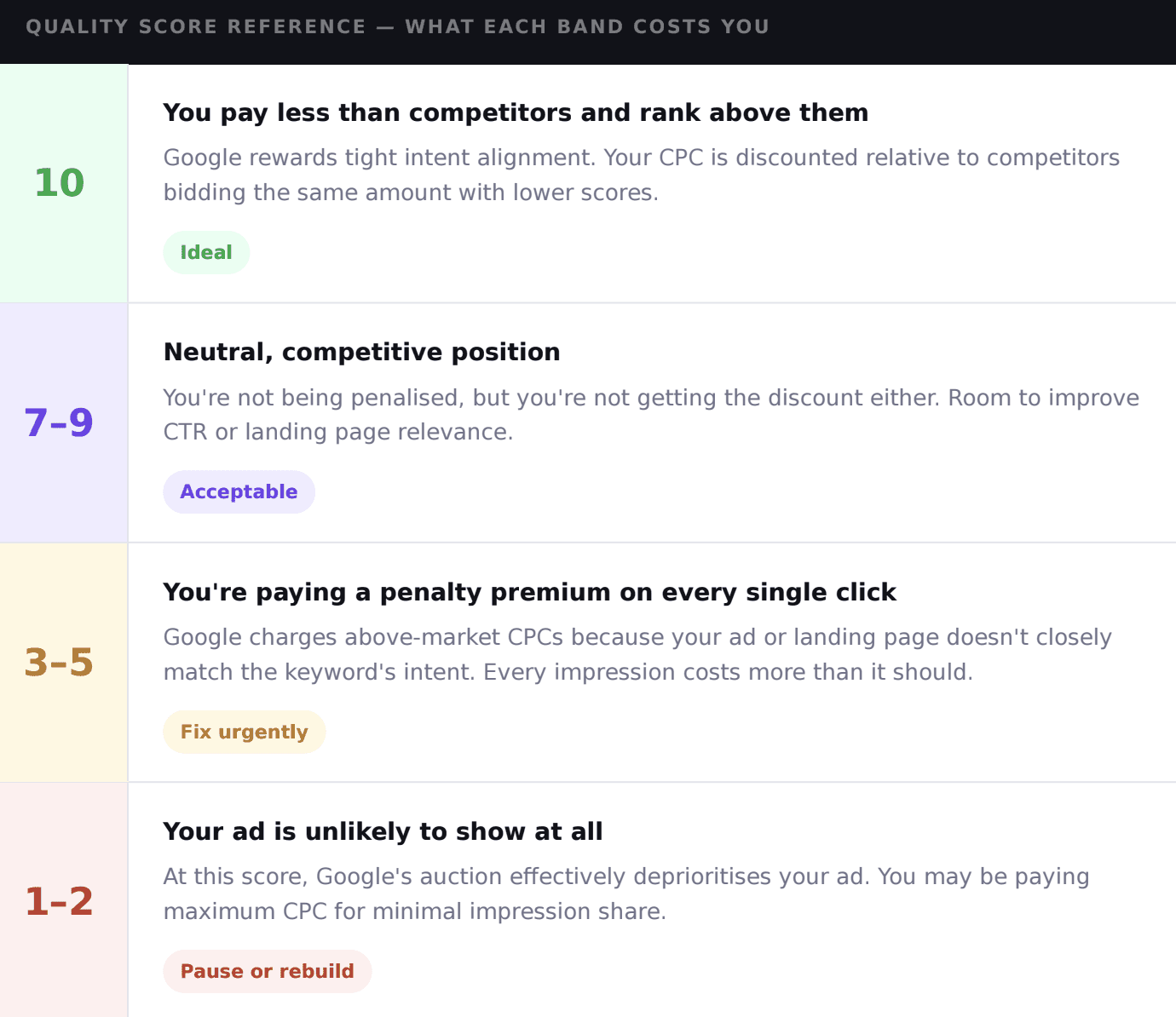
Google's scoring algorithm isn't a black box. Three specific signals account for
almost all Quality Score penalties. If your score is low, one or more of these is the
cause.
THE INTENT TRIANGLE
Quality Score measures the alignment of three things: keyword intent → ad
copy → landing page. The moment any one of these drifts from the others,
the score drops and your CPC rises. Claude's audit finds exactly where the
drift is happening
THE INTENT TRIANGLE
Quality Score measures the alignment of three things: keyword intent → ad
copy → landing page. The moment any one of these drifts from the others,
the score drops and your CPC rises. Claude's audit finds exactly where the
drift is happening
THE INTENT TRIANGLE
Quality Score measures the alignment of three things: keyword intent → ad
copy → landing page. The moment any one of these drifts from the others,
the score drops and your CPC rises. Claude's audit finds exactly where the
drift is happening
The prompt (copy this exactly)
Paste this into Claude for each low-scoring keyword. Replace only the placeholders in brackets.
# Google Ads Quality Score Audit

You are a Google Ads strategist specialising in Quality Score optimisation
and search intent alignment.

I'm going to give you three things:
1. A keyword I'm bidding on
2. The current ad copy running for that keyword
3. The landing page URL the ad sends traffic to

Keyword: [PASTE KEYWORD HERE]

Current ad copy:
Headline 1: [HEADLINE 1]
Headline 2: [HEADLINE 2]
Headline 3: [HEADLINE 3]
Description: [DESCRIPTION]

Landing page URL: [PASTE URL — Claude will read it]

Your task:
1. Identify the search intent behind the keyword (informational /
commercial / transactional)
2. Score the alignment of: (a) keyword → ad copy, (b) ad copy → landing page,
(c) keyword → landing page
3. Find every point of intent mismatch between the three
4. Tell me exactly which line in the ad copy or section of the landing page
is causing the Quality Score penalty
5. Rewrite the headline most likely to improve Expected CTR for this specific
keyword

# Output format:
# INTENT: [keyword intent in one sentence]
# ALIGNMENT SCORE: keyword→ad [x/10] | ad→page [x/10] | keyword→page [x/10]
# MISMATCHES FOUND: [bullet list]
# BIGGEST PENALTY: [the single most impactful fix]
# REWRITTEN HEADLINE: [your new headline, max 30 characters]
# Google Ads Quality Score Audit

You are a Google Ads strategist specialising in Quality Score optimisation
and search intent alignment.

I'm going to give you three things:
1. A keyword I'm bidding on
2. The current ad copy running for that keyword
3. The landing page URL the ad sends traffic to

Keyword: [PASTE KEYWORD HERE]

Current ad copy:
Headline 1: [HEADLINE 1]
Headline 2: [HEADLINE 2]
Headline 3: [HEADLINE 3]
Description: [DESCRIPTION]

Landing page URL: [PASTE URL — Claude will read it]

Your task:
1. Identify the search intent behind the keyword (informational /
commercial / transactional)
2. Score the alignment of: (a) keyword → ad copy, (b) ad copy → landing page,
(c) keyword → landing page
3. Find every point of intent mismatch between the three
4. Tell me exactly which line in the ad copy or section of the landing page
is causing the Quality Score penalty
5. Rewrite the headline most likely to improve Expected CTR for this specific
keyword

# Output format:
# INTENT: [keyword intent in one sentence]
# ALIGNMENT SCORE: keyword→ad [x/10] | ad→page [x/10] | keyword→page [x/10]
# MISMATCHES FOUND: [bullet list]
# BIGGEST PENALTY: [the single most impactful fix]
# REWRITTEN HEADLINE: [your new headline, max 30 characters]
# Google Ads Quality Score Audit

You are a Google Ads strategist specialising in Quality Score optimisation
and search intent alignment.

I'm going to give you three things:
1. A keyword I'm bidding on
2. The current ad copy running for that keyword
3. The landing page URL the ad sends traffic to

Keyword: [PASTE KEYWORD HERE]

Current ad copy:
Headline 1: [HEADLINE 1]
Headline 2: [HEADLINE 2]
Headline 3: [HEADLINE 3]
Description: [DESCRIPTION]

Landing page URL: [PASTE URL — Claude will read it]

Your task:
1. Identify the search intent behind the keyword (informational /
commercial / transactional)
2. Score the alignment of: (a) keyword → ad copy, (b) ad copy → landing page,
(c) keyword → landing page
3. Find every point of intent mismatch between the three
4. Tell me exactly which line in the ad copy or section of the landing page
is causing the Quality Score penalty
5. Rewrite the headline most likely to improve Expected CTR for this specific
keyword

# Output format:
# INTENT: [keyword intent in one sentence]
# ALIGNMENT SCORE: keyword→ad [x/10] | ad→page [x/10] | keyword→page [x/10]
# MISMATCHES FOUND: [bullet list]
# BIGGEST PENALTY: [the single most impactful fix]
# REWRITTEN HEADLINE: [your new headline, max 30 characters]
Before vs. after: what alignment looks like
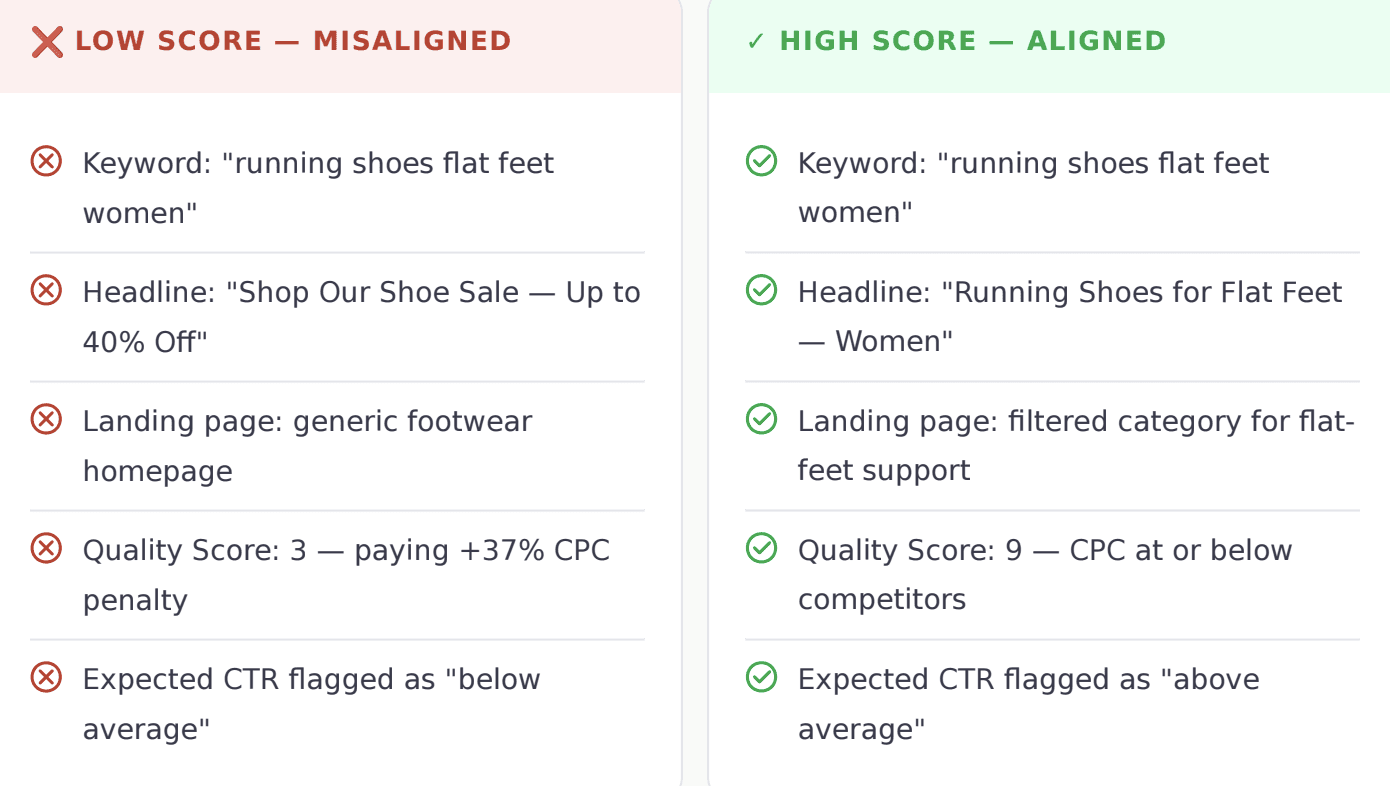
The real cost of ignoring it
If you're running £5,000/month in Google Ads and 40% of that sits on keywords
with a Quality Score of 3–5, you're paying a penalty on £2,000 of spend every
single month. That's potentially £600–£700 in avoidable cost — before you touch
a single bid.
The fix isn't more budget. It's tighter alignment between the keyword, the copy,
and the page. Claude finds the gap in 10 minutes. One rewrite can shift the score
— and the score shifts the CPC permanently, not just for one campaign.