You used to lose entire days studying competitor ads. Open 20 landing pages,
screenshot the headlines, paste it all into a doc, then try to spot the pattern at 6pm
with tired eyes.
The pattern was always there. You just didn't have the hours to find it across every
competitor in your space.
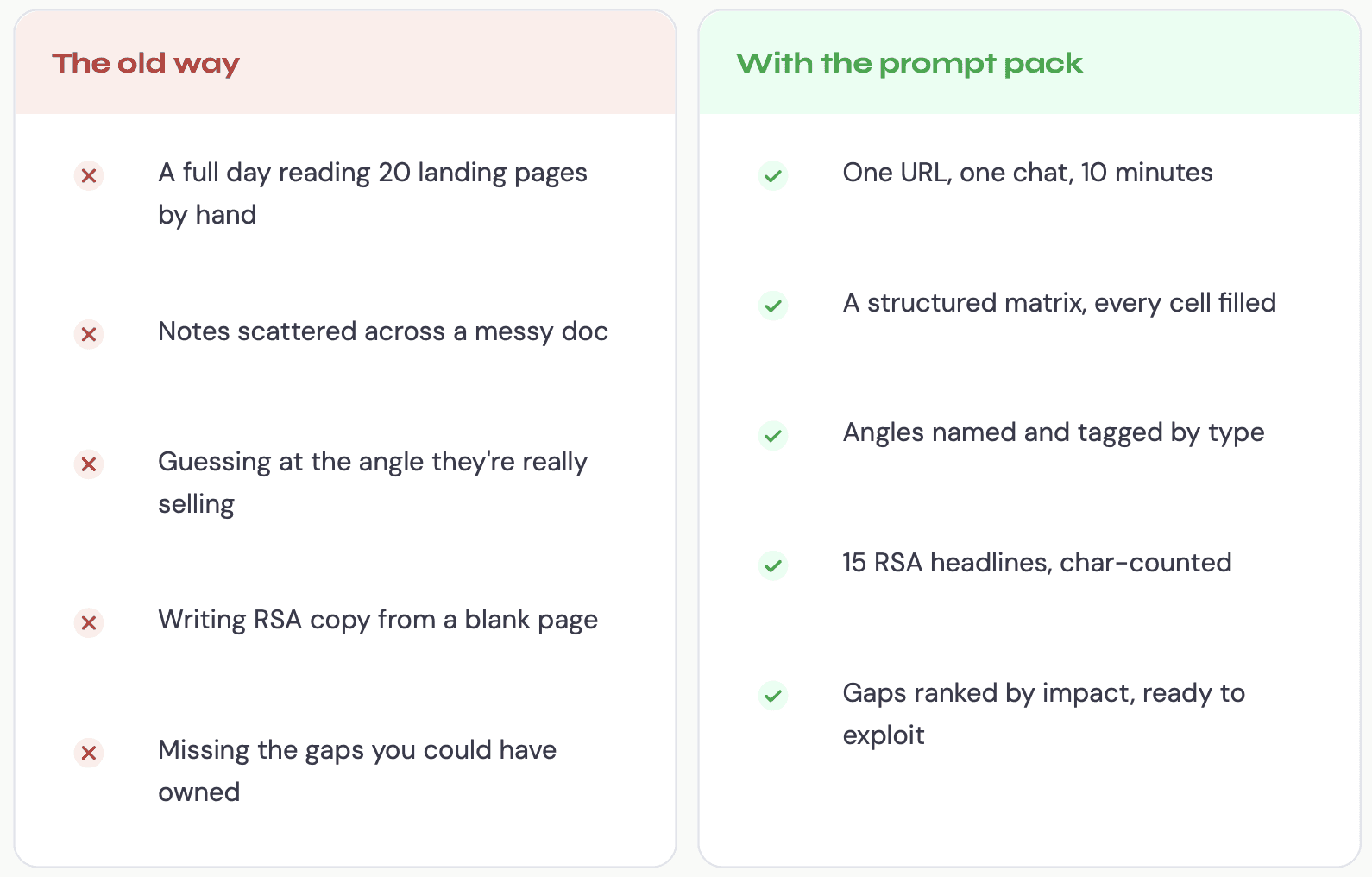
Now one pasted URL does the first pass in 10 minutes. Claude reads the page the
way a buyer would, names the angle, maps the intent, and hands you copy you can
actually run.
"Instead of manually reviewing 20 landing pages, you let Claude do the first pass. A complete competitive report in minutes."
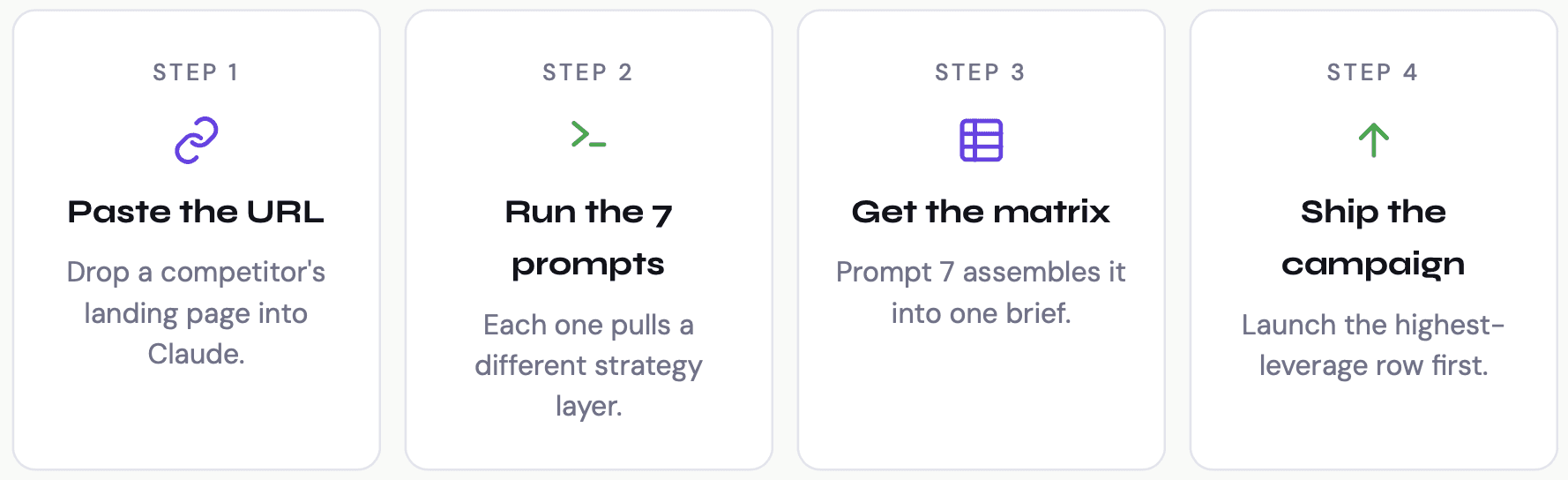
This pack is 7 prompts. Each one extracts a different layer of a competitor's paid
search strategy. Run them in order on a single URL and the last prompt assembles
everything into a messaging matrix you can hand straight to a media buyer.
Built for PPC managers, growth marketers, agencies, and founders running their
own Google Ads.
What each prompt extracts
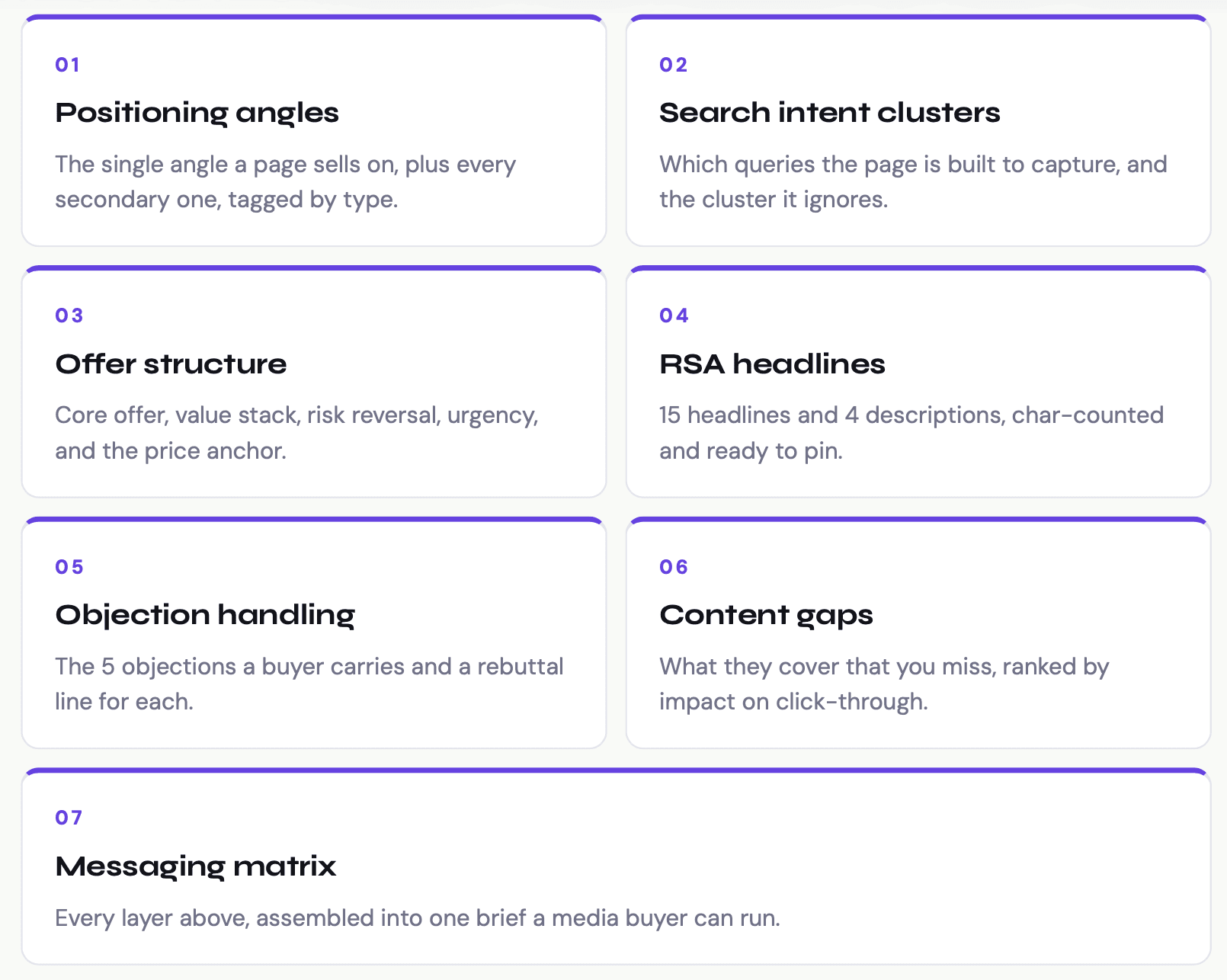
Seven passes, seven layers of the competitor's strategy. Here's what comes back
from each one.
The 7 prompts, copy them exactly
Paste each block into Claude. Swap the amber placeholders for your competitor's
URL or page copy. Run them top to bottom on the same chat so prompt 7 can see
the earlier outputs.
1 Extract positioning angles
Read a competitor page like a buyer who's never heard of them.
# Extract positioning angles
You are a competitive positioning analyst for paid search.
I'll paste a competitor's landing page below. Read it like a buyer who has never
heard of them.
[PASTE COMPETITOR URL OR PAGE COPY]
Your task:
1. Name the single primary angle the page sells on
2. List every secondary angle in priority order
3. Tag each angle: pain-led, gain-led, status-led, or price-led
4. Note which angle the headline and CTA actually commit to
# Output format:
# PRIMARY ANGLE: [one line]
# SECONDARY ANGLES: [ranked list]
# ANGLE TYPE: [tag per angle]
# HEADLINE COMMITMENT: [what the fold promises]
# Extract positioning angles
You are a competitive positioning analyst for paid search.
I'll paste a competitor's landing page below. Read it like a buyer who has never
heard of them.
[PASTE COMPETITOR URL OR PAGE COPY]
Your task:
1. Name the single primary angle the page sells on
2. List every secondary angle in priority order
3. Tag each angle: pain-led, gain-led, status-led, or price-led
4. Note which angle the headline and CTA actually commit to
# Output format:
# PRIMARY ANGLE: [one line]
# SECONDARY ANGLES: [ranked list]
# ANGLE TYPE: [tag per angle]
# HEADLINE COMMITMENT: [what the fold promises]
# Extract positioning angles
You are a competitive positioning analyst for paid search.
I'll paste a competitor's landing page below. Read it like a buyer who has never
heard of them.
[PASTE COMPETITOR URL OR PAGE COPY]
Your task:
1. Name the single primary angle the page sells on
2. List every secondary angle in priority order
3. Tag each angle: pain-led, gain-led, status-led, or price-led
4. Note which angle the headline and CTA actually commit to
# Output format:
# PRIMARY ANGLE: [one line]
# SECONDARY ANGLES: [ranked list]
# ANGLE TYPE: [tag per angle]
# HEADLINE COMMITMENT: [what the fold promises]
2 Map search intent clusters
Infer the searches the page is built to capture.
# Map search intent clusters
You are a paid search strategist who thinks in query intent.
Below is a competitor's landing page. Infer the searches it's built to capture.
[PASTE COMPETITOR URL OR PAGE COPY]
Your task:
1. List the intent clusters this page targets: problem-aware, solution-aware, brand,
comparison
2. For each cluster, write 3 example queries a buyer would type
3. Flag the one cluster the page serves best
4. Flag the cluster it ignores
# Output format:
# CLUSTER: [name] STAGE: [awareness level]
# EXAMPLE QUERIES: [3 queries]
# STRONGEST FIT: [cluster]
# IGNORED INTENT: [cluster + why it matters]
# Map search intent clusters
You are a paid search strategist who thinks in query intent.
Below is a competitor's landing page. Infer the searches it's built to capture.
[PASTE COMPETITOR URL OR PAGE COPY]
Your task:
1. List the intent clusters this page targets: problem-aware, solution-aware, brand,
comparison
2. For each cluster, write 3 example queries a buyer would type
3. Flag the one cluster the page serves best
4. Flag the cluster it ignores
# Output format:
# CLUSTER: [name] STAGE: [awareness level]
# EXAMPLE QUERIES: [3 queries]
# STRONGEST FIT: [cluster]
# IGNORED INTENT: [cluster + why it matters]
# Map search intent clusters
You are a paid search strategist who thinks in query intent.
Below is a competitor's landing page. Infer the searches it's built to capture.
[PASTE COMPETITOR URL OR PAGE COPY]
Your task:
1. List the intent clusters this page targets: problem-aware, solution-aware, brand,
comparison
2. For each cluster, write 3 example queries a buyer would type
3. Flag the one cluster the page serves best
4. Flag the cluster it ignores
# Output format:
# CLUSTER: [name] STAGE: [awareness level]
# EXAMPLE QUERIES: [3 queries]
# STRONGEST FIT: [cluster]
# IGNORED INTENT: [cluster + why it matters]
3 Reverse-engineer the offer
Strip the offer down to what they're really selling.
# Reverse-engineer the offer
You are an offer strategist who breaks a page down to its bones.
Read the competitor page below and strip the offer to its core.
[PASTE COMPETITOR URL OR PAGE COPY]
Your task:
1. State the core offer in one sentence
2. List the value stack, everything bundled in
3. Identify the risk reversal: guarantee, trial, or refund
4. Identify the urgency or scarcity mechanic, if any
5. Name the price anchor and how it's framed
# Output format:
# CORE OFFER: [one sentence]
# VALUE STACK: [list]
# RISK REVERSAL: [mechanic]
# URGENCY: [mechanic or "none"]
# PRICE
# Reverse-engineer the offer
You are an offer strategist who breaks a page down to its bones.
Read the competitor page below and strip the offer to its core.
[PASTE COMPETITOR URL OR PAGE COPY]
Your task:
1. State the core offer in one sentence
2. List the value stack, everything bundled in
3. Identify the risk reversal: guarantee, trial, or refund
4. Identify the urgency or scarcity mechanic, if any
5. Name the price anchor and how it's framed
# Output format:
# CORE OFFER: [one sentence]
# VALUE STACK: [list]
# RISK REVERSAL: [mechanic]
# URGENCY: [mechanic or "none"]
# PRICE
# Reverse-engineer the offer
You are an offer strategist who breaks a page down to its bones.
Read the competitor page below and strip the offer to its core.
[PASTE COMPETITOR URL OR PAGE COPY]
Your task:
1. State the core offer in one sentence
2. List the value stack, everything bundled in
3. Identify the risk reversal: guarantee, trial, or refund
4. Identify the urgency or scarcity mechanic, if any
5. Name the price anchor and how it's framed
# Output format:
# CORE OFFER: [one sentence]
# VALUE STACK: [list]
# RISK REVERSAL: [mechanic]
# URGENCY: [mechanic or "none"]
# PRICE
4 Generate RSA headline variations
Write Responsive Search Ad assets that beat their angles.
# Generate RSA headline variations
You are a Google Ads copywriter writing Responsive Search Ad assets.
Using the competitor angles below, write headlines that beat them on clarity.
[PASTE THE ANGLES FROM PROMPT 1]
Your task:
1. Write 15 RSA headlines, max 30 characters each
2. Write 4 descriptions, max 90 characters each
3. Cover 3 angle types: pain, gain, proof
4. Mark the 3 headlines safe to pin to position 1
# Rules:
# No em dashes. No AI words: unlock, leverage, elevate.
# Vary rhythm. Lead with the benefit, not the brand name.
# Output format:
# HEADLINES: [15, numbered, char count each]
# DESCRIPTIONS: [4, numbered, char count each]
# PIN TO H1: [3 headline numbers]
# Generate RSA headline variations
You are a Google Ads copywriter writing Responsive Search Ad assets.
Using the competitor angles below, write headlines that beat them on clarity.
[PASTE THE ANGLES FROM PROMPT 1]
Your task:
1. Write 15 RSA headlines, max 30 characters each
2. Write 4 descriptions, max 90 characters each
3. Cover 3 angle types: pain, gain, proof
4. Mark the 3 headlines safe to pin to position 1
# Rules:
# No em dashes. No AI words: unlock, leverage, elevate.
# Vary rhythm. Lead with the benefit, not the brand name.
# Output format:
# HEADLINES: [15, numbered, char count each]
# DESCRIPTIONS: [4, numbered, char count each]
# PIN TO H1: [3 headline numbers]
# Generate RSA headline variations
You are a Google Ads copywriter writing Responsive Search Ad assets.
Using the competitor angles below, write headlines that beat them on clarity.
[PASTE THE ANGLES FROM PROMPT 1]
Your task:
1. Write 15 RSA headlines, max 30 characters each
2. Write 4 descriptions, max 90 characters each
3. Cover 3 angle types: pain, gain, proof
4. Mark the 3 headlines safe to pin to position 1
# Rules:
# No em dashes. No AI words: unlock, leverage, elevate.
# Vary rhythm. Lead with the benefit, not the brand name.
# Output format:
# HEADLINES: [15, numbered, char count each]
# DESCRIPTIONS: [4, numbered, char count each]
# PIN TO H1: [3 headline numbers]
5 Map objection-handling messaging
Find what stops a buyer from clicking buy.
# Map objection-handling messaging
You are a conversion copywriter who hunts for unspoken objections.
Read the competitor page below and find what stops a buyer from clicking buy.
[PASTE COMPETITOR URL OR PAGE COPY]
Your task:
1. List the top 5 objections this buyer carries
2. Note how the competitor handles each, or fails to
3. Write one ad-ready rebuttal line per objection, max 90 characters
4. Flag the objection the competitor leaves wide open
# Output format:
# OBJECTION: [statement]
# THEIR HANDLING: [how / "ignored"]
# YOUR REBUTTAL: [line, char count]
# OPEN GAP: [the unhandled objection]
# Map objection-handling messaging
You are a conversion copywriter who hunts for unspoken objections.
Read the competitor page below and find what stops a buyer from clicking buy.
[PASTE COMPETITOR URL OR PAGE COPY]
Your task:
1. List the top 5 objections this buyer carries
2. Note how the competitor handles each, or fails to
3. Write one ad-ready rebuttal line per objection, max 90 characters
4. Flag the objection the competitor leaves wide open
# Output format:
# OBJECTION: [statement]
# THEIR HANDLING: [how / "ignored"]
# YOUR REBUTTAL: [line, char count]
# OPEN GAP: [the unhandled objection]
# Map objection-handling messaging
You are a conversion copywriter who hunts for unspoken objections.
Read the competitor page below and find what stops a buyer from clicking buy.
[PASTE COMPETITOR URL OR PAGE COPY]
Your task:
1. List the top 5 objections this buyer carries
2. Note how the competitor handles each, or fails to
3. Write one ad-ready rebuttal line per objection, max 90 characters
4. Flag the objection the competitor leaves wide open
# Output format:
# OBJECTION: [statement]
# THEIR HANDLING: [how / "ignored"]
# YOUR REBUTTAL: [line, char count]
# OPEN GAP: [the unhandled objection]
6 Find the content gaps
Compare two pages and rank what's missing.
# Find the content gaps
You are a competitive analyst comparing two pages side by side.
I'll paste a competitor page and my own page. Find what they cover that I don't, and
the reverse.
[PASTE COMPETITOR PAGE]
[PASTE MY PAGE]
Your task:
1. List topics, proof, and features they cover that I miss
2. List what I cover that they miss, my edge
3. Rank the gaps by likely impact on click-through
4. Suggest the 3 fastest gaps to close
# Output format:
# THEIR COVERAGE EDGE: [ranked list]
# MY COVERAGE EDGE: [list]
# PRIORITY GAPS: [top 3 to close + why]
# Find the content gaps
You are a competitive analyst comparing two pages side by side.
I'll paste a competitor page and my own page. Find what they cover that I don't, and
the reverse.
[PASTE COMPETITOR PAGE]
[PASTE MY PAGE]
Your task:
1. List topics, proof, and features they cover that I miss
2. List what I cover that they miss, my edge
3. Rank the gaps by likely impact on click-through
4. Suggest the 3 fastest gaps to close
# Output format:
# THEIR COVERAGE EDGE: [ranked list]
# MY COVERAGE EDGE: [list]
# PRIORITY GAPS: [top 3 to close + why]
# Find the content gaps
You are a competitive analyst comparing two pages side by side.
I'll paste a competitor page and my own page. Find what they cover that I don't, and
the reverse.
[PASTE COMPETITOR PAGE]
[PASTE MY PAGE]
Your task:
1. List topics, proof, and features they cover that I miss
2. List what I cover that they miss, my edge
3. Rank the gaps by likely impact on click-through
4. Suggest the 3 fastest gaps to close
# Output format:
# THEIR COVERAGE EDGE: [ranked list]
# MY COVERAGE EDGE: [list]
# PRIORITY GAPS: [top 3 to close + why]
7 Build the messaging matrix
Combine all six outputs into one campaign brief.
# Build the messaging matrix
You are a paid search lead assembling a campaign brief.
Combine the outputs from prompts 1 to 6 into one matrix I can hand to a media buyer.
[PASTE OUTPUTS FROM PROMPTS 1-6]
Your task:
1. Build a table: rows are intent clusters; columns are angle, headline, objection
rebuttal, gap to exploit
2. Fill every cell with copy-ready text
3. Flag the single highest-leverage row to launch first
4. Note one test to run against the competitor in week 1
# Output format:
# MATRIX: [table, one row per cluster]
# LAUNCH FIRST: [row + reason]
# WEEK 1 TEST: [hypothesis + metric]
# Build the messaging matrix
You are a paid search lead assembling a campaign brief.
Combine the outputs from prompts 1 to 6 into one matrix I can hand to a media buyer.
[PASTE OUTPUTS FROM PROMPTS 1-6]
Your task:
1. Build a table: rows are intent clusters; columns are angle, headline, objection
rebuttal, gap to exploit
2. Fill every cell with copy-ready text
3. Flag the single highest-leverage row to launch first
4. Note one test to run against the competitor in week 1
# Output format:
# MATRIX: [table, one row per cluster]
# LAUNCH FIRST: [row + reason]
# WEEK 1 TEST: [hypothesis + metric]
# Build the messaging matrix
You are a paid search lead assembling a campaign brief.
Combine the outputs from prompts 1 to 6 into one matrix I can hand to a media buyer.
[PASTE OUTPUTS FROM PROMPTS 1-6]
Your task:
1. Build a table: rows are intent clusters; columns are angle, headline, objection
rebuttal, gap to exploit
2. Fill every cell with copy-ready text
3. Flag the single highest-leverage row to launch first
4. Note one test to run against the competitor in week 1
# Output format:
# MATRIX: [table, one row per cluster]
# LAUNCH FIRST: [row + reason]
# WEEK 1 TEST: [hypothesis + metric]
How to run this at scale
One competitor takes 10 minutes. The value compounds when you run it across
your whole space.
Start with your top 3 competitors
The ones you lose deals to. Run all 7 prompts on each, in a separate chat per
competitor, so the context stays clean.
Look for patterns across the matrices
When two competitors hammer the same objection, that objection is real and your
market feels it. When none of them touch an intent cluster, that's your white space.
Run the gap prompt against your own page
Prompt 6 compares their page to yours. Do it last, once you've seen what the field
is doing, so you know which gaps actually matter.
What the output looks like
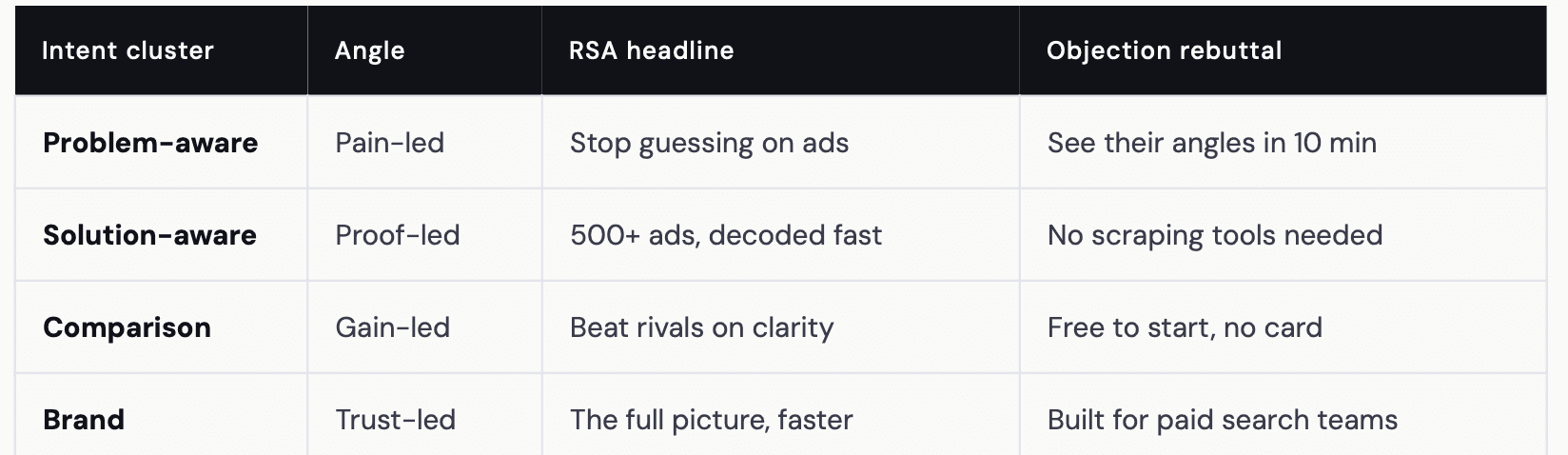
Prompt 7 returns a matrix like this, one row per intent cluster, every cell filled with
copy you can paste into an ad group.
Before and after
THE COMPOUNDING EDGE
Run this on every competitor in your space. By the tenth, you've mapped the whole market's
messaging and you know exactly where the white space is. That map is the thing nobody else
on your team has the hours to build by hand
THE COMPOUNDING EDGE
Run this on every competitor in your space. By the tenth, you've mapped the whole market's
messaging and you know exactly where the white space is. That map is the thing nobody else
on your team has the hours to build by hand
THE COMPOUNDING EDGE
Run this on every competitor in your space. By the tenth, you've mapped the whole market's
messaging and you know exactly where the white space is. That map is the thing nobody else
on your team has the hours to build by hand