Every Meta advertiser I know has done this. You build out retargeting. You layer
in a lookalike. You throw in broad interest targeting for scale. Three campaigns,
three audiences, except they're all targeting the same people.
Your own campaigns are competing for the same inventory. CPMs go up. ROAS
goes sideways. You blame the creative. You test new hooks. You change the
budget. Nothing works, because the problem was never any of those things.
"The most expensive Meta mistakes are invisible, until you know exactly where to look."
This is exactly what happened to us. Here's the full breakdown of what audience
overlap looks like, why it bleeds budget, and the 5-point checklist we now run
before every single campaign launch.
What was actually happening inside the account
When we audited the campaign structure, the problem became obvious
immediately. Three separate campaigns. Three separate audiences. Zero
separation between them.
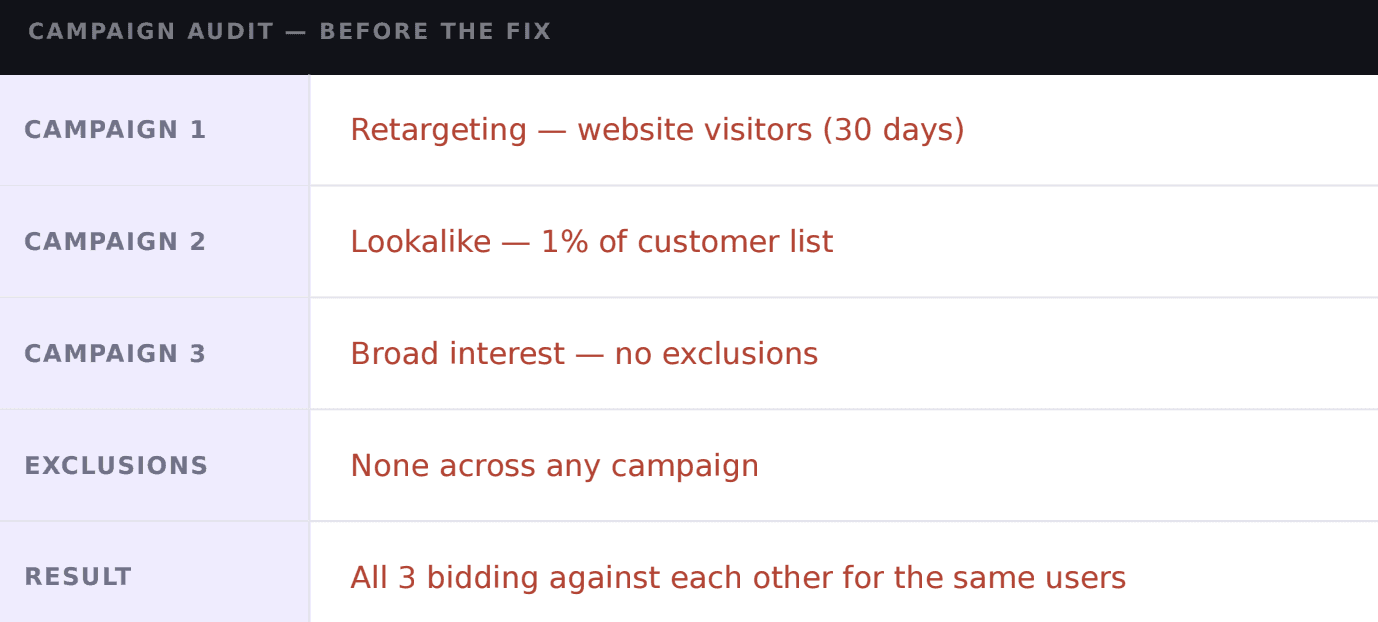
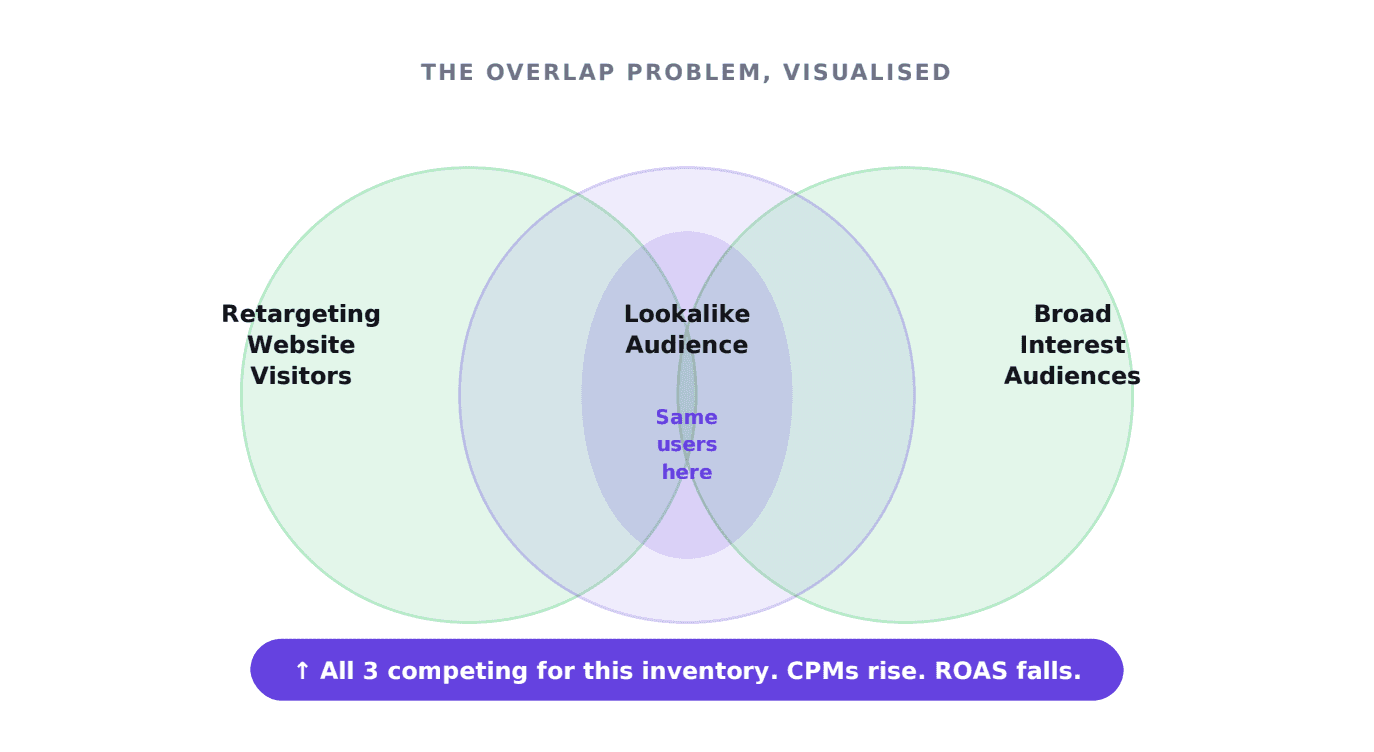
When your retargeting audience, your lookalike audience, and your broad
audience all contain the same users, Meta's auction logic forces your campaigns
to compete against each other. You're bidding against yourself, and the
platform wins every time.
Here's the fix we applied
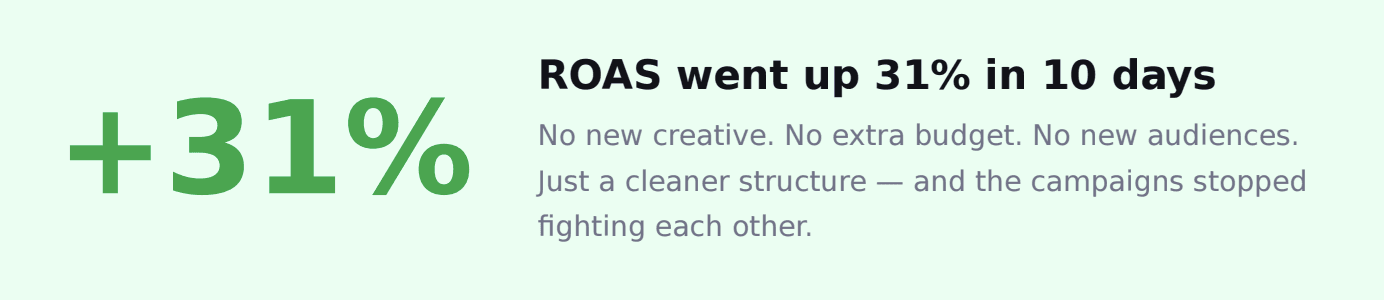
None of this required new creative. No budget increase. No agency. Just a
structural cleanup that took under 20 minutes once we knew what we were
looking for.
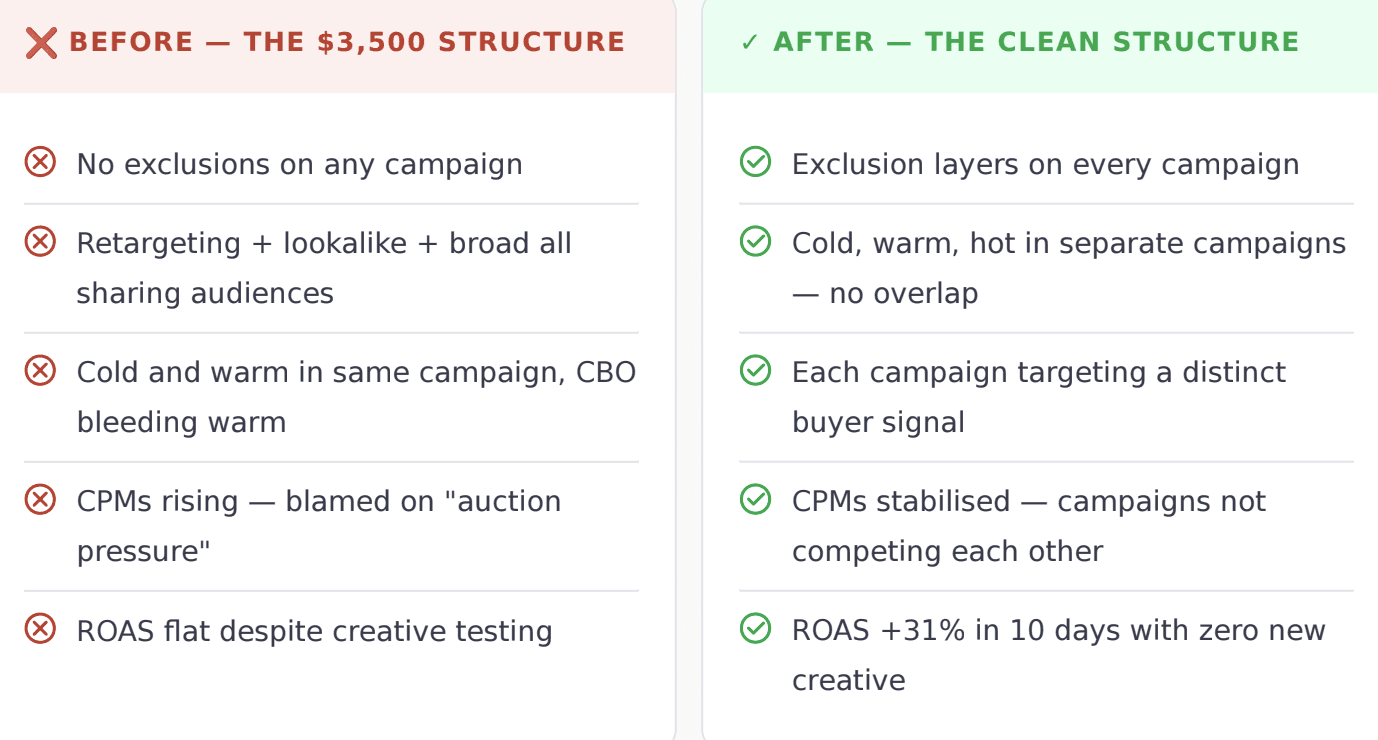
→ Added exclusion audiences across every campaign to stop internal competition.
Retargeting excludes existing customers. Lookalike excludes retargeting list.
Broad excludes both.
→ Separated funnel stages into clean, non-overlapping buckets. Cold traffic, warm
traffic, and hot traffic each live in their own campaign with no shared audience
pool.
→ Pasted our full ad set targeting into Claude, it flagged 4 overlapping audiences
we'd missed that weren't obvious from the dashboard. This step alone saved us
from rebuilding the wrong thing.
→ Rebuilt the campaign structure around distinct audience signals. Each campaign
now targets a different buyer stage, with clear exclusions that prevent
cannibalism at every level.
How Claude flagged what we couldn't see
WHAT WE PASTED INTO CLAUDE
The full targeting configuration from each ad set — audience name,
inclusions, exclusions, funnel stage, and estimated size. Claude returned a
structured breakdown of exactly which audiences were likely to overlap
and why, plus a recommended exclusion layer for each
WHAT WE PASTED INTO CLAUDE
The full targeting configuration from each ad set — audience name,
inclusions, exclusions, funnel stage, and estimated size. Claude returned a
structured breakdown of exactly which audiences were likely to overlap
and why, plus a recommended exclusion layer for each
WHAT WE PASTED INTO CLAUDE
The full targeting configuration from each ad set — audience name,
inclusions, exclusions, funnel stage, and estimated size. Claude returned a
structured breakdown of exactly which audiences were likely to overlap
and why, plus a recommended exclusion layer for each
Here's the exact prompt we used:
PROMPT — PASTE INTO CLAUDE

# Meta Audience Overlap Audit

You
are a Meta Ads strategist specialising in campaign structure and audience
architecture.

I'm going to paste my full ad set targeting below.
For each ad set, I'll include:
- Campaign name and objective
- Audience inclusions (interests, lookalikes, custom audiences)
- Audience exclusions (if any)
- Estimated audience size
- Funnel stage (cold / warm / hot)

Your task:
1. Identify every instance of likely audience overlap between ad sets
2. Flag any campaigns that are probably competing against each other in
auction
3. For each overlap found, explain why it's happening and what it's costing
4. Recommend a specific exclusion layer for each campaign to eliminate the
overlap
5. Suggest a clean funnel structure based on my existing audiences

# Output format:
# OVERLAP FOUND: [description]
# CAMPAIGNS AFFECTED: [list]
# RECOMMENDED EXCLUSION: [specific fix]
# ---

Here is my targeting:
[PASTE YOUR AD SET TARGETING HERE]
PROMPT — PASTE INTO CLAUDE

# Meta Audience Overlap Audit

You
are a Meta Ads strategist specialising in campaign structure and audience
architecture.

I'm going to paste my full ad set targeting below.
For each ad set, I'll include:
- Campaign name and objective
- Audience inclusions (interests, lookalikes, custom audiences)
- Audience exclusions (if any)
- Estimated audience size
- Funnel stage (cold / warm / hot)

Your task:
1. Identify every instance of likely audience overlap between ad sets
2. Flag any campaigns that are probably competing against each other in
auction
3. For each overlap found, explain why it's happening and what it's costing
4. Recommend a specific exclusion layer for each campaign to eliminate the
overlap
5. Suggest a clean funnel structure based on my existing audiences

# Output format:
# OVERLAP FOUND: [description]
# CAMPAIGNS AFFECTED: [list]
# RECOMMENDED EXCLUSION: [specific fix]
# ---

Here is my targeting:
[PASTE YOUR AD SET TARGETING HERE]
PROMPT — PASTE INTO CLAUDE

# Meta Audience Overlap Audit

You
are a Meta Ads strategist specialising in campaign structure and audience
architecture.

I'm going to paste my full ad set targeting below.
For each ad set, I'll include:
- Campaign name and objective
- Audience inclusions (interests, lookalikes, custom audiences)
- Audience exclusions (if any)
- Estimated audience size
- Funnel stage (cold / warm / hot)

Your task:
1. Identify every instance of likely audience overlap between ad sets
2. Flag any campaigns that are probably competing against each other in
auction
3. For each overlap found, explain why it's happening and what it's costing
4. Recommend a specific exclusion layer for each campaign to eliminate the
overlap
5. Suggest a clean funnel structure based on my existing audiences

# Output format:
# OVERLAP FOUND: [description]
# CAMPAIGNS AFFECTED: [list]
# RECOMMENDED EXCLUSION: [specific fix]
# ---

Here is my targeting:
[PASTE YOUR AD SET TARGETING HERE]
The 5-point overlap checklist, run this before every launch
This is the checklist we now run on every account before a campaign goes live. It
takes 15 minutes. It has saved us from repeating the $3,500 mistake more than
once.
1.Do your retargeting audiences exclude your customer list?
Existing customers converting again looks like ROAS, but it's margin you'd have
captured anyway. Exclude your full customer email list from every retargeting
campaign. Also exclude anyone who purchased in the last 180 days.
Claude check: Paste your retargeting ad set config → ask "What exclusions am I missing?"
Claude check: Paste your retargeting ad set config → ask "What exclusions am I missing?"
Claude check: Paste your retargeting ad set config → ask "What exclusions am I missing?"
2. Does your lookalike campaign exclude your retargeting audience?
A 1% lookalike of your customer list will heavily overlap with warm retargeting
audiences — especially website visitors and video viewers. If both campaigns are
live with no exclusions, they're bidding against each other.
Claude check: List all custom audiences → ask "Which overlap with a 1% lookalike?"
Claude check: List all custom audiences → ask "Which overlap with a 1% lookalike?"
Claude check: List all custom audiences → ask "Which overlap with a 1% lookalike?"
3.Does broad/interest targeting exclude all warm and hot audiences?
Broad interest campaigns should be cold traffic only. Add your full retargeting pool
(website visitors, video viewers, social engagers, email list) as exclusions on every
broad ad set. Without this, broad is bidding against your warmer campaigns at a
higher CPM.
Claude check:Paste broad ad set targeting → ask "What should I exclude to reach cold traffic
only?"
Claude check:Paste broad ad set targeting → ask "What should I exclude to reach cold traffic
only?"
Claude check:Paste broad ad set targeting → ask "What should I exclude to reach cold traffic
only?"
4.Are your funnel stages in separate campaigns, not separate ad sets?
Many accounts put cold, warm, and hot audiences into separate ad sets within the
same campaign. Meta's CBO then allocates budget to wherever it sees easiest
conversions — usually warm — starving cold traffic of spend.
Claude check:Share your campaign structure → ask "Is my budget likely to be cannibalised
between funnel stages?"
Claude check:Share your campaign structure → ask "Is my budget likely to be cannibalised
between funnel stages?"
Claude check:Share your campaign structure → ask "Is my budget likely to be cannibalised
between funnel stages?"
5.Have you used Meta's Audience Overlap tool, and checked Claude's read?
Meta's native Audience Overlap tool (Audiences → Actions) shows percentage
overlap between any two saved audiences. Run it across every pair. Then paste the
results plus your full ad set targeting into Claude and ask it to identify structural
problems the tool missed.
Claude check:Paste overlap % + targeting → ask "Which overlaps are causing auction
competition?"
Claude check:Paste overlap % + targeting → ask "Which overlaps are causing auction
competition?"
Claude check:Paste overlap % + targeting → ask "Which overlaps are causing auction
competition?"
Before vs. after: what a clean structure looks like
The takeaway
Most performance problems in Meta accounts aren't creative problems. They're
structural problems, and they're invisible from the dashboard. The platform
won't tell you your campaigns are competing against each other. It just lets the
auction run, collects the CPMs, and returns mediocre ROAS.
Run the 5-point checklist above before every launch. Paste your targeting into
Claude and ask it to flag what you've missed. And the next time ROAS goes flat,
audit your structure before you write a single new hook.
"No new creative. No extra budget. Just a cleaner structure."