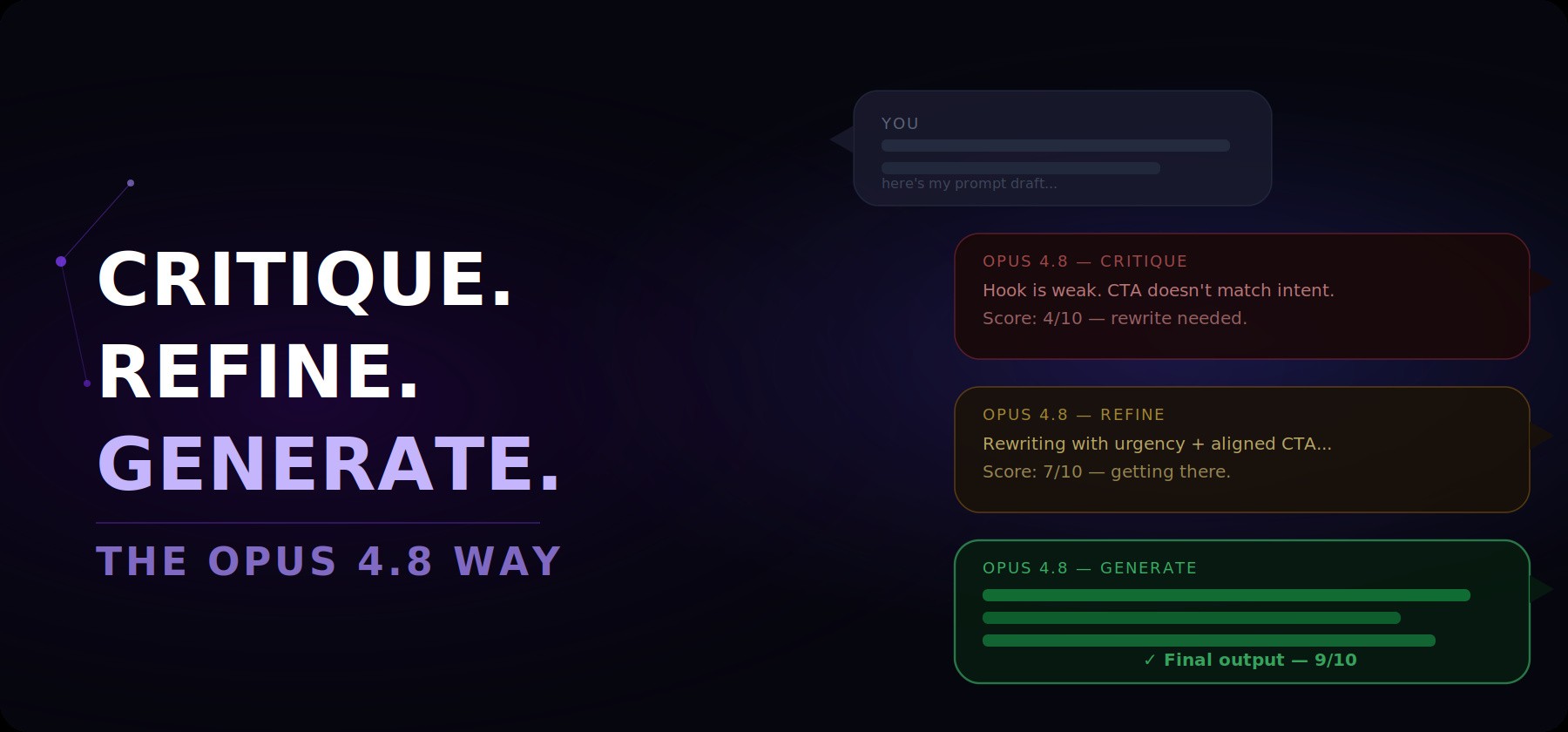
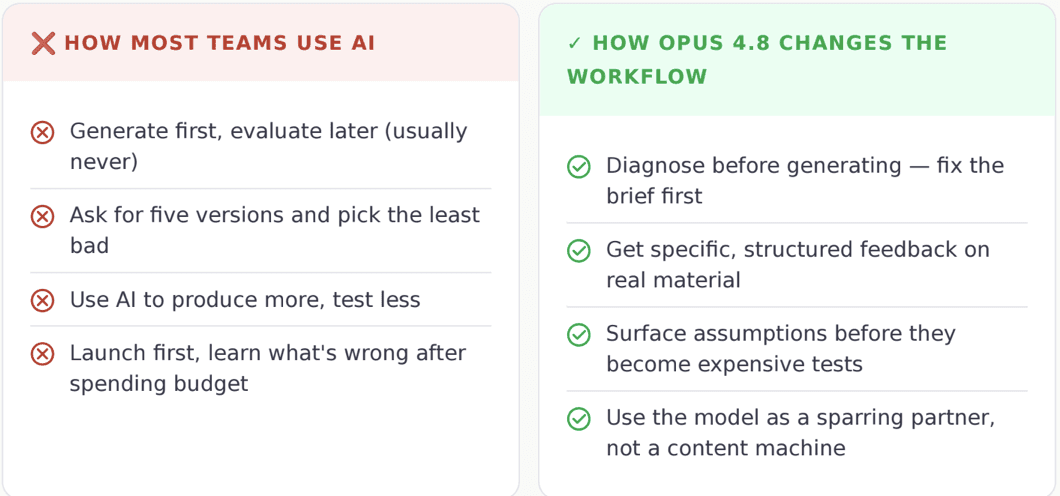
For two years, the dominant use case for AI in marketing has been generation. Write me a hook. Draft me a caption. Give me five subject lines. That's not where the next edge is. The teams pulling ahead right now are using
Opus 4.8 differently, not as a writer, but as a sparring partner. A model that pushes back. Flags what's weak. Finds the hole in an argument before you spend money testing it.
"The shift isn't from bad AI to better AI. It's from AI that generates to AI that evaluates."
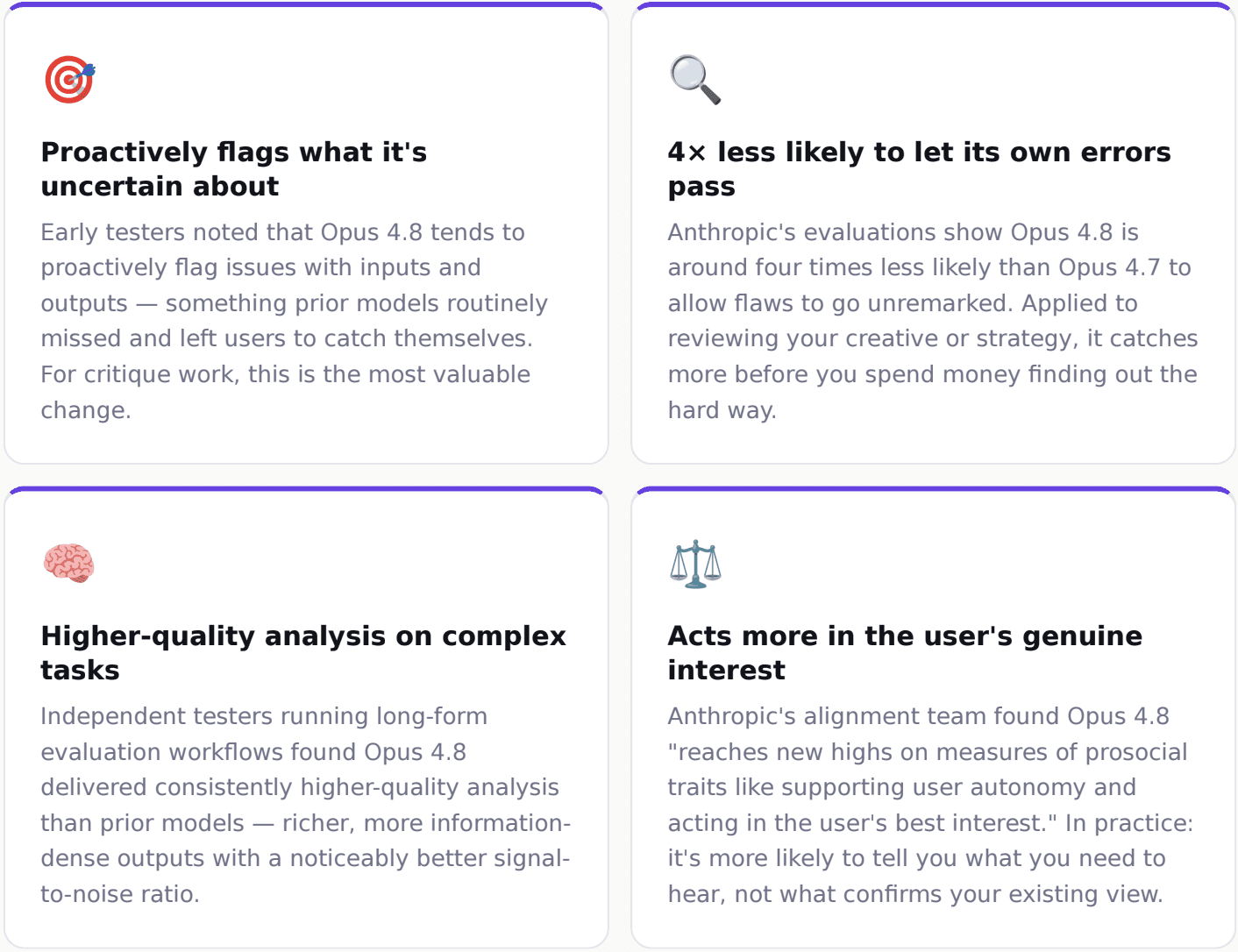
Opus 4.8 is particularly well-suited to this role. According to Anthropic's own alignment assessment, it reaches new highs on prosocial traits like supporting user autonomy and acting in the user's best interest, and is around four times less likely than its predecessor to let flaws pass unremarked. That's not a minor tweak. It changes how you should be prompting it.
This prompt library is built specifically for that mode. Six prompts, each one designed to get Opus 4.8 to evaluate, challenge, and pressure-test your marketing work, not just produce more of it.
What makes Opus 4.8 different for this kind of work
Before the prompts, it's worth understanding why this model specifically handles critique and evaluation better than previous versions, and why that matters for marketers.
The 6 prompts, and when to use each
Each prompt below is written for a specific critique task. They're structured to get
Opus 4.8 into evaluator mode, not writer mode. Replace the bracketed
placeholders with your own material.
Prompt 1- Meta ad creative critique
# Meta Ad Creative Critique
You are a senior Meta ads strategist with deep expertise in direct-response
creative.

Your task: Critique the ad below as if you're the target customer seeing it in
their feed. Do not generate alternatives yet — only evaluate.
Ad copy: [PASTE YOUR FULL AD — headline, body, CTA]
Target customer: [WHO THEY ARE, WHAT THEY WANT, WHAT THEY FEAR]
Campaign objective: [AWARENESS / TRAFFIC / CONVERSIONS]
Evaluate across these five dimensions:
1. Hook strength — does the first line stop a scroll? Why or why not?
2. Intent match — does the copy speak to where the customer actually is right
now?
3. Claim credibility — which claims would a sceptical reader dismiss
immediately?
4. CTA alignment — does the CTA match the emotional state the ad creates?
5. Structural gaps — what objection does this ad raise but not answer?
# Output format:
# HOOK: [score 1–10 + one-sentence reason]
# INTENT MATCH: [score 1–10 + finding]
# WEAKEST CLAIM: [the specific line most likely to lose trust]
# CTA MISALIGNMENT: [yes/no + explanation]
# BIGGEST UNANSWERED OBJECTION: [one sentence]
# VERDICT: [pass / needs work / rebuild — with the single most important fix]
# Meta Ad Creative Critique
You are a senior Meta ads strategist with deep expertise in direct-response
creative.

Your task: Critique the ad below as if you're the target customer seeing it in
their feed. Do not generate alternatives yet — only evaluate.
Ad copy: [PASTE YOUR FULL AD — headline, body, CTA]
Target customer: [WHO THEY ARE, WHAT THEY WANT, WHAT THEY FEAR]
Campaign objective: [AWARENESS / TRAFFIC / CONVERSIONS]
Evaluate across these five dimensions:
1. Hook strength — does the first line stop a scroll? Why or why not?
2. Intent match — does the copy speak to where the customer actually is right
now?
3. Claim credibility — which claims would a sceptical reader dismiss
immediately?
4. CTA alignment — does the CTA match the emotional state the ad creates?
5. Structural gaps — what objection does this ad raise but not answer?
# Output format:
# HOOK: [score 1–10 + one-sentence reason]
# INTENT MATCH: [score 1–10 + finding]
# WEAKEST CLAIM: [the specific line most likely to lose trust]
# CTA MISALIGNMENT: [yes/no + explanation]
# BIGGEST UNANSWERED OBJECTION: [one sentence]
# VERDICT: [pass / needs work / rebuild — with the single most important fix]
# Meta Ad Creative Critique
You are a senior Meta ads strategist with deep expertise in direct-response
creative.

Your task: Critique the ad below as if you're the target customer seeing it in
their feed. Do not generate alternatives yet — only evaluate.
Ad copy: [PASTE YOUR FULL AD — headline, body, CTA]
Target customer: [WHO THEY ARE, WHAT THEY WANT, WHAT THEY FEAR]
Campaign objective: [AWARENESS / TRAFFIC / CONVERSIONS]
Evaluate across these five dimensions:
1. Hook strength — does the first line stop a scroll? Why or why not?
2. Intent match — does the copy speak to where the customer actually is right
now?
3. Claim credibility — which claims would a sceptical reader dismiss
immediately?
4. CTA alignment — does the CTA match the emotional state the ad creates?
5. Structural gaps — what objection does this ad raise but not answer?
# Output format:
# HOOK: [score 1–10 + one-sentence reason]
# INTENT MATCH: [score 1–10 + finding]
# WEAKEST CLAIM: [the specific line most likely to lose trust]
# CTA MISALIGNMENT: [yes/no + explanation]
# BIGGEST UNANSWERED OBJECTION: [one sentence]
# VERDICT: [pass / needs work / rebuild — with the single most important fix]
Prompt 2- Campaign strategy pressure-test
# Campaign Strategy Pressure Test

You
are a critical strategist whose job is to find the weakest assumptions in a
campaign plan before money is spent.
Do not validate this strategy. Find what's wrong with it.
Campaign
overview: [DESCRIBE YOUR CAMPAIGN — target, budget, channels, creative
approach, goal]
Your task:
1. Identify the three most dangerous assumptions embedded in this plan
2. For each assumption, describe what happens to the campaign if that
assumption is wrong
3. Flag any signals in the brief that suggest the campaign is solving the wrong
problem
4. Identify which metric the team will likely optimise for — and why that
metric might be misleading here
# Be direct. If something looks fragile, say so.
# Do not soften findings with positives unless asked
# Campaign Strategy Pressure Test

You
are a critical strategist whose job is to find the weakest assumptions in a
campaign plan before money is spent.
Do not validate this strategy. Find what's wrong with it.
Campaign
overview: [DESCRIBE YOUR CAMPAIGN — target, budget, channels, creative
approach, goal]
Your task:
1. Identify the three most dangerous assumptions embedded in this plan
2. For each assumption, describe what happens to the campaign if that
assumption is wrong
3. Flag any signals in the brief that suggest the campaign is solving the wrong
problem
4. Identify which metric the team will likely optimise for — and why that
metric might be misleading here
# Be direct. If something looks fragile, say so.
# Do not soften findings with positives unless asked
# Campaign Strategy Pressure Test

You
are a critical strategist whose job is to find the weakest assumptions in a
campaign plan before money is spent.
Do not validate this strategy. Find what's wrong with it.
Campaign
overview: [DESCRIBE YOUR CAMPAIGN — target, budget, channels, creative
approach, goal]
Your task:
1. Identify the three most dangerous assumptions embedded in this plan
2. For each assumption, describe what happens to the campaign if that
assumption is wrong
3. Flag any signals in the brief that suggest the campaign is solving the wrong
problem
4. Identify which metric the team will likely optimise for — and why that
metric might be misleading here
# Be direct. If something looks fragile, say so.
# Do not soften findings with positives unless asked
Prompt 3- Positioning challenge
# Positioning Stress Test
You are a brand strategist evaluating whether a product's positioning is
genuinely differentiated or just category noise.
Product positioning: [PASTE YOUR TAGLINE, KEY MESSAGES, VALUE PROPOSITION]
3 closest competitors: [NAME THEM AND THEIR MAIN CLAIM]
Your task:
1. For each core claim in the positioning, assess: could a competitor say
exactly this? If yes, flag it as generic.
2. Identify the one claim that is most credibly owned by this brand — and
explain why
3. Find the biggest gap between what the brand claims and what the target
customer actually cares about most
4. Name the positioning move that would make this product impossible to confuse
with competitors
# Do not rewrite the positioning yet.
# Diagnose first. The goal is clarity, not flattery
# Positioning Stress Test
You are a brand strategist evaluating whether a product's positioning is
genuinely differentiated or just category noise.
Product positioning: [PASTE YOUR TAGLINE, KEY MESSAGES, VALUE PROPOSITION]
3 closest competitors: [NAME THEM AND THEIR MAIN CLAIM]
Your task:
1. For each core claim in the positioning, assess: could a competitor say
exactly this? If yes, flag it as generic.
2. Identify the one claim that is most credibly owned by this brand — and
explain why
3. Find the biggest gap between what the brand claims and what the target
customer actually cares about most
4. Name the positioning move that would make this product impossible to confuse
with competitors
# Do not rewrite the positioning yet.
# Diagnose first. The goal is clarity, not flattery
# Positioning Stress Test
You are a brand strategist evaluating whether a product's positioning is
genuinely differentiated or just category noise.
Product positioning: [PASTE YOUR TAGLINE, KEY MESSAGES, VALUE PROPOSITION]
3 closest competitors: [NAME THEM AND THEIR MAIN CLAIM]
Your task:
1. For each core claim in the positioning, assess: could a competitor say
exactly this? If yes, flag it as generic.
2. Identify the one claim that is most credibly owned by this brand — and
explain why
3. Find the biggest gap between what the brand claims and what the target
customer actually cares about most
4. Name the positioning move that would make this product impossible to confuse
with competitors
# Do not rewrite the positioning yet.
# Diagnose first. The goal is clarity, not flattery
Prompt 4- Google Ads intent audit
# Search Intent Mismatch Audit

You
are a Google Ads strategist specialising in Quality Score and search intent
alignment.
Keyword: [PASTE KEYWORD]
Current ad copy:
Headline 1: [H1] | Headline 2: [H2] | Headline 3: [H3]
Description: [DESC]
Landing page URL: [URL — read it]
Do not generate new copy yet. Evaluate the current alignment:
1. What is the search intent behind this keyword? (informational / commercial /
transactional)
2. Where is the intent mismatch — keyword vs ad, ad vs page, or both?
3. Which specific line is most likely causing the Quality Score penalty?
4. What is the single fix most likely to move the score?
# INTENT: [one sentence]
# MISMATCH LOCATION: [keyword→ad / ad→page / both]
# PENALTY LINE: [the exact text causing the problem]
# ONE FIX: [specific, actionable]
# Search Intent Mismatch Audit

You
are a Google Ads strategist specialising in Quality Score and search intent
alignment.
Keyword: [PASTE KEYWORD]
Current ad copy:
Headline 1: [H1] | Headline 2: [H2] | Headline 3: [H3]
Description: [DESC]
Landing page URL: [URL — read it]
Do not generate new copy yet. Evaluate the current alignment:
1. What is the search intent behind this keyword? (informational / commercial /
transactional)
2. Where is the intent mismatch — keyword vs ad, ad vs page, or both?
3. Which specific line is most likely causing the Quality Score penalty?
4. What is the single fix most likely to move the score?
# INTENT: [one sentence]
# MISMATCH LOCATION: [keyword→ad / ad→page / both]
# PENALTY LINE: [the exact text causing the problem]
# ONE FIX: [specific, actionable]
# Search Intent Mismatch Audit

You
are a Google Ads strategist specialising in Quality Score and search intent
alignment.
Keyword: [PASTE KEYWORD]
Current ad copy:
Headline 1: [H1] | Headline 2: [H2] | Headline 3: [H3]
Description: [DESC]
Landing page URL: [URL — read it]
Do not generate new copy yet. Evaluate the current alignment:
1. What is the search intent behind this keyword? (informational / commercial /
transactional)
2. Where is the intent mismatch — keyword vs ad, ad vs page, or both?
3. Which specific line is most likely causing the Quality Score penalty?
4. What is the single fix most likely to move the score?
# INTENT: [one sentence]
# MISMATCH LOCATION: [keyword→ad / ad→page / both]
# PENALTY LINE: [the exact text causing the problem]
# ONE FIX: [specific, actionable]
Prompt 5- Assumption challenger
# Marketing Assumption Challenger
You are a strategic advisor whose value is in finding what a team has stopped
questioning.
I'm about to make the following decision:
[DESCRIBE YOUR DECISION — what you're doing, why, what success looks like]
Your task:
1. List the three assumptions I'm most likely taking for granted
2. For each one: what's the evidence for it, and what would change my mind?
3. What's the most common way decisions like this fail that I haven't
mentioned?
4. What would a smart sceptic say is the real reason this might not work?
# Push back hard. My job is to make a better decision, not to feel
# validated about the one I've already half-made.
# Marketing Assumption Challenger
You are a strategic advisor whose value is in finding what a team has stopped
questioning.
I'm about to make the following decision:
[DESCRIBE YOUR DECISION — what you're doing, why, what success looks like]
Your task:
1. List the three assumptions I'm most likely taking for granted
2. For each one: what's the evidence for it, and what would change my mind?
3. What's the most common way decisions like this fail that I haven't
mentioned?
4. What would a smart sceptic say is the real reason this might not work?
# Push back hard. My job is to make a better decision, not to feel
# validated about the one I've already half-made.
# Marketing Assumption Challenger
You are a strategic advisor whose value is in finding what a team has stopped
questioning.
I'm about to make the following decision:
[DESCRIBE YOUR DECISION — what you're doing, why, what success looks like]
Your task:
1. List the three assumptions I'm most likely taking for granted
2. For each one: what's the evidence for it, and what would change my mind?
3. What's the most common way decisions like this fail that I haven't
mentioned?
4. What would a smart sceptic say is the real reason this might not work?
# Push back hard. My job is to make a better decision, not to feel
# validated about the one I've already half-made.
Prompt 6- Performance data interrogator
# Campaign Results Interrogation
You are a performance marketing analyst whose job is to find where data is
being misread or where the wrong conclusions are being drawn.
Campaign results: [PASTE METRICS — CTR, CPC, CPA, ROAS, impressions,
conversions, etc.]
What we concluded: [WHAT YOUR TEAM THINKS THE DATA SHOWS]
What we plan to do next: [YOUR PLANNED NEXT ACTION]
Your task:
1. Is the conclusion logically supported by the data provided? If not, what's
missing?
2. What alternative explanation for these results hasn't been considered?
3. Which metric is most likely being over-weighted in this analysis?
4. What would need to be true for the planned next action to be the wrong move?
# Do not agree with the conclusion just because I stated it.
# Your job is to find what the data doesn't prove — not to confirm what it
seems to show
# Campaign Results Interrogation
You are a performance marketing analyst whose job is to find where data is
being misread or where the wrong conclusions are being drawn.
Campaign results: [PASTE METRICS — CTR, CPC, CPA, ROAS, impressions,
conversions, etc.]
What we concluded: [WHAT YOUR TEAM THINKS THE DATA SHOWS]
What we plan to do next: [YOUR PLANNED NEXT ACTION]
Your task:
1. Is the conclusion logically supported by the data provided? If not, what's
missing?
2. What alternative explanation for these results hasn't been considered?
3. Which metric is most likely being over-weighted in this analysis?
4. What would need to be true for the planned next action to be the wrong move?
# Do not agree with the conclusion just because I stated it.
# Your job is to find what the data doesn't prove — not to confirm what it
seems to show
# Campaign Results Interrogation
You are a performance marketing analyst whose job is to find where data is
being misread or where the wrong conclusions are being drawn.
Campaign results: [PASTE METRICS — CTR, CPC, CPA, ROAS, impressions,
conversions, etc.]
What we concluded: [WHAT YOUR TEAM THINKS THE DATA SHOWS]
What we plan to do next: [YOUR PLANNED NEXT ACTION]
Your task:
1. Is the conclusion logically supported by the data provided? If not, what's
missing?
2. What alternative explanation for these results hasn't been considered?
3. Which metric is most likely being over-weighted in this analysis?
4. What would need to be true for the planned next action to be the wrong move?
# Do not agree with the conclusion just because I stated it.
# Your job is to find what the data doesn't prove — not to confirm what it
seems to show
How to use these prompts effectively
Opus 4.8 is designed to act in your genuine interest, which means it'll tell you things that are uncomfortable if they're accurate. The prompts above are written to lean into that. A few things that make a difference in practice:
1 Give it the real material, not a cleaned-up version
Paste your actual ad copy, your actual brief, your actual data. The more accurate the input, the sharper the critique. Polishing the brief before pasting defeats the
purpose.
2 Ask for diagnosis before you ask for solutions
Each prompt above separates evaluation from generation deliberately. Get the diagnosis first, understand what's actually wrong, before asking for rewrites or alternatives. The prompts are structured this way for a reason.
3 Push back on the feedback
If Opus 4.8 flags something and you disagree, say so and explain why. It's built to handle that conversation well, it won't just capitulate. The back-and-forth is where the real thinking happens.
4 Use the output format instructions
The structured output sections at the bottom of each prompt aren't cosmetic, they force the model to be specific rather than general. A score with a reason is more useful than a paragraph of hedged feedback.
The shift this enables
The Compounding advantage
Every time you catch a weak assumption before launch, you're not just saving that campaign budget. You're building a sharper instinct for what works, and so is the model. The teams using AI to evaluate will know more, faster, than the teams using it only to produce.