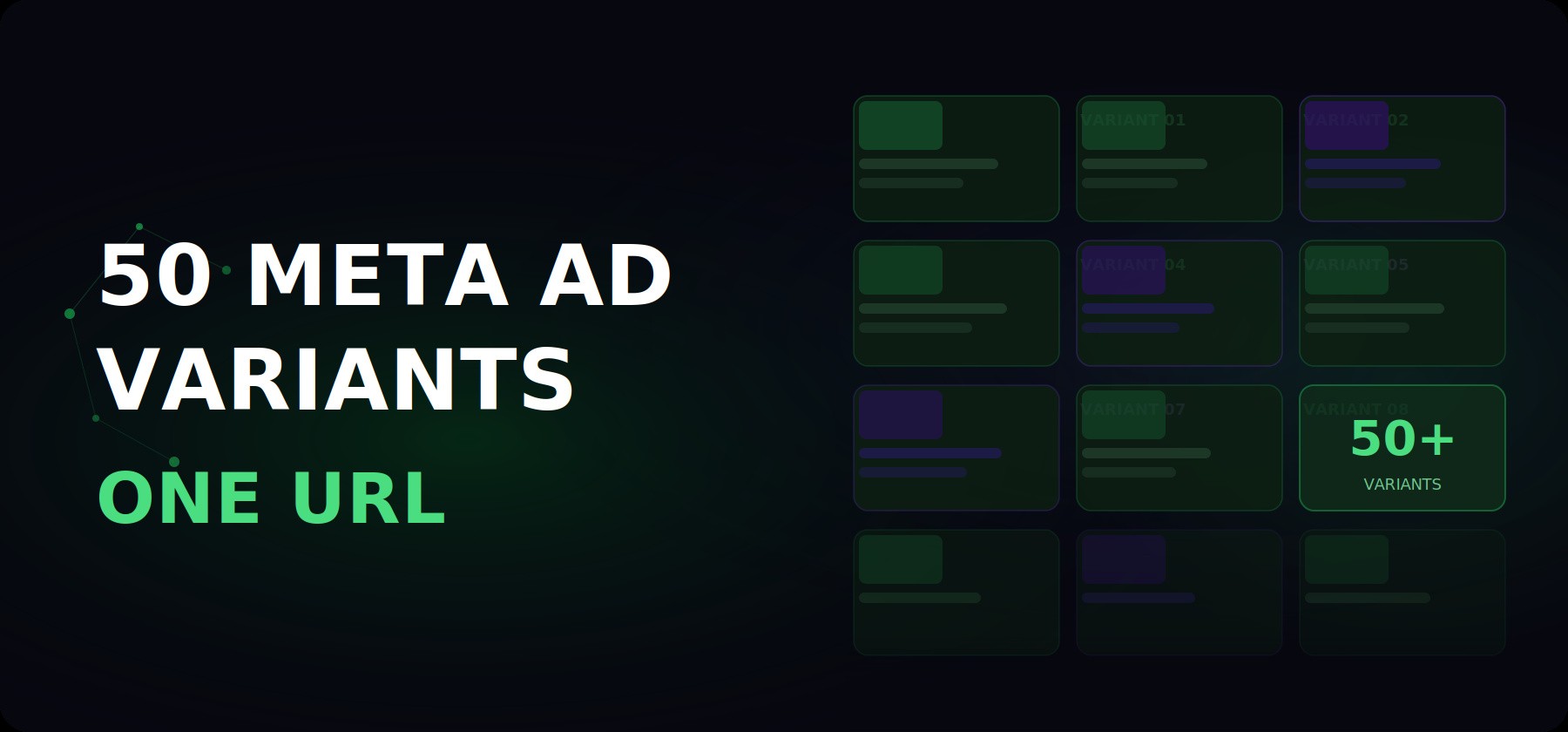
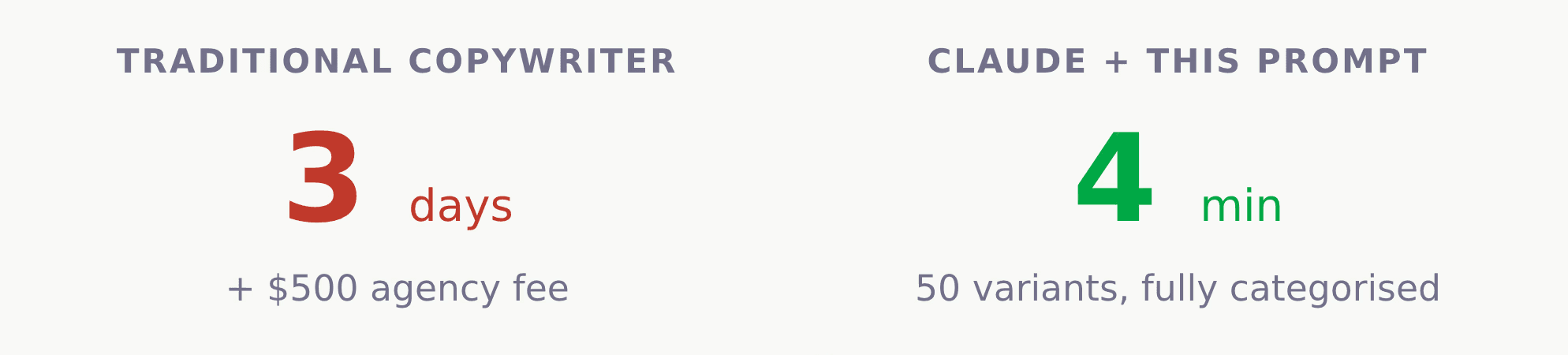
What took your copywriter 3 days and $500 now takes 4 minutes. Here's the full system.
The best Meta advertisers aren't threatened by AI. They're using it to test 10x more angles than their competitors — in the same time their competitors write one ad.
Here's exactly what that looks like in practice. From a single product URL, Claude did four things your copywriter bills $500 and 3 days for:
WHAT CLAUDE DID — FROM ONE PRODUCT URL

→ Pulled 8 core pain points directly from the landing page
copy
→ Wrote 6 distinct hook variations for each pain point
→ Categorised every hook by type for easy review
→ Formatted the full output as a ready-to-test swipe fill
WHAT CLAUDE DID — FROM ONE PRODUCT URL

→ Pulled 8 core pain points directly from the landing page
copy
→ Wrote 6 distinct hook variations for each pain point
→ Categorised every hook by type for easy review
→ Formatted the full output as a ready-to-test swipe fill
WHAT CLAUDE DID — FROM ONE PRODUCT URL

→ Pulled 8 core pain points directly from the landing page
copy
→ Wrote 6 distinct hook variations for each pain point
→ Categorised every hook by type for easy review
→ Formatted the full output as a ready-to-test swipe fill
Fear hooks. Aspiration hooks. Curiosity hooks. Social proof hooks. All 50. In 4 minutes. Organised and ready to brief your designer.
More tests = more signal = winning ads faster. That's the whole game.
Below is the exact prompt that makes this happen — and a complete breakdown of how to use the output.
Why most copywriters test too little.
Traditional creative testing is bottlenecked at the idea-generation stage. A skilled copywriter can produce maybe 5–8.
The result? Most brands run 2–4 creative angles per campaign, pick a winner after a week, and call it done. But the real winners in paid social aren't finding the best angle from 4 options. They're finding the best angle from 50.
The 4 hook types you need to cover.
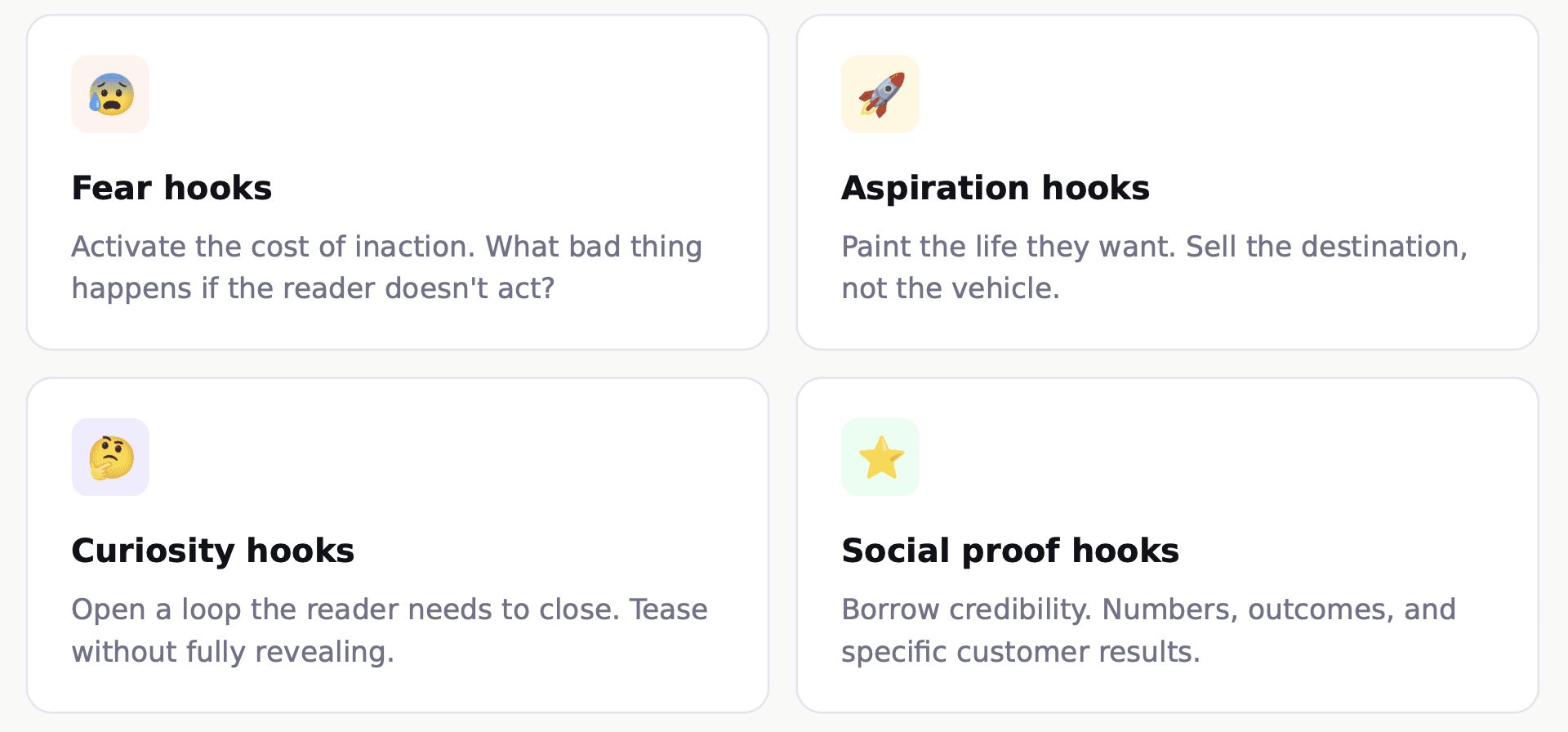
Before you look at the prompt, understand the framework underneath it. Every high-performing Meta ad hooks the reader through one of four emotional levers. The prompt you're about to see generates 6 variations across each of these types —which is why you end up with 50 variants, not 5.
What the prompt actually does?
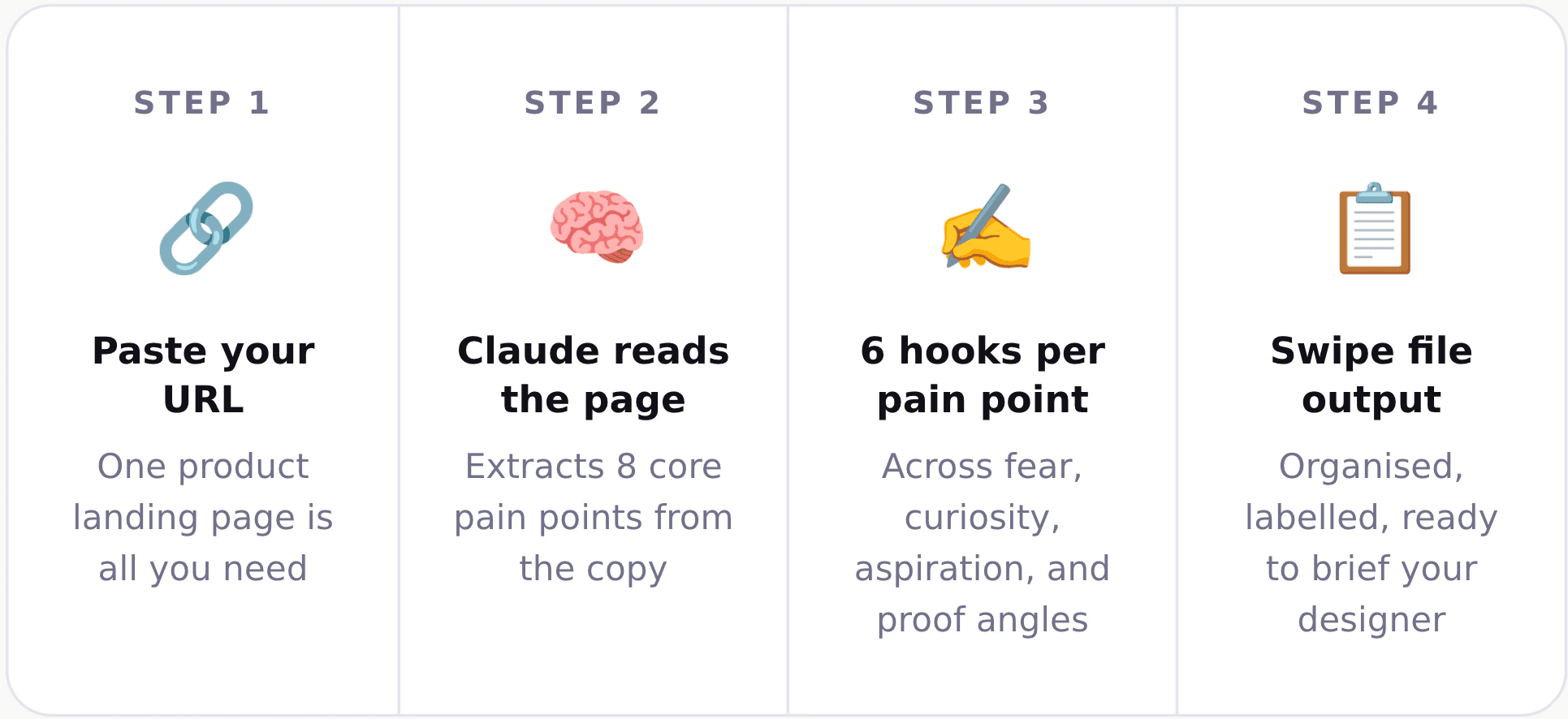
Here's the exact sequence Claude runs when you use this prompt. Each step builds on the last — so the output is structured, not just a random dump of copy ideas.
Reads and scrapes the landing page
Claude fetches the URL and pulls every claim, benefit, and feature mentioned. It's reading your copy the same way a prospect would — but faster, and looking specifically for emotional triggers.
Identifies 8 core pain points.
From the page copy, Claude distills the 8 deepest pain points your product addresses. Not features — pains. The things keeping your customer up at night.
Writes 6 hook variations per pain point
For each pain point, Claude writes 6 ad hooks — one per major emotional angle plus variations. Each hook is standalone: a complete first line that would stop a scroll.
Categorises and labels everything
Each hook gets tagged by type (fear, aspiration, curiosity, social proof) so you can filter by angle and run structured tests rather than random experiments.
Formats the full swipe file
The output arrives ready to paste into a brief. Pain point header → hook type label → copy. Clean enough to share directly with your designer or media buyer.
The prompt (copy this exactly)
Paste this into Claude with your product URL. Replace only the placeholder in brackets.
# Meta Ad Hook Generator

You are an expert direct-response copywriter specialising
in Meta (Facebook/Instagram) advertising.
Your task: Read the landing page at the URL below.
Generate 50 Meta ad hook variants that I can test immediately.
Product URL: [PASTE YOUR PRODUCT URL HERE]

Step 1 — Extract pain points
Read the landing page and identify the 8 deepest customer
pain points it addresses. Focus on emotional triggers, not
feature lists. Write each as a one-sentence "before state":
the frustration, fear, or stuck feeling the customer has
RIGHT NOW.

Step 2 — Write 6 hooks per pain point
For each of the 8 pain points, write 6 ad hook variations
using these types:
- Fear hook: what bad thing happens if they don't act?
- Aspiration hook: what transformation do they want?
- Curiosity hook: open a loop without resolving it
- Social proof hook: borrow credibility with specifics
- Contrarian hook: challenge a belief they hold
- Story hook: start mid-scene with a specific moment
Each hook = one punchy opening line (max 15 words). No
fluff. No setup. Just the scroll-stopper.

Step 3 — Format as a swipe file
Output in this exact structure:
PAIN POINT [number]: [one-sentence description]
→ [Hook type] | [Hook copy]
→ [Hook type] | [Hook copy]
(repeat for all 6 hooks)

# Rules:
# - No em dashes
# - No "but here's the thing" constructions
# - No AI-sounding phrases (unlock, leverage, transform)
# - Each hook must work as a standalone first sentence
# - Vary sentence length and rhythm across the 50.
# Meta Ad Hook Generator

You are an expert direct-response copywriter specialising
in Meta (Facebook/Instagram) advertising.
Your task: Read the landing page at the URL below.
Generate 50 Meta ad hook variants that I can test immediately.
Product URL: [PASTE YOUR PRODUCT URL HERE]

Step 1 — Extract pain points
Read the landing page and identify the 8 deepest customer
pain points it addresses. Focus on emotional triggers, not
feature lists. Write each as a one-sentence "before state":
the frustration, fear, or stuck feeling the customer has
RIGHT NOW.

Step 2 — Write 6 hooks per pain point
For each of the 8 pain points, write 6 ad hook variations
using these types:
- Fear hook: what bad thing happens if they don't act?
- Aspiration hook: what transformation do they want?
- Curiosity hook: open a loop without resolving it
- Social proof hook: borrow credibility with specifics
- Contrarian hook: challenge a belief they hold
- Story hook: start mid-scene with a specific moment
Each hook = one punchy opening line (max 15 words). No
fluff. No setup. Just the scroll-stopper.

Step 3 — Format as a swipe file
Output in this exact structure:
PAIN POINT [number]: [one-sentence description]
→ [Hook type] | [Hook copy]
→ [Hook type] | [Hook copy]
(repeat for all 6 hooks)

# Rules:
# - No em dashes
# - No "but here's the thing" constructions
# - No AI-sounding phrases (unlock, leverage, transform)
# - Each hook must work as a standalone first sentence
# - Vary sentence length and rhythm across the 50.
# Meta Ad Hook Generator

You are an expert direct-response copywriter specialising
in Meta (Facebook/Instagram) advertising.
Your task: Read the landing page at the URL below.
Generate 50 Meta ad hook variants that I can test immediately.
Product URL: [PASTE YOUR PRODUCT URL HERE]

Step 1 — Extract pain points
Read the landing page and identify the 8 deepest customer
pain points it addresses. Focus on emotional triggers, not
feature lists. Write each as a one-sentence "before state":
the frustration, fear, or stuck feeling the customer has
RIGHT NOW.

Step 2 — Write 6 hooks per pain point
For each of the 8 pain points, write 6 ad hook variations
using these types:
- Fear hook: what bad thing happens if they don't act?
- Aspiration hook: what transformation do they want?
- Curiosity hook: open a loop without resolving it
- Social proof hook: borrow credibility with specifics
- Contrarian hook: challenge a belief they hold
- Story hook: start mid-scene with a specific moment
Each hook = one punchy opening line (max 15 words). No
fluff. No setup. Just the scroll-stopper.

Step 3 — Format as a swipe file
Output in this exact structure:
PAIN POINT [number]: [one-sentence description]
→ [Hook type] | [Hook copy]
→ [Hook type] | [Hook copy]
(repeat for all 6 hooks)

# Rules:
# - No em dashes
# - No "but here's the thing" constructions
# - No AI-sounding phrases (unlock, leverage, transform)
# - Each hook must work as a standalone first sentence
# - Vary sentence length and rhythm across the 50.
How to use the output?
Getting 50 hooks is step one. Here's how to turn them into actual test results.
THE TESTING FRAMEWORK

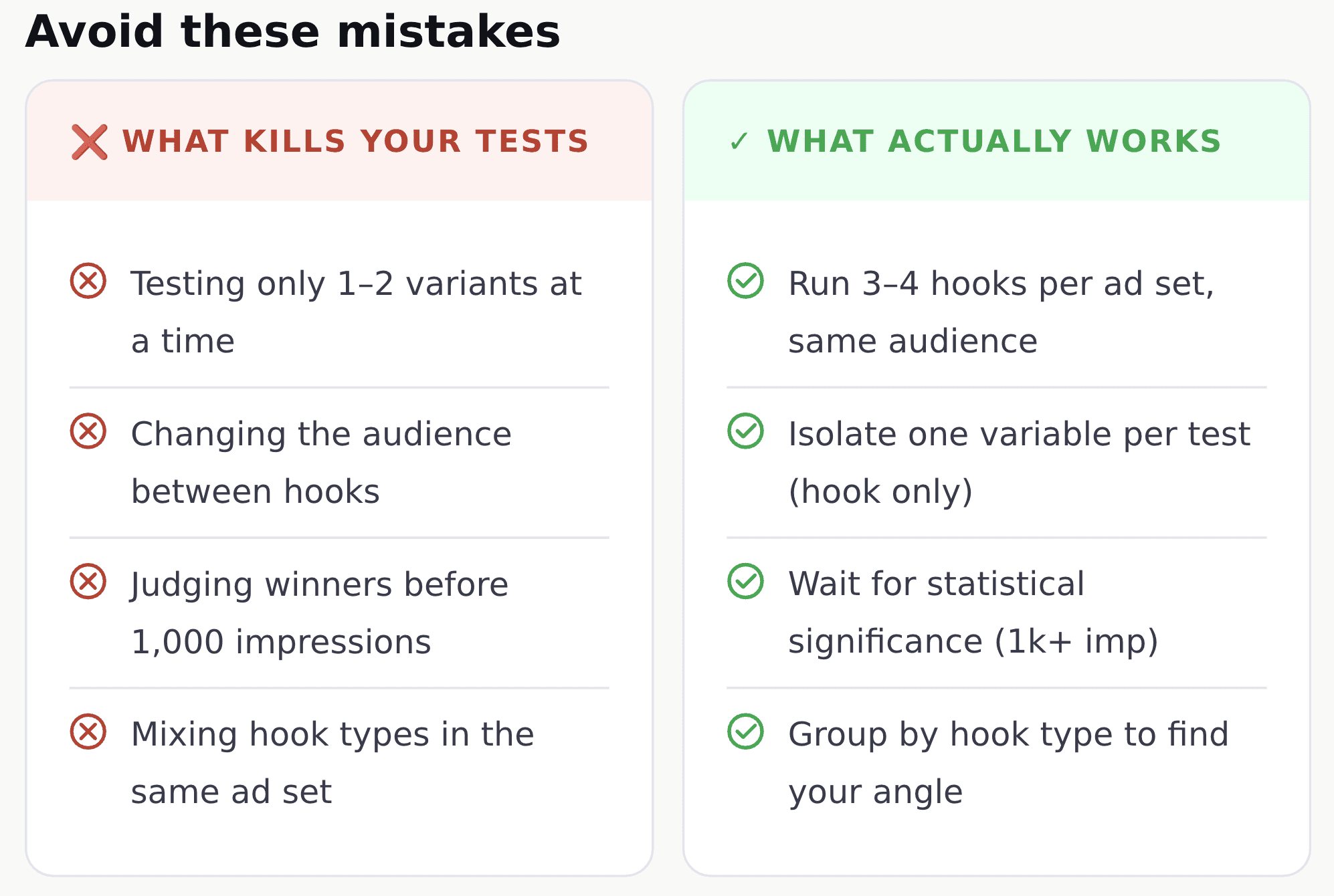
Run 3–4 hooks per ad set, targeting the same audience.
After 3–4 days and roughly 1,000 impressions each,
pause the bottom 2 by CTR. Reinvest budget into the top
performer. Repeat weekly until you have a clear winner
per pain point
THE TESTING FRAMEWORK

Run 3–4 hooks per ad set, targeting the same audience.
After 3–4 days and roughly 1,000 impressions each,
pause the bottom 2 by CTR. Reinvest budget into the top
performer. Repeat weekly until you have a clear winner
per pain point
THE TESTING FRAMEWORK

Run 3–4 hooks per ad set, targeting the same audience.
After 3–4 days and roughly 1,000 impressions each,
pause the bottom 2 by CTR. Reinvest budget into the top
performer. Repeat weekly until you have a clear winner
per pain point
What you're building is a signal factory. Each test tells you not just which ad performed, but which pain point resonates most with which audience. That data compounds over time.
The real advantage
The copywriters using this aren't replacing creative judgment. They're offloading the volume problem to Claude so their creative judgment has more material to work with.
Your instincts about which hook feels right still matter. But now you're choosing between 50 options instead of 5. And you're backing your instinct with data 10x faster than your competitors.
More tests = more signal = winning ads faster.
That's the whole game.