

The AI Creative Testing Playbook: Test 20 Meta Creatives Before Competitors Runs One
The AI Creative Testing Playbook: Test 20 Meta Creatives Before Competitors Runs One
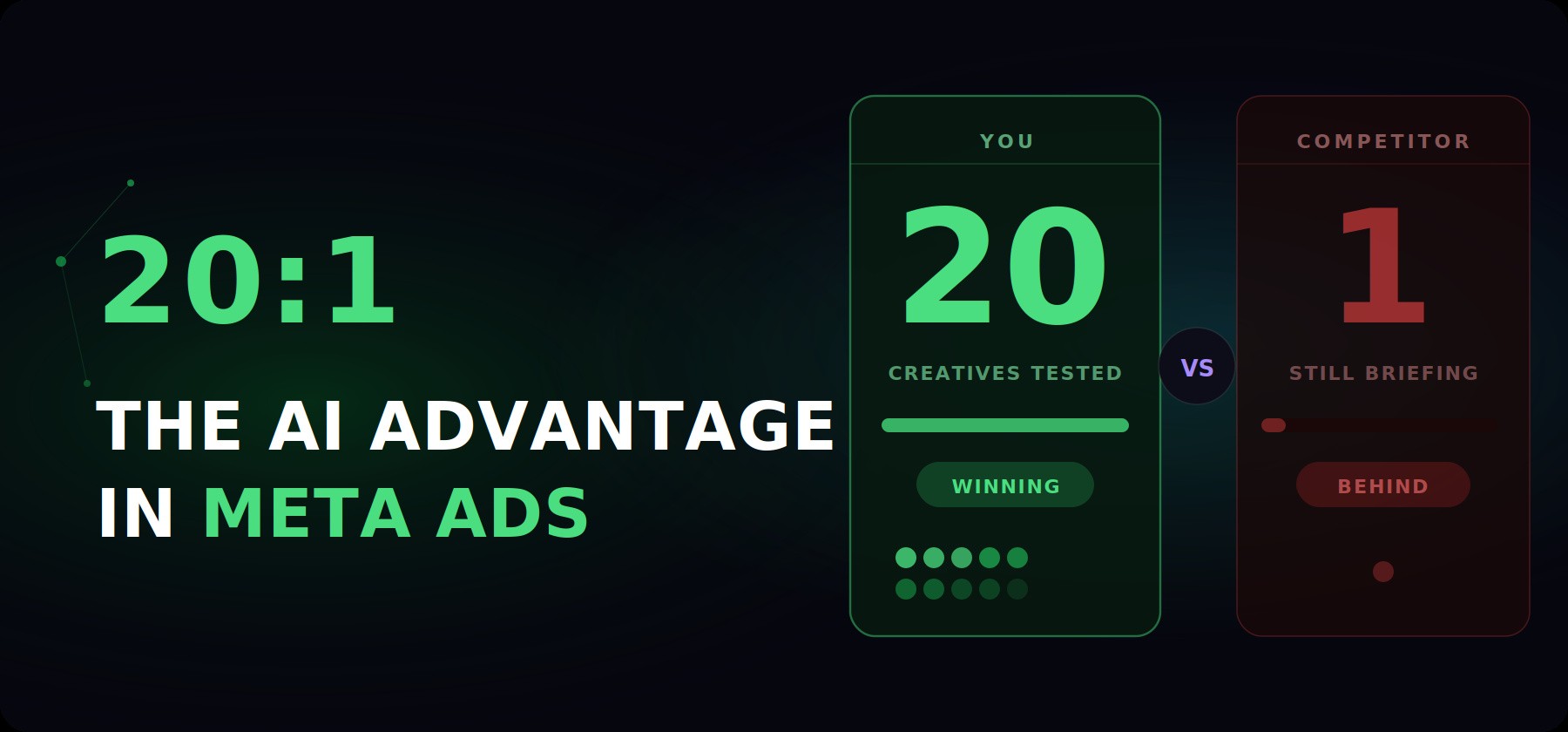
A few months ago, launching 20 new Meta creatives meant finding creators,
writing scripts, going through revisions, edits, and approvals. Most brands still
work this way.
The brands that suddenly look impossible to catch aren't smarter. They're not
spending more. They're operating on a completely different creative cycle
— one where the bottleneck between idea and live ad has been eliminated.
The craziest part isn't the content quality. It's the testing speed. While one
team is still debating their next creative, another has already tested 20 angles
and knows which one wins.
WHAT TH IS WORKFLOW PRODUCES
→ Multiple creator concepts from a single product upload
→ Different hooks tested across the same visual narrative
→ Fresh emotional angles without briefing a new creator
→ 20 ready-to-test variants before the old process writes one brief
This is the workflow. Here's exactly how it runs.
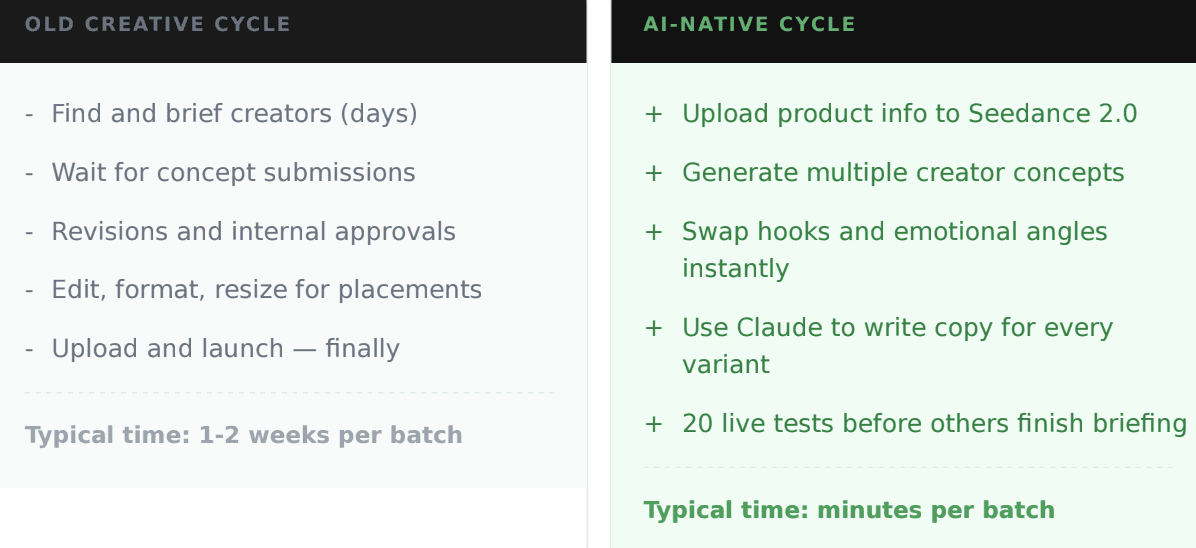
The old cycle vs the new one
The difference isn't incremental. It's structural. Every step in the old creative
process is a delay. The new cycle compresses the entire thing into a single
session.
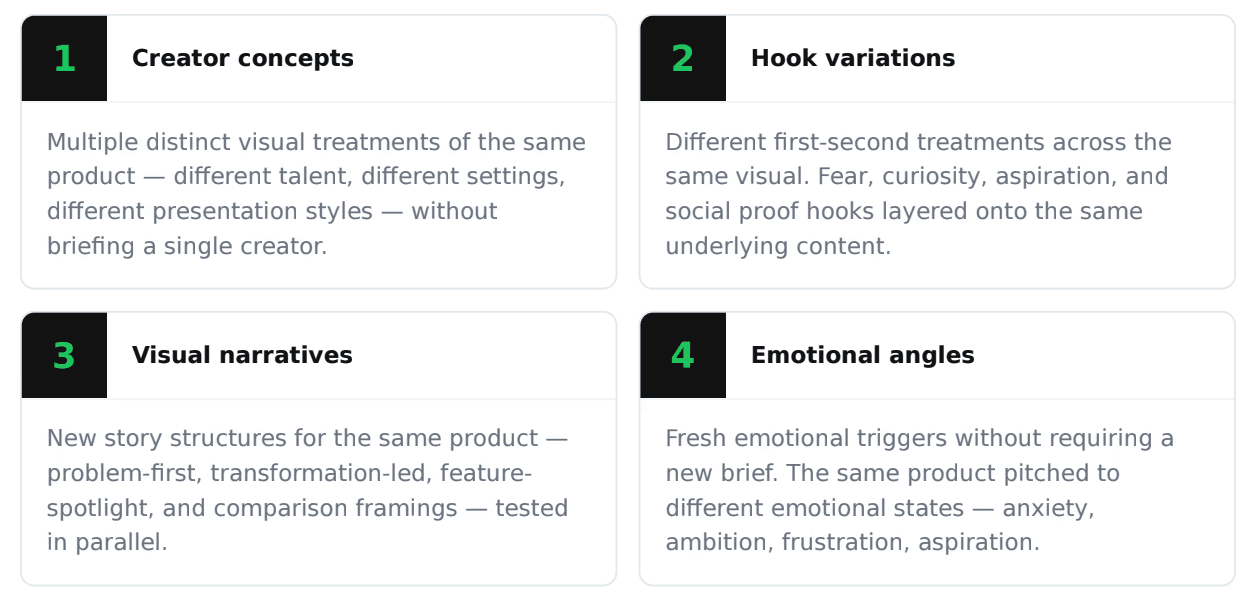
The 4 outputs one product upload generates
When you upload your product information into Seedance 2.0, you're not
getting one creative with minor variations. You're getting four distinct
dimensions of output — each one a different lever to test in the Meta auction.
The exact workflow step by step
Here's how the full cycle runs in practice. Each step feeds the next — so by the
end you have 20 structured, testable creatives ready to go live.
STEP 1 Upload your product information to Seedance 2.0
Drop in your product URL, key benefits, target customer, and any existing
winning ad copy. This is the only input you need. Seedance 2.0 reads it as a
creative brief and generates the first batch of concepts automatically.
STEP 2 Generate multiple creator concepts in one session
Seedance 2.0 produces multiple distinct visual treatments — different talent,
different contexts, different visual styles — from the same product information.
What used to require briefing five separate creators now happens in one
session.
STEP 3 Use Claude to write copy for every variant
For each visual concept, paste the creative brief into Claude and generate
hooks, body copy, and CTAs across all four emotional angles. One prompt run
covers the full copy layer for every creative in the batch.
STEP 4 Structure your 20 variants as a testing grid
Pair each visual concept with each hook angle. Label every variant by concept
type and emotional angle so you can read results by dimension — not just by
individual ad. This is what turns 20 creatives into structured signal.
STEP 5 Launch and read signal by dimension
Run all 20 against the same audience. After 1,000 impressions each, you're not
just reading which ad won — you're reading which concept type performed and
which emotional angle outperformed. That signal compounds into every future
batch.
The Claude prompt (copy this exactly)
Once your Seedance 2.0 visuals are ready, paste this into Claude for each
concept batch. It generates hooks and copy across all four emotional angles in
one run.
PROMPT — PASTE INTO CLAUDE · REPLACE THE BRACKETS
# Meta Creative Copy Generator
You are an expert Meta ads copywriter.
Your task: Write hooks and copy for the creative
concepts below. Cover all four emotional angles for
each concept so I have a full testing grid.
Product: [PRODUCT NAME AND ONE-LINE DESCRIPTION]
Target customer: [WHO THEY ARE AND WHAT THEY WANT]
Existing winner (if any): [PASTE BEST PERFORMING AD]
Creative concepts to cover:
[LIST YOUR SEEDANCE CONCEPT TYPES — e.g.]
Concept A: Transformation story
Concept B: Problem-first approach
Concept C: Social proof / results
Concept D: Feature spotlight
Concept E: Comparison framing
Step 1 — For each concept, write 4 hooks
One hook per emotional angle:
- Fear: activate the cost of not acting
- Aspiration: paint the destination they want
- Curiosity: open a loop without resolving it
- Social proof: borrow credibility with specifics
Each hook = max 15 words. Scroll-stopper first line only.
Step 2 — Write body copy for each hook
2-3 sentences that follow the hook's emotional logic.
End with one CTA matched to the angle:
- Fear: escape/protect CTA
- Aspiration: start/achieve CTA
- Curiosity: discover/find out CTA
- Social proof: join/see results CTA
Step 3 — Format as a testing grid
CONCEPT [letter]: [concept name]
ANGLE: [Fear/Aspiration/Curiosity/Social proof]
Hook: [hook copy]
Body: [body copy]
CTA: [call to action]
# Rules:
# - No em dashes, no AI phrases (unlock, leverage)
# - Each hook works as a standalone scroll-stopper
# - Body copy follows the hook's emotional logic exactly
# - CTAs match the angle — no generic "learn more"
# - Vary sentence length and rhythm across all variants
How to run the testing grid
Having 20 variants ready is step one. Here's how to structure the launch so the
data compounds rather than cancels out.
THE TEST ING FRAMEWORK
Run one emotional angle per ad set across all concepts. Same cold audience
across all sets. After 1,000 impressions per variant, pause the bottom two concepts
by CTR within each angle. You're now reading two signals simultaneously — which
concept type performs and which emotional angle outperforms. Layer by layer until
you have a clear winner per dimension
What you're building is a creative signal library. Every batch tells you not
just which ad won — it tells you which dimension drove the result. That data
shapes every brief, every batch, every campaign from here.
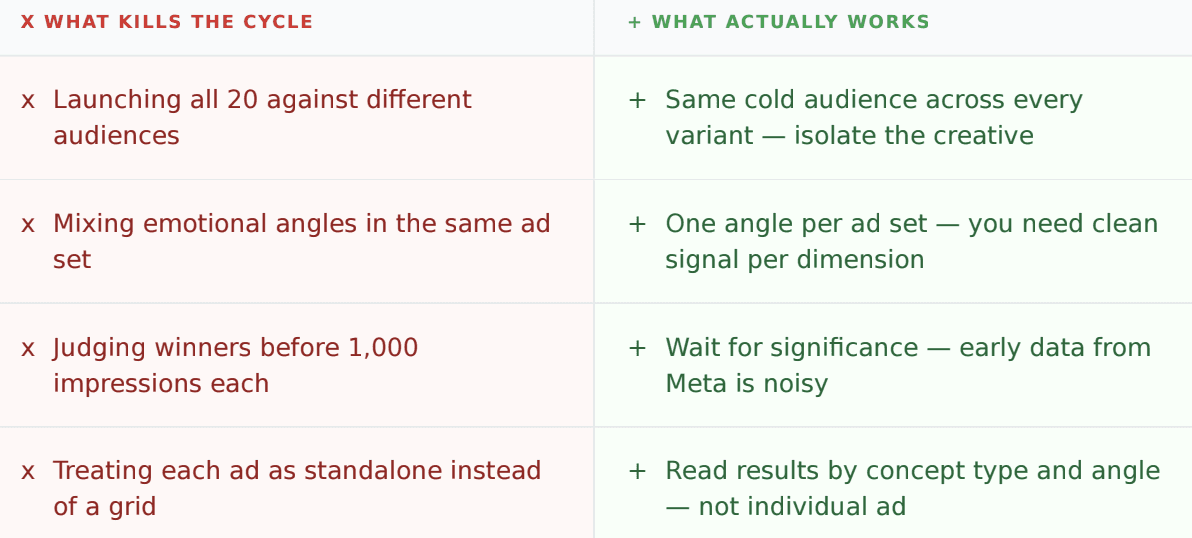
Avoid these mistakes
The real advantage
AI-native teams aren't replacing creative judgment. They're operating on a
different creative clock — one where the time between idea and live test has
collapsed from weeks to minutes.
The compounding effect is brutal for competitors still on the old cycle. Every
week, the AI-native team adds another layer of signal. Every week, the gap
between what they know and what their competitors know gets wider.
They're not smarter. They just started the clock earlier — and they're not
stopping.
1 product upload + Seedance 2.0 + Claude =
20 testable variants = minutes
More tests = more signal = winning creative found faster.
That's the whole game.
A few months ago, launching 20 new Meta creatives meant finding creators,
writing scripts, going through revisions, edits, and approvals. Most brands still
work this way.
The brands that suddenly look impossible to catch aren't smarter. They're not
spending more. They're operating on a completely different creative cycle
— one where the bottleneck between idea and live ad has been eliminated.
The craziest part isn't the content quality. It's the testing speed. While one
team is still debating their next creative, another has already tested 20 angles
and knows which one wins.
WHAT TH IS WORKFLOW PRODUCES
→ Multiple creator concepts from a single product upload
→ Different hooks tested across the same visual narrative
→ Fresh emotional angles without briefing a new creator
→ 20 ready-to-test variants before the old process writes one brief
This is the workflow. Here's exactly how it runs.
The old cycle vs the new one
The difference isn't incremental. It's structural. Every step in the old creative
process is a delay. The new cycle compresses the entire thing into a single
session.
The 4 outputs one product upload generates
When you upload your product information into Seedance 2.0, you're not
getting one creative with minor variations. You're getting four distinct
dimensions of output — each one a different lever to test in the Meta auction.
The exact workflow step by step
Here's how the full cycle runs in practice. Each step feeds the next — so by the
end you have 20 structured, testable creatives ready to go live.
STEP 1 Upload your product information to Seedance 2.0
Drop in your product URL, key benefits, target customer, and any existing
winning ad copy. This is the only input you need. Seedance 2.0 reads it as a
creative brief and generates the first batch of concepts automatically.
STEP 2 Generate multiple creator concepts in one session
Seedance 2.0 produces multiple distinct visual treatments — different talent,
different contexts, different visual styles — from the same product information.
What used to require briefing five separate creators now happens in one
session.
STEP 3 Use Claude to write copy for every variant
For each visual concept, paste the creative brief into Claude and generate
hooks, body copy, and CTAs across all four emotional angles. One prompt run
covers the full copy layer for every creative in the batch.
STEP 4 Structure your 20 variants as a testing grid
Pair each visual concept with each hook angle. Label every variant by concept
type and emotional angle so you can read results by dimension — not just by
individual ad. This is what turns 20 creatives into structured signal.
STEP 5 Launch and read signal by dimension
Run all 20 against the same audience. After 1,000 impressions each, you're not
just reading which ad won — you're reading which concept type performed and
which emotional angle outperformed. That signal compounds into every future
batch.
The Claude prompt (copy this exactly)
Once your Seedance 2.0 visuals are ready, paste this into Claude for each
concept batch. It generates hooks and copy across all four emotional angles in
one run.
PROMPT — PASTE INTO CLAUDE · REPLACE THE BRACKETS
# Meta Creative Copy Generator
You are an expert Meta ads copywriter.
Your task: Write hooks and copy for the creative
concepts below. Cover all four emotional angles for
each concept so I have a full testing grid.
Product: [PRODUCT NAME AND ONE-LINE DESCRIPTION]
Target customer: [WHO THEY ARE AND WHAT THEY WANT]
Existing winner (if any): [PASTE BEST PERFORMING AD]
Creative concepts to cover:
[LIST YOUR SEEDANCE CONCEPT TYPES — e.g.]
Concept A: Transformation story
Concept B: Problem-first approach
Concept C: Social proof / results
Concept D: Feature spotlight
Concept E: Comparison framing
Step 1 — For each concept, write 4 hooks
One hook per emotional angle:
- Fear: activate the cost of not acting
- Aspiration: paint the destination they want
- Curiosity: open a loop without resolving it
- Social proof: borrow credibility with specifics
Each hook = max 15 words. Scroll-stopper first line only.
Step 2 — Write body copy for each hook
2-3 sentences that follow the hook's emotional logic.
End with one CTA matched to the angle:
- Fear: escape/protect CTA
- Aspiration: start/achieve CTA
- Curiosity: discover/find out CTA
- Social proof: join/see results CTA
Step 3 — Format as a testing grid
CONCEPT [letter]: [concept name]
ANGLE: [Fear/Aspiration/Curiosity/Social proof]
Hook: [hook copy]
Body: [body copy]
CTA: [call to action]
# Rules:
# - No em dashes, no AI phrases (unlock, leverage)
# - Each hook works as a standalone scroll-stopper
# - Body copy follows the hook's emotional logic exactly
# - CTAs match the angle — no generic "learn more"
# - Vary sentence length and rhythm across all variants
How to run the testing grid
Having 20 variants ready is step one. Here's how to structure the launch so the
data compounds rather than cancels out.
THE TEST ING FRAMEWORK
Run one emotional angle per ad set across all concepts. Same cold audience
across all sets. After 1,000 impressions per variant, pause the bottom two concepts
by CTR within each angle. You're now reading two signals simultaneously — which
concept type performs and which emotional angle outperforms. Layer by layer until
you have a clear winner per dimension
What you're building is a creative signal library. Every batch tells you not
just which ad won — it tells you which dimension drove the result. That data
shapes every brief, every batch, every campaign from here.
Avoid these mistakes
The real advantage
AI-native teams aren't replacing creative judgment. They're operating on a
different creative clock — one where the time between idea and live test has
collapsed from weeks to minutes.
The compounding effect is brutal for competitors still on the old cycle. Every
week, the AI-native team adds another layer of signal. Every week, the gap
between what they know and what their competitors know gets wider.
They're not smarter. They just started the clock earlier — and they're not
stopping.
1 product upload + Seedance 2.0 + Claude =
20 testable variants = minutes
More tests = more signal = winning creative found faster.
That's the whole game.
A few months ago, launching 20 new Meta creatives meant finding creators,
writing scripts, going through revisions, edits, and approvals. Most brands still
work this way.
The brands that suddenly look impossible to catch aren't smarter. They're not
spending more. They're operating on a completely different creative cycle
— one where the bottleneck between idea and live ad has been eliminated.
The craziest part isn't the content quality. It's the testing speed. While one
team is still debating their next creative, another has already tested 20 angles
and knows which one wins.
WHAT TH IS WORKFLOW PRODUCES
→ Multiple creator concepts from a single product upload
→ Different hooks tested across the same visual narrative
→ Fresh emotional angles without briefing a new creator
→ 20 ready-to-test variants before the old process writes one brief
This is the workflow. Here's exactly how it runs.
The old cycle vs the new one
The difference isn't incremental. It's structural. Every step in the old creative
process is a delay. The new cycle compresses the entire thing into a single
session.
The 4 outputs one product upload generates
When you upload your product information into Seedance 2.0, you're not
getting one creative with minor variations. You're getting four distinct
dimensions of output — each one a different lever to test in the Meta auction.
The exact workflow step by step
Here's how the full cycle runs in practice. Each step feeds the next — so by the
end you have 20 structured, testable creatives ready to go live.
STEP 1 Upload your product information to Seedance 2.0
Drop in your product URL, key benefits, target customer, and any existing
winning ad copy. This is the only input you need. Seedance 2.0 reads it as a
creative brief and generates the first batch of concepts automatically.
STEP 2 Generate multiple creator concepts in one session
Seedance 2.0 produces multiple distinct visual treatments — different talent,
different contexts, different visual styles — from the same product information.
What used to require briefing five separate creators now happens in one
session.
STEP 3 Use Claude to write copy for every variant
For each visual concept, paste the creative brief into Claude and generate
hooks, body copy, and CTAs across all four emotional angles. One prompt run
covers the full copy layer for every creative in the batch.
STEP 4 Structure your 20 variants as a testing grid
Pair each visual concept with each hook angle. Label every variant by concept
type and emotional angle so you can read results by dimension — not just by
individual ad. This is what turns 20 creatives into structured signal.
STEP 5 Launch and read signal by dimension
Run all 20 against the same audience. After 1,000 impressions each, you're not
just reading which ad won — you're reading which concept type performed and
which emotional angle outperformed. That signal compounds into every future
batch.
The Claude prompt (copy this exactly)
Once your Seedance 2.0 visuals are ready, paste this into Claude for each
concept batch. It generates hooks and copy across all four emotional angles in
one run.
PROMPT — PASTE INTO CLAUDE · REPLACE THE BRACKETS
# Meta Creative Copy Generator
You are an expert Meta ads copywriter.
Your task: Write hooks and copy for the creative
concepts below. Cover all four emotional angles for
each concept so I have a full testing grid.
Product: [PRODUCT NAME AND ONE-LINE DESCRIPTION]
Target customer: [WHO THEY ARE AND WHAT THEY WANT]
Existing winner (if any): [PASTE BEST PERFORMING AD]
Creative concepts to cover:
[LIST YOUR SEEDANCE CONCEPT TYPES — e.g.]
Concept A: Transformation story
Concept B: Problem-first approach
Concept C: Social proof / results
Concept D: Feature spotlight
Concept E: Comparison framing
Step 1 — For each concept, write 4 hooks
One hook per emotional angle:
- Fear: activate the cost of not acting
- Aspiration: paint the destination they want
- Curiosity: open a loop without resolving it
- Social proof: borrow credibility with specifics
Each hook = max 15 words. Scroll-stopper first line only.
Step 2 — Write body copy for each hook
2-3 sentences that follow the hook's emotional logic.
End with one CTA matched to the angle:
- Fear: escape/protect CTA
- Aspiration: start/achieve CTA
- Curiosity: discover/find out CTA
- Social proof: join/see results CTA
Step 3 — Format as a testing grid
CONCEPT [letter]: [concept name]
ANGLE: [Fear/Aspiration/Curiosity/Social proof]
Hook: [hook copy]
Body: [body copy]
CTA: [call to action]
# Rules:
# - No em dashes, no AI phrases (unlock, leverage)
# - Each hook works as a standalone scroll-stopper
# - Body copy follows the hook's emotional logic exactly
# - CTAs match the angle — no generic "learn more"
# - Vary sentence length and rhythm across all variants
How to run the testing grid
Having 20 variants ready is step one. Here's how to structure the launch so the
data compounds rather than cancels out.
THE TEST ING FRAMEWORK
Run one emotional angle per ad set across all concepts. Same cold audience
across all sets. After 1,000 impressions per variant, pause the bottom two concepts
by CTR within each angle. You're now reading two signals simultaneously — which
concept type performs and which emotional angle outperforms. Layer by layer until
you have a clear winner per dimension
What you're building is a creative signal library. Every batch tells you not
just which ad won — it tells you which dimension drove the result. That data
shapes every brief, every batch, every campaign from here.
Avoid these mistakes
The real advantage
AI-native teams aren't replacing creative judgment. They're operating on a
different creative clock — one where the time between idea and live test has
collapsed from weeks to minutes.
The compounding effect is brutal for competitors still on the old cycle. Every
week, the AI-native team adds another layer of signal. Every week, the gap
between what they know and what their competitors know gets wider.
They're not smarter. They just started the clock earlier — and they're not
stopping.
1 product upload + Seedance 2.0 + Claude =
20 testable variants = minutes
More tests = more signal = winning creative found faster.
That's the whole game.