Most Meta advertisers test too randomly. They launch a few creatives, pick the
best performer after a week, and call it a strategy.
The top buyers do something different. They test systematically — isolating
variables so every experiment tells them something the others can't.
That's the entire difference between a brand that finds a winning ad by luck
and one that builds a repeatable system for finding winners.
THE CORE INSIGHT
→ 50 random creatives give you noise
→ 27 structured experiments give you signal
→ The constraint was never ideas — it was the time between idea and live ad
→ Claude closes that gap entirely
THE CORE INSIGHT
→ 50 random creatives give you noise
→ 27 structured experiments give you signal
→ The constraint was never ideas — it was the time between idea and live ad
→ Claude closes that gap entirely
THE CORE INSIGHT
→ 50 random creatives give you noise
→ 27 structured experiments give you signal
→ The constraint was never ideas — it was the time between idea and live ad
→ Claude closes that gap entirely
3 variables. 3 options each. Every combination is a structured test with a clear
hypothesis. Here's the full system.
The 3 variables every Meta test needs to cover
Before you look at the prompt, understand the framework underneath it. Every
high-performing Meta ad is a combination of three decisions. Test them in
isolation and the data compounds. Test them randomly and it cancels out.
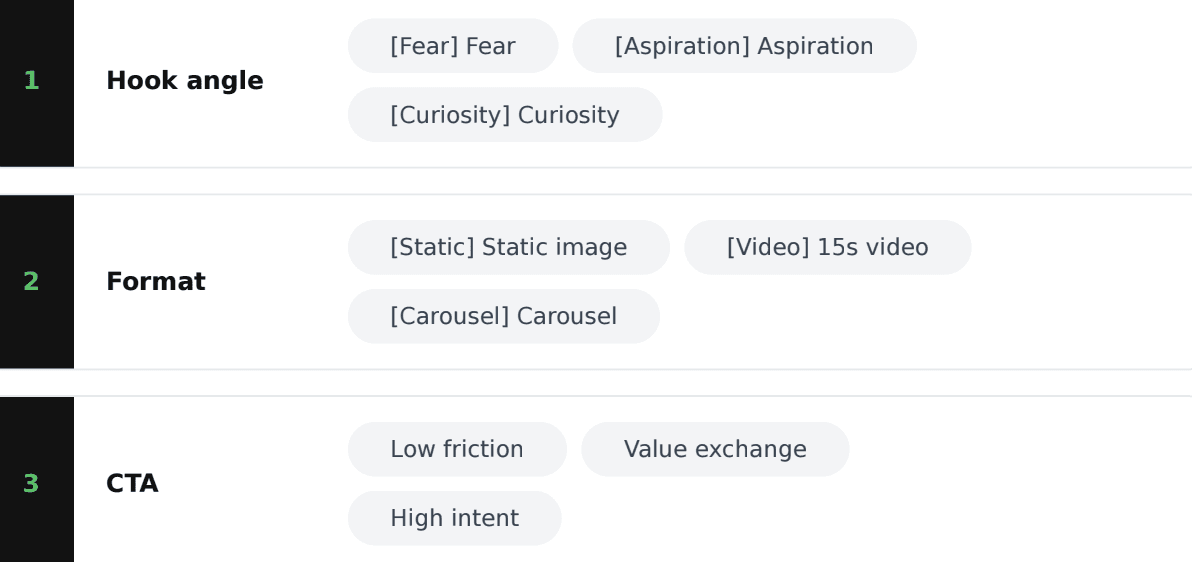
3 variables × 3 options = 27 structured experiments
3 variables × 3 options = 27 structured experiments
3 variables × 3 options = 27 structured experiments
Each combination is its own hypothesis. Fear hook + static image + low-friction
CTA tells you something completely different from aspiration hook + carousel +
high-intent CTA. That's the signal.
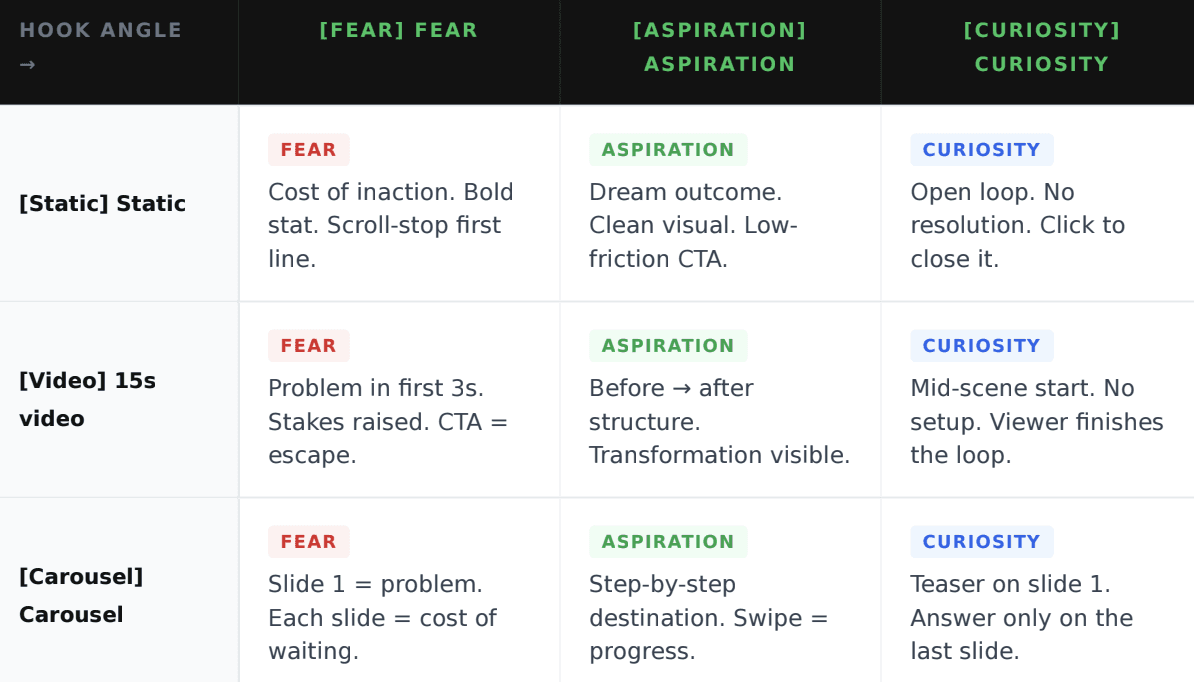
What the 3×3 matrix looks like in practice
Here's how the combinations map out across hook angle and format. Each cell
is one ready-to-brief experiment — hook type, format, and CTA defined before a
single word is written.
How Claude generates all 27 variants in under 10 minutes
Here's the exact sequence. One prompt, one paste, full swipe file output —
structured, labelled, and ready to brief your designer.
1 Reads your product and landing page
Claude takes your product URL or brief and extracts the core claims, benefits, and
emotional triggers. It reads the copy the way a cold prospect would — looking for
what would actually stop a scroll.
2 Maps every combination across the 3×3 grid
For each of the 9 format–hook combinations, Claude writes copy matched to that
specific angle. Not generic variations — each one is built around the emotional
logic of that cell.
3 Writes 3 CTA variants per combination
Each hook + format combination gets three CTA treatments: low friction ("See
how it works"), value exchange ("Get the free guide"), high intent ("Start your
trial"). That's where the 27 comes from.
4 Labels and formats the full swipe file
Every variant is tagged by hook type, format, and CTA — so you can filter by
angle and run structured tests rather than random experiments. Clean enough to
paste directly into a designer brief.
The prompt (copy this exactly)
Paste this into Claude with your product URL or brief. Replace only the words in
brackets — everything else is intentional.
PROMPT — PASTE INTO CLAUDE · REPLACE THE BRACKETS

# 3×3 Meta Creative Testing System
You are an expert direct-response Meta ads copywriter.
Your task: Generate 27 Meta ad copy variants for the
product below using a structured 3×3 testing framework.
Product URL / brief: [PASTE YOUR URL OR PRODUCT BRIEF]
Step 1 — Extract core emotional triggers
Read the product page and identify:
- The 3 deepest fears your customer has right now
- The 3 strongest aspirations they're chasing
- The 3 curiosity gaps your product can open
Step 2 — Generate copy across the 3×3 grid
For each combination of Hook angle × Format, write one
complete ad hook (max 15 words) + 3 CTA variants:
Variables:
- Hook angle: Fear / Aspiration / Curiosity
- Format: Static image / 15s video / Carousel
- CTA: Low friction / Value exchange / High intent
Step 3 — Format as a labelled swipe file
EXPERIMENT [number]: [Hook] × [Format] × [CTA type]
→ Hook copy: [first line, max 15 words]
→ CTA copy: [call to action text]
→ Brief note: [one line for the designer]
# Rules:
# - No em dashes, no AI phrases (unlock, leverage)
# - Each hook works as a standalone scroll-stopper
# - Fear hooks activate cost of inaction — not fear itself
# - Curiosity hooks open a loop without resolving it
# - Vary sentence length and rhythm across all 27
Product brief:
[PASTE HERE]
PROMPT — PASTE INTO CLAUDE · REPLACE THE BRACKETS

# 3×3 Meta Creative Testing System
You are an expert direct-response Meta ads copywriter.
Your task: Generate 27 Meta ad copy variants for the
product below using a structured 3×3 testing framework.
Product URL / brief: [PASTE YOUR URL OR PRODUCT BRIEF]
Step 1 — Extract core emotional triggers
Read the product page and identify:
- The 3 deepest fears your customer has right now
- The 3 strongest aspirations they're chasing
- The 3 curiosity gaps your product can open
Step 2 — Generate copy across the 3×3 grid
For each combination of Hook angle × Format, write one
complete ad hook (max 15 words) + 3 CTA variants:
Variables:
- Hook angle: Fear / Aspiration / Curiosity
- Format: Static image / 15s video / Carousel
- CTA: Low friction / Value exchange / High intent
Step 3 — Format as a labelled swipe file
EXPERIMENT [number]: [Hook] × [Format] × [CTA type]
→ Hook copy: [first line, max 15 words]
→ CTA copy: [call to action text]
→ Brief note: [one line for the designer]
# Rules:
# - No em dashes, no AI phrases (unlock, leverage)
# - Each hook works as a standalone scroll-stopper
# - Fear hooks activate cost of inaction — not fear itself
# - Curiosity hooks open a loop without resolving it
# - Vary sentence length and rhythm across all 27
Product brief:
[PASTE HERE]
PROMPT — PASTE INTO CLAUDE · REPLACE THE BRACKETS

# 3×3 Meta Creative Testing System
You are an expert direct-response Meta ads copywriter.
Your task: Generate 27 Meta ad copy variants for the
product below using a structured 3×3 testing framework.
Product URL / brief: [PASTE YOUR URL OR PRODUCT BRIEF]
Step 1 — Extract core emotional triggers
Read the product page and identify:
- The 3 deepest fears your customer has right now
- The 3 strongest aspirations they're chasing
- The 3 curiosity gaps your product can open
Step 2 — Generate copy across the 3×3 grid
For each combination of Hook angle × Format, write one
complete ad hook (max 15 words) + 3 CTA variants:
Variables:
- Hook angle: Fear / Aspiration / Curiosity
- Format: Static image / 15s video / Carousel
- CTA: Low friction / Value exchange / High intent
Step 3 — Format as a labelled swipe file
EXPERIMENT [number]: [Hook] × [Format] × [CTA type]
→ Hook copy: [first line, max 15 words]
→ CTA copy: [call to action text]
→ Brief note: [one line for the designer]
# Rules:
# - No em dashes, no AI phrases (unlock, leverage)
# - Each hook works as a standalone scroll-stopper
# - Fear hooks activate cost of inaction — not fear itself
# - Curiosity hooks open a loop without resolving it
# - Vary sentence length and rhythm across all 27
Product brief:
[PASTE HERE]
How to use the output
Getting 27 variants is step one. Here's how to turn them into actual test results
that compound.
THE TESTING FRAMEWORK
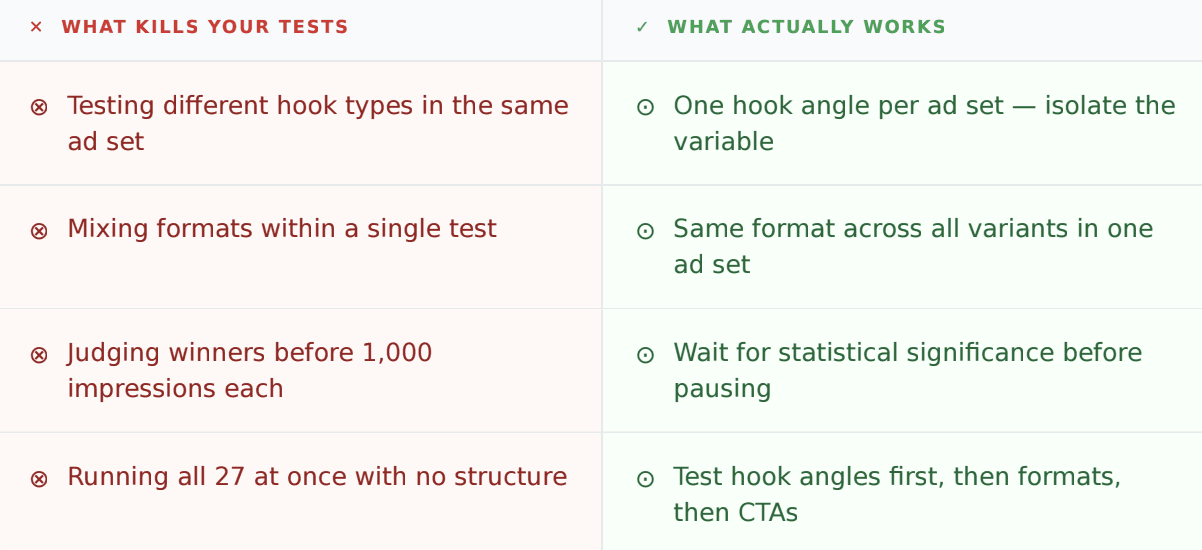
Run one combination per ad set, targeting the same cold audience. After 3–4
days and 1,000 impressions per variant, pause the bottom performers by CTR.
Reinvest into the top hook angle. Then test CTA variants within that winner. Layer
by layer until you have a clear champion per intent level
THE TESTING FRAMEWORK
Run one combination per ad set, targeting the same cold audience. After 3–4
days and 1,000 impressions per variant, pause the bottom performers by CTR.
Reinvest into the top hook angle. Then test CTA variants within that winner. Layer
by layer until you have a clear champion per intent level
THE TESTING FRAMEWORK
Run one combination per ad set, targeting the same cold audience. After 3–4
days and 1,000 impressions per variant, pause the bottom performers by CTR.
Reinvest into the top hook angle. Then test CTA variants within that winner. Layer
by layer until you have a clear champion per intent level
What you're building is a structured signal factory. Each test tells you not
just which ad performed — it tells you which variable drove the result. That's
data you can apply to every campaign you run from here.
Avoid these mistakes
The real advantage
The media buyers using this aren't replacing creative judgment. They're
offloading the volume problem to Claude so their judgment has more signal to
work with.
Your designer builds the master template once. You swap the hooks across
variants. No brief needed. No back-and-forth. Launch-ready in an hour.
The constraint was never ideas. It was the time between idea and live ad.
3 variables × 3 options = 27 experiments = real signal
More structured tests = cleaner signal = winning ads faster.
That's the whole game.