5 Key Elements of a Successful AI Marketing Strategy
Nov 28, 2025
Nov 28, 2025


Marketing in 2026 has become more accessible but it sure has become complicated than it was a few years ago. Brands and businesses are constantly competing against each other at all times making fast execution a priority.
With AI marketing strategy being adopted across the world, businesses of all sizes can now adopt and experiment with their existing resources to produce better results. Through this blog let us understand the key elements involved in a successful marketing strategy for businesses.
What Is AI Marketing Strategy?
AI marketing strategy is the use of artificial intelligence in your daily marketing tasks to make them faster, accurate, and efficient. Most AI tools for marketing strategy are equipped with the abilities to generate content of all forms, ad creatives, videos, predictive analysis, and much more.
AI can predict users' behavior based on their past data and predict whether or not they will be making a purchase. Unlike traditional marketing strategies, this is far more efficient and helps in taking informed decisions.
What Are the Key Elements of AI for Marketing Strategy?
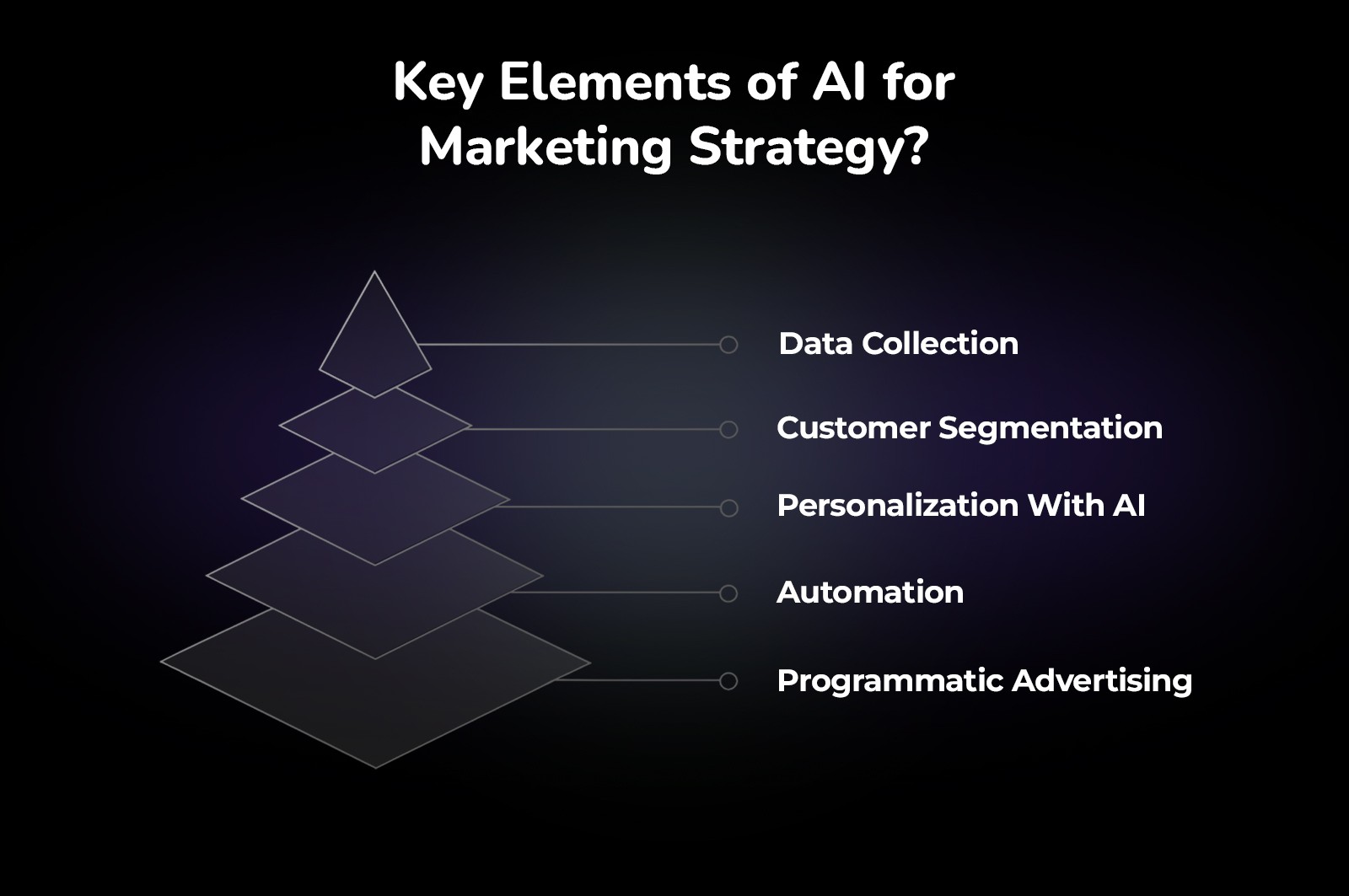
Your marketing strategy needs to be revamped before it's too late. With more companies and businesses leaning towards the efficient use of AI marketing strategy, it has become a necessity. But to begin with a successful transition, you must start systematically and not all at once. The ideal way of transitioning is to replace one task at a time to understand this better. Let us go through the elements of AI for marketing strategy.
Data Collection
An AI marketing strategy must include tools for data collection and analysis, as it can process large amounts of data within minutes. Besides this, AI tools are proficient in spotting patterns based on previous data. For example, from previous sales data, AI can predict seasonal demand.
Customer Segmentation
AI categorizes your customers based on the actions they perform on your website. It can determine the likes of the customer based on their search history, the time they spend on a product page, and the items they have in their cart. With this data, marketers can target every customer with different ad creatives.
Personalization With AI
AI marketing strategy tools have unique features that humans could never tackle with traditional marketing methods. Personalization with AI is one of those features that makes the user experience much more interactive and increases the chances of sale. For example, if a user searches for a specific denim on your website, their upcoming suggestions will include denim in the preferred color or design.
Automation
Automation tools within AI marketing strategy have contributed to making marketing more accessible. AI tools for marketing strategy can automate tasks such as email marketing, generating creative variations, social media posting, generating reports, and even managing FAQs by customers. This allows marketing teams to focus on ideation, creative tasks, and strategizing for future campaigns.
Programmatic Advertising
AI marketing tools are efficient in audience targeting; they automatically detect where and which audience to target based on user actions. Meta already has this integrated within its system to allow marketers to bid the best price instantly for targeting their ideal audience for Meta ads.
How to Get Started With AI Marketing Strategy?
Step 1: Analyze Your Current Strategy
Carefully analyze your existing marketing strategy and list down the tasks that you want to include in your strategy. Besides this, also list down the tasks that take up most of your team’s time and resources. Rearrange tasks on this list based on the most important ones (that affect your revenue) and the least important.

Step 2: Choose Where AI Can Make A Real Difference
Every task does not require AI, which is why you must carefully analyze and decide which sections would benefit the most from AI integration. Start with basic tasks such as handling customer data, generating ad variations, or brainstorming. Start by adding 2 to 3 basic tasks to make the transition easier. These tasks can include:
Email marketing
Social media posting
Ad optimization
Step 3: Choose The Right Tools
Picking a tool can be a bit challenging, as you must see clearly through the noise about the USPs and really explore how it would be beneficial for your team. Test different tools using their free trials; take as many demos as possible to analyze how they would solve your problem. Choose a tool that solves your specific problem and make sure it aligns with your existing tool stack. Invest time in training your team properly to make a noticeable difference.
Step 4: Analyse and Improvise
Analyze the performance of your new AI tool closely. Set clear measurable goals to assess the efficiency of your new AI marketing strategy. These goals can be reducing production time by 30%, increasing email opens by 10%, etc. Take suggestions from your team about the tool’s efficiency, and make sure to replace the tool if it does not contribute value.
Benefits of AI in Marketing
Building the right AI marketing strategy does not indicate that you must improvise every task. AI cannot fully replace all marketing tasks. Start by optimizing a one-time taking or repetitive task, analyze the results, and then move to other tasks one by one. This way you can accurately measure the outcome that the AI tool brings to your marketing team.
This task can be writing content, generating ad creatives, optimizing ad budget according to performance, and more. The benefits of AI in marketing are so huge that even smaller companies with little to no resources can now place their products alongside giants.
With AI marketing strategy tools like Vibelets, marketers can automate time-taking tasks, analyze the loopholes in their ad campaigns, and generate winning ads within minutes. Join the waitlist today to experience the future of marketing.
Marketing in 2026 has become more accessible but it sure has become complicated than it was a few years ago. Brands and businesses are constantly competing against each other at all times making fast execution a priority.
With AI marketing strategy being adopted across the world, businesses of all sizes can now adopt and experiment with their existing resources to produce better results. Through this blog let us understand the key elements involved in a successful marketing strategy for businesses.
What Is AI Marketing Strategy?
AI marketing strategy is the use of artificial intelligence in your daily marketing tasks to make them faster, accurate, and efficient. Most AI tools for marketing strategy are equipped with the abilities to generate content of all forms, ad creatives, videos, predictive analysis, and much more.
AI can predict users' behavior based on their past data and predict whether or not they will be making a purchase. Unlike traditional marketing strategies, this is far more efficient and helps in taking informed decisions.
What Are the Key Elements of AI for Marketing Strategy?

Your marketing strategy needs to be revamped before it's too late. With more companies and businesses leaning towards the efficient use of AI marketing strategy, it has become a necessity. But to begin with a successful transition, you must start systematically and not all at once. The ideal way of transitioning is to replace one task at a time to understand this better. Let us go through the elements of AI for marketing strategy.
Data Collection
An AI marketing strategy must include tools for data collection and analysis, as it can process large amounts of data within minutes. Besides this, AI tools are proficient in spotting patterns based on previous data. For example, from previous sales data, AI can predict seasonal demand.
Customer Segmentation
AI categorizes your customers based on the actions they perform on your website. It can determine the likes of the customer based on their search history, the time they spend on a product page, and the items they have in their cart. With this data, marketers can target every customer with different ad creatives.
Personalization With AI
AI marketing strategy tools have unique features that humans could never tackle with traditional marketing methods. Personalization with AI is one of those features that makes the user experience much more interactive and increases the chances of sale. For example, if a user searches for a specific denim on your website, their upcoming suggestions will include denim in the preferred color or design.
Automation
Automation tools within AI marketing strategy have contributed to making marketing more accessible. AI tools for marketing strategy can automate tasks such as email marketing, generating creative variations, social media posting, generating reports, and even managing FAQs by customers. This allows marketing teams to focus on ideation, creative tasks, and strategizing for future campaigns.
Programmatic Advertising
AI marketing tools are efficient in audience targeting; they automatically detect where and which audience to target based on user actions. Meta already has this integrated within its system to allow marketers to bid the best price instantly for targeting their ideal audience for Meta ads.
How to Get Started With AI Marketing Strategy?
Step 1: Analyze Your Current Strategy
Carefully analyze your existing marketing strategy and list down the tasks that you want to include in your strategy. Besides this, also list down the tasks that take up most of your team’s time and resources. Rearrange tasks on this list based on the most important ones (that affect your revenue) and the least important.

Step 2: Choose Where AI Can Make A Real Difference
Every task does not require AI, which is why you must carefully analyze and decide which sections would benefit the most from AI integration. Start with basic tasks such as handling customer data, generating ad variations, or brainstorming. Start by adding 2 to 3 basic tasks to make the transition easier. These tasks can include:
Email marketing
Social media posting
Ad optimization
Step 3: Choose The Right Tools
Picking a tool can be a bit challenging, as you must see clearly through the noise about the USPs and really explore how it would be beneficial for your team. Test different tools using their free trials; take as many demos as possible to analyze how they would solve your problem. Choose a tool that solves your specific problem and make sure it aligns with your existing tool stack. Invest time in training your team properly to make a noticeable difference.
Step 4: Analyse and Improvise
Analyze the performance of your new AI tool closely. Set clear measurable goals to assess the efficiency of your new AI marketing strategy. These goals can be reducing production time by 30%, increasing email opens by 10%, etc. Take suggestions from your team about the tool’s efficiency, and make sure to replace the tool if it does not contribute value.
Benefits of AI in Marketing
Building the right AI marketing strategy does not indicate that you must improvise every task. AI cannot fully replace all marketing tasks. Start by optimizing a one-time taking or repetitive task, analyze the results, and then move to other tasks one by one. This way you can accurately measure the outcome that the AI tool brings to your marketing team.
This task can be writing content, generating ad creatives, optimizing ad budget according to performance, and more. The benefits of AI in marketing are so huge that even smaller companies with little to no resources can now place their products alongside giants.
With AI marketing strategy tools like Vibelets, marketers can automate time-taking tasks, analyze the loopholes in their ad campaigns, and generate winning ads within minutes. Join the waitlist today to experience the future of marketing.
Marketing in 2026 has become more accessible but it sure has become complicated than it was a few years ago. Brands and businesses are constantly competing against each other at all times making fast execution a priority.
With AI marketing strategy being adopted across the world, businesses of all sizes can now adopt and experiment with their existing resources to produce better results. Through this blog let us understand the key elements involved in a successful marketing strategy for businesses.
What Is AI Marketing Strategy?
AI marketing strategy is the use of artificial intelligence in your daily marketing tasks to make them faster, accurate, and efficient. Most AI tools for marketing strategy are equipped with the abilities to generate content of all forms, ad creatives, videos, predictive analysis, and much more.
AI can predict users' behavior based on their past data and predict whether or not they will be making a purchase. Unlike traditional marketing strategies, this is far more efficient and helps in taking informed decisions.
What Are the Key Elements of AI for Marketing Strategy?

Your marketing strategy needs to be revamped before it's too late. With more companies and businesses leaning towards the efficient use of AI marketing strategy, it has become a necessity. But to begin with a successful transition, you must start systematically and not all at once. The ideal way of transitioning is to replace one task at a time to understand this better. Let us go through the elements of AI for marketing strategy.
Data Collection
An AI marketing strategy must include tools for data collection and analysis, as it can process large amounts of data within minutes. Besides this, AI tools are proficient in spotting patterns based on previous data. For example, from previous sales data, AI can predict seasonal demand.
Customer Segmentation
AI categorizes your customers based on the actions they perform on your website. It can determine the likes of the customer based on their search history, the time they spend on a product page, and the items they have in their cart. With this data, marketers can target every customer with different ad creatives.
Personalization With AI
AI marketing strategy tools have unique features that humans could never tackle with traditional marketing methods. Personalization with AI is one of those features that makes the user experience much more interactive and increases the chances of sale. For example, if a user searches for a specific denim on your website, their upcoming suggestions will include denim in the preferred color or design.
Automation
Automation tools within AI marketing strategy have contributed to making marketing more accessible. AI tools for marketing strategy can automate tasks such as email marketing, generating creative variations, social media posting, generating reports, and even managing FAQs by customers. This allows marketing teams to focus on ideation, creative tasks, and strategizing for future campaigns.
Programmatic Advertising
AI marketing tools are efficient in audience targeting; they automatically detect where and which audience to target based on user actions. Meta already has this integrated within its system to allow marketers to bid the best price instantly for targeting their ideal audience for Meta ads.
How to Get Started With AI Marketing Strategy?
Step 1: Analyze Your Current Strategy
Carefully analyze your existing marketing strategy and list down the tasks that you want to include in your strategy. Besides this, also list down the tasks that take up most of your team’s time and resources. Rearrange tasks on this list based on the most important ones (that affect your revenue) and the least important.

Step 2: Choose Where AI Can Make A Real Difference
Every task does not require AI, which is why you must carefully analyze and decide which sections would benefit the most from AI integration. Start with basic tasks such as handling customer data, generating ad variations, or brainstorming. Start by adding 2 to 3 basic tasks to make the transition easier. These tasks can include:
Email marketing
Social media posting
Ad optimization
Step 3: Choose The Right Tools
Picking a tool can be a bit challenging, as you must see clearly through the noise about the USPs and really explore how it would be beneficial for your team. Test different tools using their free trials; take as many demos as possible to analyze how they would solve your problem. Choose a tool that solves your specific problem and make sure it aligns with your existing tool stack. Invest time in training your team properly to make a noticeable difference.
Step 4: Analyse and Improvise
Analyze the performance of your new AI tool closely. Set clear measurable goals to assess the efficiency of your new AI marketing strategy. These goals can be reducing production time by 30%, increasing email opens by 10%, etc. Take suggestions from your team about the tool’s efficiency, and make sure to replace the tool if it does not contribute value.
Benefits of AI in Marketing
Building the right AI marketing strategy does not indicate that you must improvise every task. AI cannot fully replace all marketing tasks. Start by optimizing a one-time taking or repetitive task, analyze the results, and then move to other tasks one by one. This way you can accurately measure the outcome that the AI tool brings to your marketing team.
This task can be writing content, generating ad creatives, optimizing ad budget according to performance, and more. The benefits of AI in marketing are so huge that even smaller companies with little to no resources can now place their products alongside giants.
With AI marketing strategy tools like Vibelets, marketers can automate time-taking tasks, analyze the loopholes in their ad campaigns, and generate winning ads within minutes. Join the waitlist today to experience the future of marketing.