Creative volume is the bottleneck for most paid social teams. You can nail your
targeting, tighten your bidding, and still watch ROAS flatline because you're running
the same three creatives for three months.
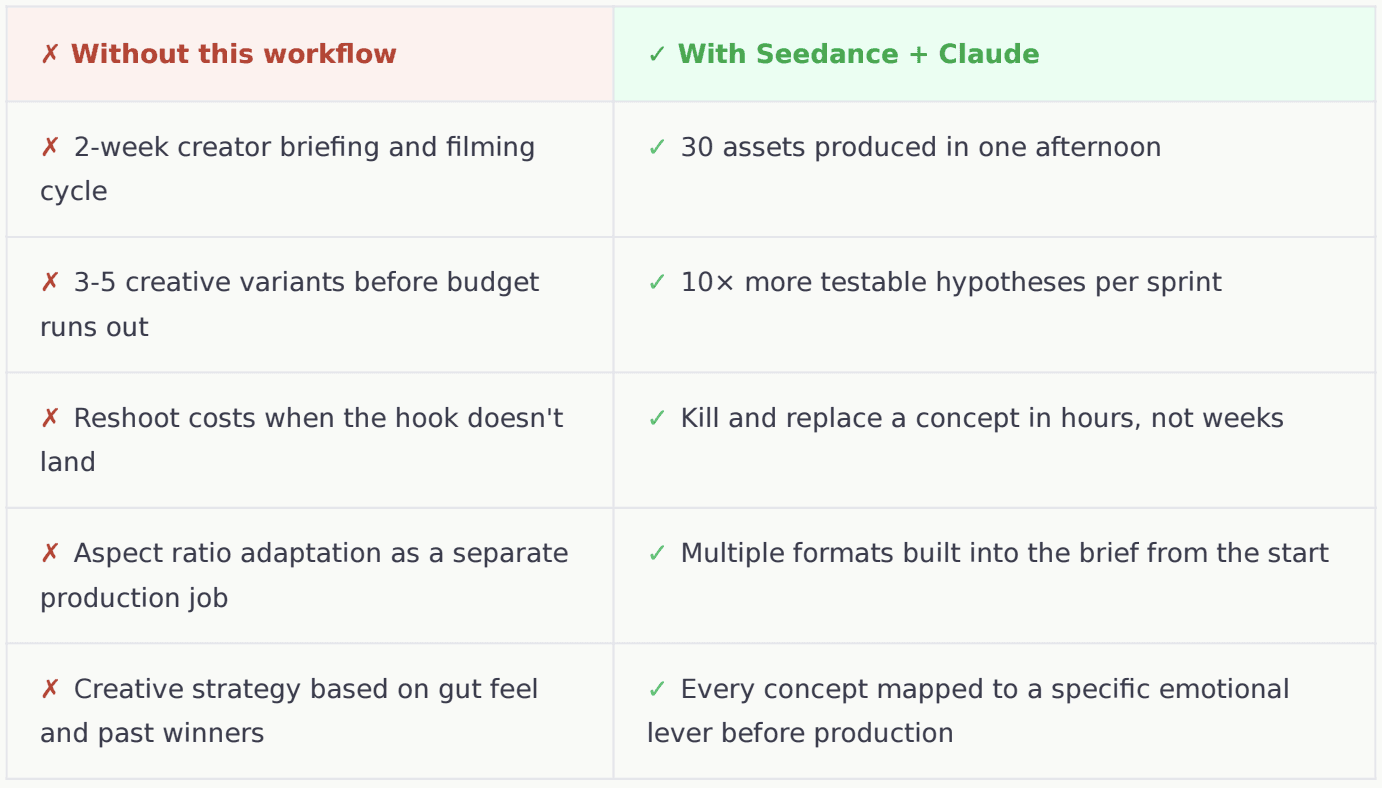
The old way: brief a creator, wait two weeks, review raw footage, reshoot half of it,
edit, adapt for four aspect ratios. By the time your creative is live, the hook that
tested well is already stale.
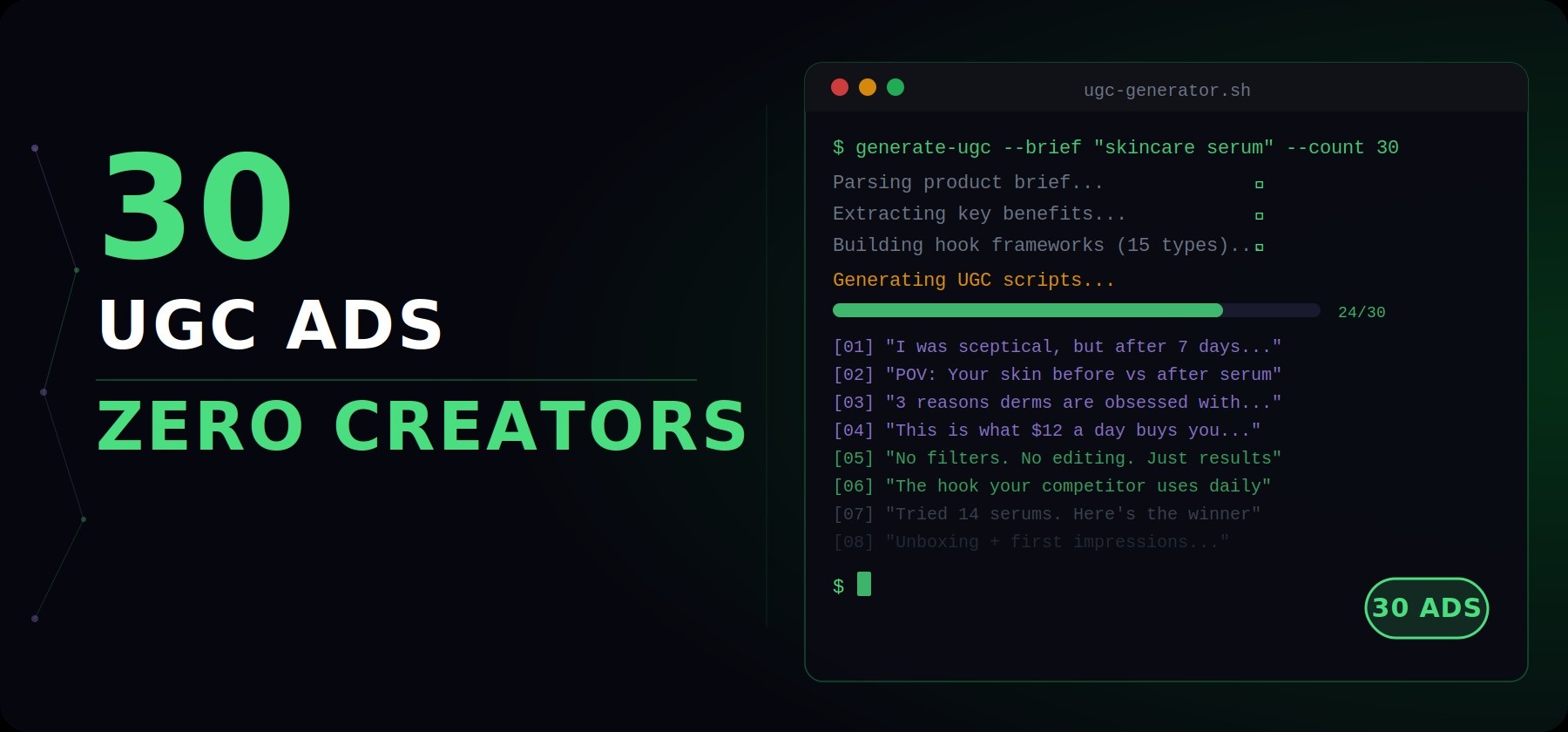
Seedance 2.0 removes most of that cycle. One afternoon, one product brief, 30
testable UGC-style ads. Here's the complete workflow.
"Every creative starts as a hypothesis. Now we can test 10x more of them before any creator gets briefed."
This guide gives you the exact workflow structure, the Claude prompts to brief
Seedance 2.0 intelligently, and a testing framework so your 30 assets don't just
exist, they produce signal.
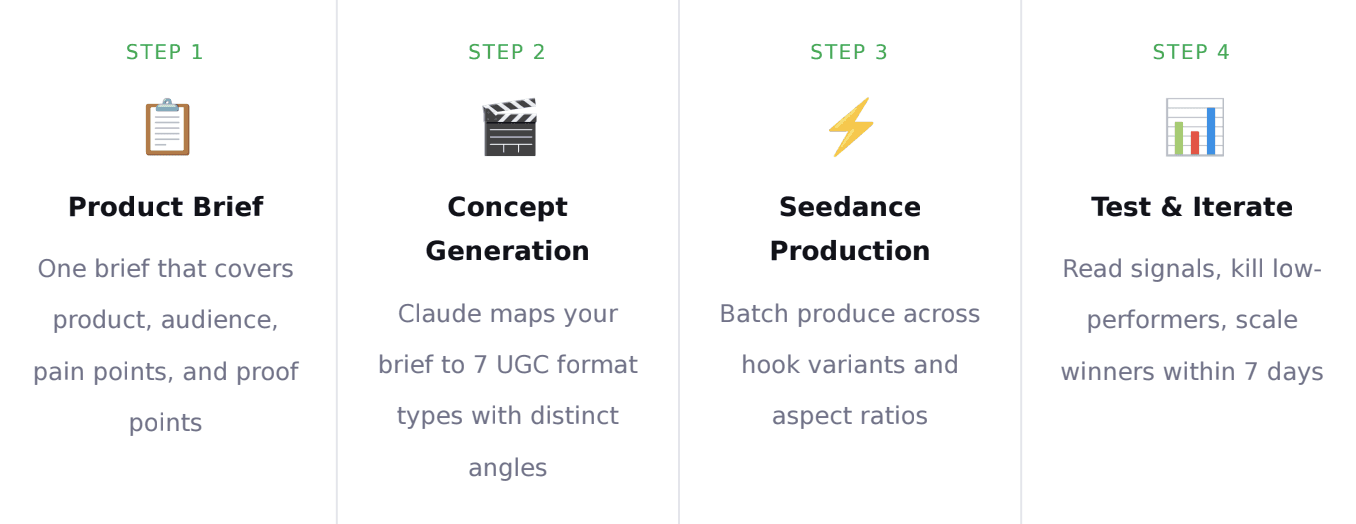
How the workflow runs
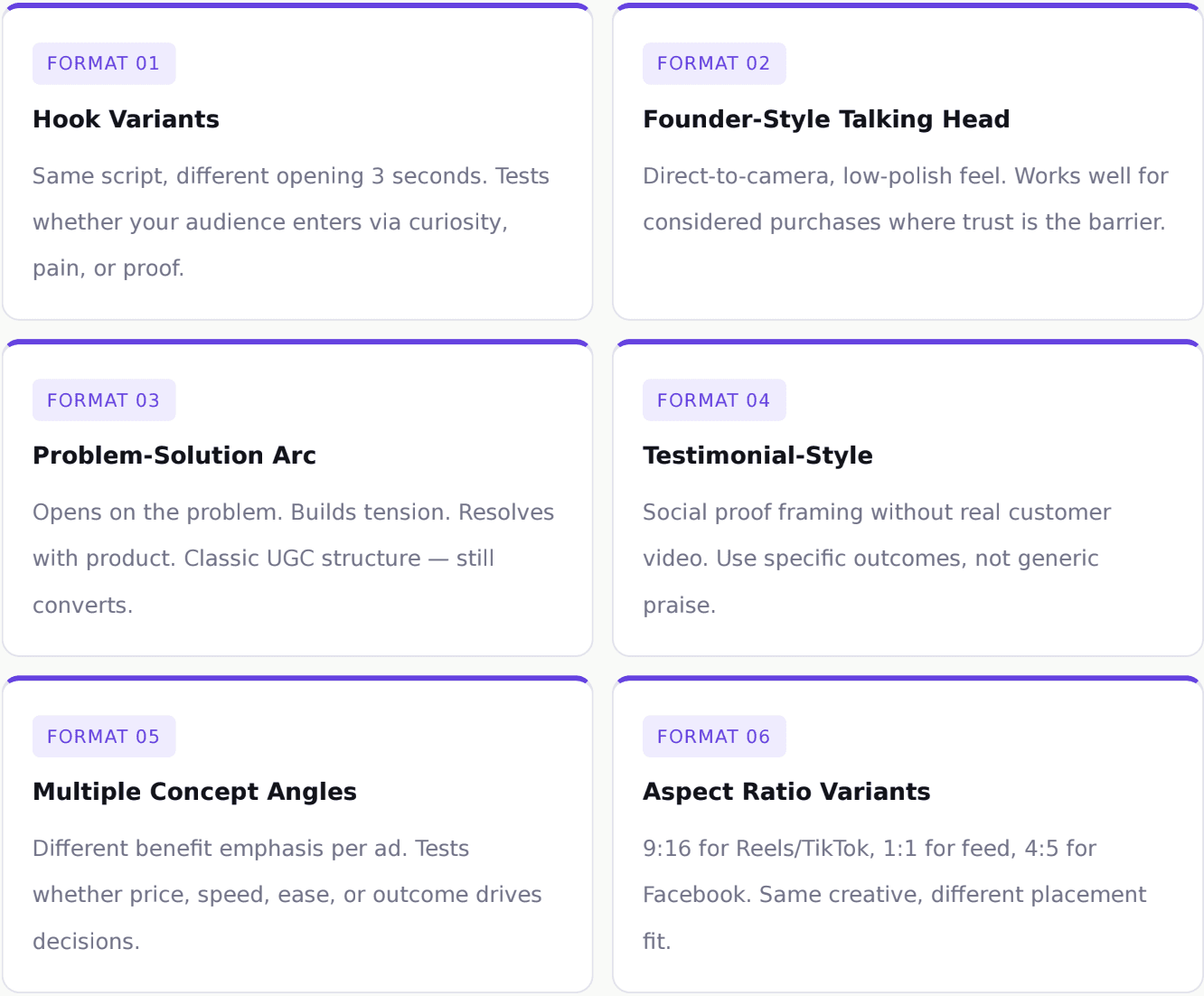
The 7 UGC formats to produce
Each format type targets a different psychological entry point. Testing across all
seven tells you which emotional lever your audience actually responds to before
you invest in expensive creator content.
WHY VOLUME MATTERS
Meta's delivery system rewards creative diversity. Running 30 distinct assets across one
campaign gives the algorithm more signal to find the right audience segment. More
assets in rotation also extends creative fatigue timelines significantly
WHY VOLUME MATTERS
Meta's delivery system rewards creative diversity. Running 30 distinct assets across one
campaign gives the algorithm more signal to find the right audience segment. More
assets in rotation also extends creative fatigue timelines significantly
WHY VOLUME MATTERS
Meta's delivery system rewards creative diversity. Running 30 distinct assets across one
campaign gives the algorithm more signal to find the right audience segment. More
assets in rotation also extends creative fatigue timelines significantly
The complete Seedance 2.0 briefing workflow
Use this in two stages: first generate your UGC concept map with Claude, then feed each concept as a structured brief into Seedance 2.0. The prompts below are the exact ones we use.
Prompt 1, UGC Concept Map
You are a paid social creative strategist specialising in UGC ad production.
I'm going to give you a product brief. Your job is to generate
a complete UGC concept map — 7 distinct creative formats,
each with a specific angle and hook direction.
[PASTE YOUR PRODUCT BRIEF HERE]
# Include: product name, core benefit, target audience, main pain point,
# 2-3 proof points or outcomes, price point if relevant
Your task:
1. Map the brief to all 7 UGC formats: hook variants, founder-style,
problem-solution, testimonial-style, concept angles, aspect ratio plan,
and one fresh angle you derive from the brief
2. For each format, write: format name, 1-sentence angle, opening hook line,
and the core emotional lever it targets
3. Flag which 3 formats to produce first based on the brief
4. Note which pain point is strongest for cold audiences
# Output format:
# FORMAT: [format name]
# ANGLE: [one sentence]
# HOOK: [opening line, max 8 words]
# LEVER: [curiosity / pain / proof / aspiration / urgency]
# PRIORITY: [first batch / second batch]
You are a paid social creative strategist specialising in UGC ad production.
I'm going to give you a product brief. Your job is to generate
a complete UGC concept map — 7 distinct creative formats,
each with a specific angle and hook direction.
[PASTE YOUR PRODUCT BRIEF HERE]
# Include: product name, core benefit, target audience, main pain point,
# 2-3 proof points or outcomes, price point if relevant
Your task:
1. Map the brief to all 7 UGC formats: hook variants, founder-style,
problem-solution, testimonial-style, concept angles, aspect ratio plan,
and one fresh angle you derive from the brief
2. For each format, write: format name, 1-sentence angle, opening hook line,
and the core emotional lever it targets
3. Flag which 3 formats to produce first based on the brief
4. Note which pain point is strongest for cold audiences
# Output format:
# FORMAT: [format name]
# ANGLE: [one sentence]
# HOOK: [opening line, max 8 words]
# LEVER: [curiosity / pain / proof / aspiration / urgency]
# PRIORITY: [first batch / second batch]
You are a paid social creative strategist specialising in UGC ad production.
I'm going to give you a product brief. Your job is to generate
a complete UGC concept map — 7 distinct creative formats,
each with a specific angle and hook direction.
[PASTE YOUR PRODUCT BRIEF HERE]
# Include: product name, core benefit, target audience, main pain point,
# 2-3 proof points or outcomes, price point if relevant
Your task:
1. Map the brief to all 7 UGC formats: hook variants, founder-style,
problem-solution, testimonial-style, concept angles, aspect ratio plan,
and one fresh angle you derive from the brief
2. For each format, write: format name, 1-sentence angle, opening hook line,
and the core emotional lever it targets
3. Flag which 3 formats to produce first based on the brief
4. Note which pain point is strongest for cold audiences
# Output format:
# FORMAT: [format name]
# ANGLE: [one sentence]
# HOOK: [opening line, max 8 words]
# LEVER: [curiosity / pain / proof / aspiration / urgency]
# PRIORITY: [first batch / second batch]
Prompt 2, Seedance 2.0 Video Brief
You are a video creative director writing production briefs for AI video generation.
I'm producing a UGC-style ad using Seedance 2.0. Write a complete
Seedance production brief for the format below.
[PASTE FORMAT OUTPUT FROM PROMPT 1]
Product context:
[PRODUCT NAME] — [ONE LINE DESCRIPTION]
Target: [AUDIENCE]
Tone: [TONE — e.g. conversational, direct, warm]
Your task:
1. Write a scene-by-scene brief (3-4 scenes max) with visual direction
2. Write the voiceover or on-screen text for each scene
3. Specify: setting, subject appearance, lighting style, camera movement
4. Write 3 hook variations for scene 1 (same visual, different text overlay)
5. Flag the aspect ratio this format should run in first
# Output format:
# SCENE: [number]
# VISUAL: [description of what's on screen]
# VOICEOVER: [exact script]
# OVERLAY: [on-screen text if any]
# CAMERA: [movement/style]
# HOOK VARIANTS: [3 alternatives for scene 1 only]
# ASPECT RATIO: [9:16 / 1:1 / 4:5]
You are a video creative director writing production briefs for AI video generation.
I'm producing a UGC-style ad using Seedance 2.0. Write a complete
Seedance production brief for the format below.
[PASTE FORMAT OUTPUT FROM PROMPT 1]
Product context:
[PRODUCT NAME] — [ONE LINE DESCRIPTION]
Target: [AUDIENCE]
Tone: [TONE — e.g. conversational, direct, warm]
Your task:
1. Write a scene-by-scene brief (3-4 scenes max) with visual direction
2. Write the voiceover or on-screen text for each scene
3. Specify: setting, subject appearance, lighting style, camera movement
4. Write 3 hook variations for scene 1 (same visual, different text overlay)
5. Flag the aspect ratio this format should run in first
# Output format:
# SCENE: [number]
# VISUAL: [description of what's on screen]
# VOICEOVER: [exact script]
# OVERLAY: [on-screen text if any]
# CAMERA: [movement/style]
# HOOK VARIANTS: [3 alternatives for scene 1 only]
# ASPECT RATIO: [9:16 / 1:1 / 4:5]
You are a video creative director writing production briefs for AI video generation.
I'm producing a UGC-style ad using Seedance 2.0. Write a complete
Seedance production brief for the format below.
[PASTE FORMAT OUTPUT FROM PROMPT 1]
Product context:
[PRODUCT NAME] — [ONE LINE DESCRIPTION]
Target: [AUDIENCE]
Tone: [TONE — e.g. conversational, direct, warm]
Your task:
1. Write a scene-by-scene brief (3-4 scenes max) with visual direction
2. Write the voiceover or on-screen text for each scene
3. Specify: setting, subject appearance, lighting style, camera movement
4. Write 3 hook variations for scene 1 (same visual, different text overlay)
5. Flag the aspect ratio this format should run in first
# Output format:
# SCENE: [number]
# VISUAL: [description of what's on screen]
# VOICEOVER: [exact script]
# OVERLAY: [on-screen text if any]
# CAMERA: [movement/style]
# HOOK VARIANTS: [3 alternatives for scene 1 only]
# ASPECT RATIO: [9:16 / 1:1 / 4:5]
Prompt 3, Fresh Angle Generator
You are a creative director who specialises in pattern-interrupting ad concepts.
I've already produced UGC ads for this product using standard formats.
I need 5 fresh creative angles that break from the obvious approaches.
[PASTE PRODUCT BRIEF]
[LIST THE ANGLES YOU'VE ALREADY TESTED]
Your task:
1. Identify what's been over-done in this category by competitors
2. Generate 5 angles that don't start with the product or problem
3. For each: write the angle name, the unexpected entry point,
and the first 10 words of the hook
4. Rate each angle: safe / medium / bold
5. Recommend which one to test next and why
# Output format:
# ANGLE NAME: [descriptive title]
# ENTRY POINT: [what you lead with instead of the product]
# HOOK: [first 10 words]
# RISK LEVEL: [safe / medium / bold]
# RECOMMENDATION: [yes/no + one sentence reason]
You are a creative director who specialises in pattern-interrupting ad concepts.
I've already produced UGC ads for this product using standard formats.
I need 5 fresh creative angles that break from the obvious approaches.
[PASTE PRODUCT BRIEF]
[LIST THE ANGLES YOU'VE ALREADY TESTED]
Your task:
1. Identify what's been over-done in this category by competitors
2. Generate 5 angles that don't start with the product or problem
3. For each: write the angle name, the unexpected entry point,
and the first 10 words of the hook
4. Rate each angle: safe / medium / bold
5. Recommend which one to test next and why
# Output format:
# ANGLE NAME: [descriptive title]
# ENTRY POINT: [what you lead with instead of the product]
# HOOK: [first 10 words]
# RISK LEVEL: [safe / medium / bold]
# RECOMMENDATION: [yes/no + one sentence reason]
You are a creative director who specialises in pattern-interrupting ad concepts.
I've already produced UGC ads for this product using standard formats.
I need 5 fresh creative angles that break from the obvious approaches.
[PASTE PRODUCT BRIEF]
[LIST THE ANGLES YOU'VE ALREADY TESTED]
Your task:
1. Identify what's been over-done in this category by competitors
2. Generate 5 angles that don't start with the product or problem
3. For each: write the angle name, the unexpected entry point,
and the first 10 words of the hook
4. Rate each angle: safe / medium / bold
5. Recommend which one to test next and why
# Output format:
# ANGLE NAME: [descriptive title]
# ENTRY POINT: [what you lead with instead of the product]
# HOOK: [first 10 words]
# RISK LEVEL: [safe / medium / bold]
# RECOMMENDATION: [yes/no + one sentence reason]
How to use the output
Getting 30 assets out of Seedance 2.0 is the easy part. The work that compounds
is in how you read the signals and decide what to produce next.
1 Run your first batch of 10
Use the 3 priority formats from Prompt 1. Test hook variants only, keep the body of
each ad identical. This isolates whether your hook is the variable, not your offer.
2 Read hook-level metrics at 48 hours
Pull 3-second view rate and thumb-stop ratio. Any hook below your account
average is out. Promote the top 2 to a larger budget. This is your signal on emotional
lever.
3 Produce your second batch from winners
Take the winning hook, apply it to the remaining formats. Now you're not testing
blind, you're scaling a proven entry point into new structures.
4 Run Prompt 3 when CTR drops
Creative fatigue shows up as declining CTR before ROAS moves. When CTR drops
15% week-on-week, use the fresh angle generator. Don't wait for ROAS to tell you
it's stale.
Before and after
THE COMPOUNDING ADVANTAGE
Every batch of 30 assets builds a proprietary signal library. After 90 days you know
exactly which hooks, levers, and formats work for your specific product and audience.
That knowledge is yours, no creator has it, no competitor can copy it. And it compounds
every sprint
THE COMPOUNDING ADVANTAGE
Every batch of 30 assets builds a proprietary signal library. After 90 days you know
exactly which hooks, levers, and formats work for your specific product and audience.
That knowledge is yours, no creator has it, no competitor can copy it. And it compounds
every sprint
THE COMPOUNDING ADVANTAGE
Every batch of 30 assets builds a proprietary signal library. After 90 days you know
exactly which hooks, levers, and formats work for your specific product and audience.
That knowledge is yours, no creator has it, no competitor can copy it. And it compounds
every sprint